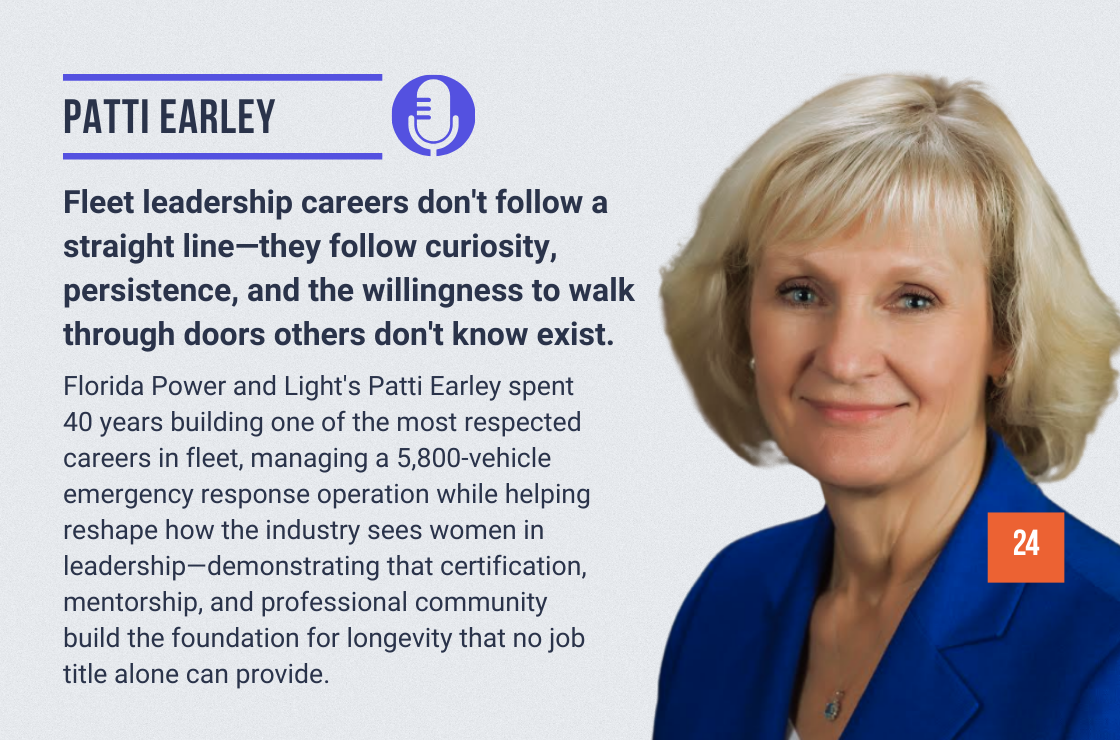
Patti Earley is Fleet Fuel Operations Manager at Florida Power & Light, where she oversees fuel operations and fleet management for one of the nation’s largest emergency response fleets. With over 40 years in the fleet industry, a past presidency of NAFA (National Association of Fleet Administrators), and the inaugural recipient of NAFA’s Tom Johnson Award for exceptional leadership and service, Patti brings both historical perspective and cutting-edge thinking to the challenges fleet leaders face today. She’s also a vocal advocate for women in fleet leadership and workforce development, actively mentoring the next generation through partnerships with technical schools and military transition programs.
Career Path: From University Fleet Manager to Industry Pioneer
Patti’s entry into fleet management wasn’t by design. It was by proximity. As a student at South Dakota State University working in the transportation department, she never left. What began as a college job evolved into a career: she became the fleet manager at SDSU, then deputy state director of Fleet and Travel Management for South Dakota, and eventually moved to Florida Power & Light in 2006, where she’s built a reputation as one of the industry’s most respected leaders.
“No one really sets out to get into fleet,” Patti laughs. “It’s kind of a running joke in NAFA that no one grows up wanting to be a fleet manager.” But those 40+ years of incremental growth, continuous learning, and willingness to adapt have positioned her at the forefront of an industry facing unprecedented technological disruption.
Her leadership at NAFA underscores her industry stature. Serving as president in 2019–2020 during the COVID pandemic tested her resilience and adaptability. But what’s perhaps more telling is that she was the fifth female president of an organization founded in 1957. Today, three of the last six NAFA presidents have been women, reflecting broader industry evolution Patti has witnessed firsthand.
The Scale of Modern Fleet Operations
At Florida Power & Light, Patti oversees fuel operations for approximately 3,800 on-road vehicles and nearly 5,800 pieces of equipment statewide. Her team includes 100 heavy-duty diesel technicians across 29 garages, all supporting critical operations and emergency restoration when hurricanes strike.
The fuel portfolio alone underscores the complexity of modern fleet management. Roughly 80% of FPL’s fuel consumption is diesel, driven by its heavy-duty fleet. Of that diesel, more than 70% is B20 biodiesel, a deliberate decision aligned with parent company NextEra Energy Resources, the world’s largest producer of wind and solar electricity.
Fuel, however, is only one component of a broader strategy. The fleet also includes hybrid, plug-in hybrid, and fully electric vehicles, reflecting a diversified approach designed to support the evolving energy landscape. Patti notes that the organization continually evaluates emerging technologies and new opportunities to ensure long-term operational resilience.
This is not a theoretical ambition. It is proactive positioning within an industry undergoing rapid technological transformation.
Emergency Response: Where Technology Meets Real-World Pressure
FPL’s fleet operates differently than most. When hurricanes strike Florida, the company mobilizes hundreds of vehicles for massive restoration efforts, staging equipment in areas where power is out, coordinating logistics across a devastated region, and working around the clock until electricity is restored to residents.
“When we have a hurricane, we do a massive restoration effort to get everyone’s power back on,” Patti describes. “Those are very stressful but also very rewarding times because you’re working very long hours, but we’re doing it to help people get their lives back in order.”
This operational reality creates unique constraints on technology adoption. Heavy-duty vehicles staged in areas without power must operate reliably. Electric vehicles with range limitations present challenges in emergency response scenarios. Infrastructure matters, not just charging infrastructure, but the underlying fuel and logistics systems that enable rapid deployment.
These real-world constraints inform how Patti approaches technological innovation. She’s not a technophobe chasing every shiny new tool. She’s a pragmatist evaluating which innovations genuinely improve operations in emergency conditions.
Technology Adoption: Early, but Selective
Patti describes herself as an early adopter, but with qualifications.
“Being an early adopter is a great thing to a point. You have to be picky and choosy about what you adopt. But if you can show me new technology or a better way to do something, bring it on. We will figure out how to incorporate it.”
This mindset separates effective leaders from those who chase every trend. Early adoption without selectivity leads to wasted resources and staff frustration. Selective early adoption accelerates learning and builds organizational capability.
The contemporary example is AI. Rather than resist or blindly embrace, FPL is experimenting methodically.
“We are embracing AI,” Patti explains. “We have a project going on right now company-wide called Rewire where we are looking for ways to bring AI into what we do every day and help us make our jobs more efficient.”
Resources mentioned in this episode
About Patti Earley
Patti Earley is Fleet Fuel Operations Manager at Florida Power & Light, responsible for fuel operations and maintenance coordination for approximately 3,800 on-road vehicles and 5,800 pieces of equipment across Florida. With more than 40 years in fleet management, she began her career at South Dakota State University, served as deputy state director of Fleet and Travel Management for South Dakota, and joined FPL in 2006.
A past president of NAFA (2019–2020), Patti was the inaugural recipient of NAFA’s Tom Johnson Award recognizing exceptional service and leadership. She is recognized as a champion for professional certification, workforce development, and women in fleet leadership.
Sponsor for this episode
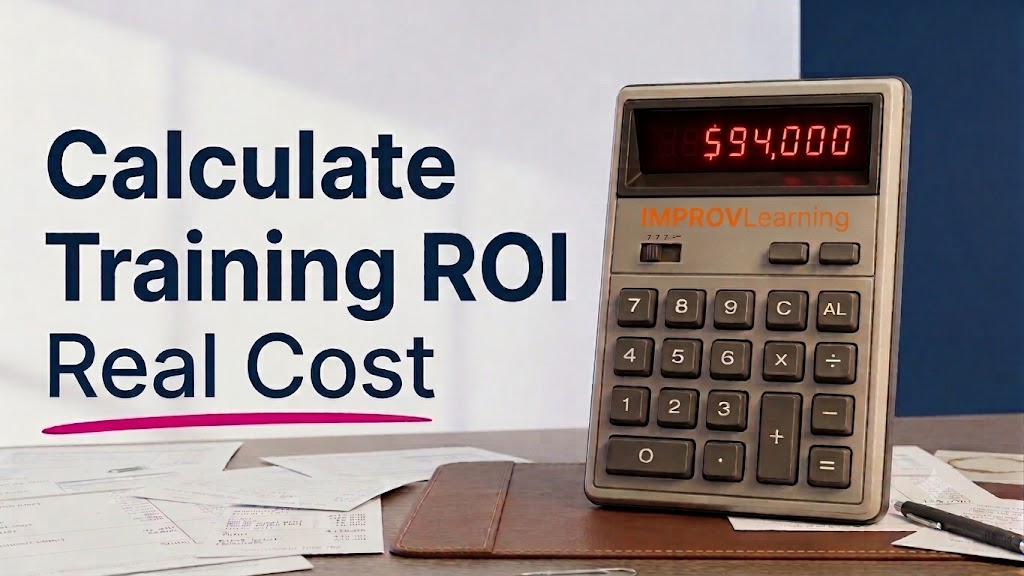
This episode is brought to you by IMPROVLearning.
As Patti demonstrates, technology transforms fleet operations, but only if drivers possess the skills to work safely within increasingly complex systems. AI may optimize routes and predict maintenance needs, but trained drivers operating those vehicles prevent incidents.
SPIDER™ Driver Training develops the cognitive skills that endure regardless of technology: hazard recognition patterns, space management principles, and split-second decision-making under pressure.
Technology shows you what happened. Training determines what happens next. Learn how IMPROVLearning helps fleet leaders prepare their workforce for whatever comes at improvlearning.com.
 Learner Login