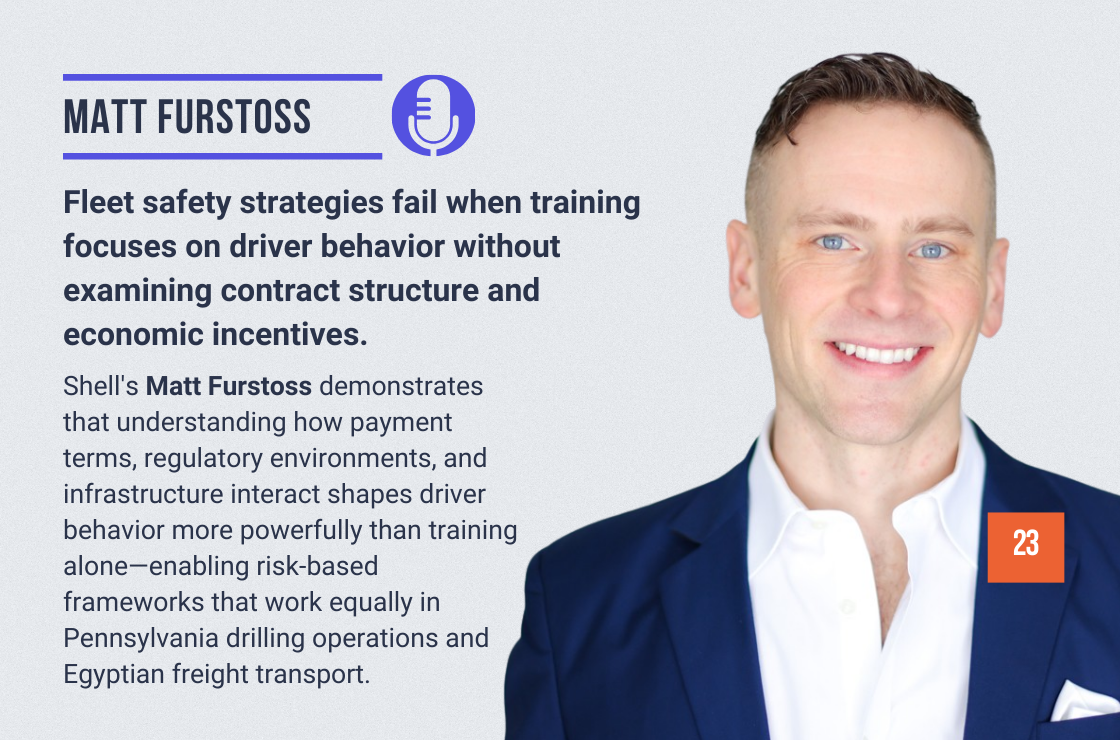
Matt Furstoss is a Certified Safety Professional (CSP) and Certified Risk Management Professional serving as Global Road Safety Advisor at Shell. With a background in brain and cognitive sciences combined with frontline field experience on drilling rigs, Matt brings both analytical rigor and human connection to managing transportation risk across Shell’s global operations. He develops safety frameworks, analyzes incident data from thousands of operations worldwide, and influences safety culture across diverse business units spanning from the Canadian tundra to the deserts of Oman.
Here’s a glimpse of what you’ll learn:
-
- [1:21] How a brain science degree led to safety leadership in the energy sector
- [4:39] Creating video hazard mapping that won best presentation at Shell’s Global Conference
- [6:03] What it means to be a global road safety advisor at a major energy company
- [8:35] Why contract structure affects driver behavior and safety outcomes
- [12:14] The compliance trap: moving from checklist mentality to risk-based thinking
- [14:34] Breaking down 1,000 incidents using driver, vehicle, and journey factors
- [20:08] Turning complex data analysis into three bullets that executives will act on
- [21:03] Building trust, maintaining networks, and establishing SME credibility
- [22:22] Using authentic connection and local imagery to make safety personal
- [25:22] Why staying at the edge of discomfort accelerates professional growth
In this episode…
Most safety professionals never analyze a thousand incidents by hand. Most never extract patterns from free-text fields written in dozens of countries. Most never develop frameworks that work equally well in North American drilling operations and international freight transport across drastically different regulatory environments.
Matt Furstoss does all three. He manually analyzed 1,000 collision incidents to extract data buried in free-text fields. He developed systematic categorization that works across drastically different geographies, regulations, and infrastructure quality. And he built risk-based frameworks that Shell now deploys globally—from North American drilling operations to Middle Eastern freight transport.
As Global Road Safety Advisor at Shell, Matt architected a systematic approach to turning unstructured incident narratives into actionable intelligence that tells leadership exactly where to invest safety resources. His method: Break every collision into three components—what the vehicle did, what it interacted with, and what factors contributed. Categorize contributing factors into driver, vehicle, and journey elements. Apply this formula to every incident. Extract patterns. Identify weak controls.
But the real insight is what Matt learned about influence in an organization where safety leaders have zero direct authority over business units. Where operations run 24/7 across cultures that approach risk differently. Where contract terms and incentive structures directly affect whether drivers prioritize speed over safety in remote locations.
The Unexpected Journey: From Cognitive Science to Drilling Rigs
Matt graduated in 2009 from the University of Rochester with a degree in brain and cognitive sciences, expecting to pursue academic research. Instead, the domestic shale boom created opportunity. He started working on drilling rigs in Northern Pennsylvania, managing massive truck traffic required for hydraulic fracturing operations—hundreds of trucks daily navigating farm roads and rural communities.
The routing challenge led to innovation. Matt mounted a GoPro on his truck, drove routes before contractors ever saw them, and created edited videos highlighting hazards and fast-forwarding through routine sections. “We dubbed that process video hazard mapping.”
He submitted it to Shell’s Global Wells Conference, presented in the Netherlands, and won best presentation. That innovation earned him an official Shell job offer in 2017.
What Global Road Safety Actually Means
When people hear “Global Road Safety Advisor,” they often picture someone reviewing incident reports and sending safety reminders. Matt’s role is fundamentally different—and far more influential.
Matt’s team functions as internal consultants developing frameworks and helping business units manage risk effectively across upstream, downstream, lubricants, and multiple service lines. His safety standards apply across operations spanning Canadian tundras, North American shale fields, Middle Eastern deserts, and Southeast Asian operations. He doesn’t supervise anyone. He has no budget authority. He can’t compel compliance. Yet his frameworks guide decisions that affect thousands of drivers and hundreds of millions of dollars in operations.
“We’re trying to move away from compliance in Shell. We want to manage the risk from a risk-based approach rather than just the strict check-the-box compliance perspective.” This distinction matters enormously. Compliance is about checking boxes and passing audits. Risk-based thinking is about understanding what could go wrong, why it could go wrong, and how to prevent it through smart system design.
Diversity creates constant challenge and growth—but also reveals how differently risk operates across geographies, regulations, and infrastructure quality. What works in one region doesn’t automatically work in another. What’s safe in developed infrastructure markets isn’t safe in emerging markets. Matt’s job is understanding these nuances deeply enough to develop frameworks flexible enough to be globally applicable yet specific enough to address local conditions.
Infrastructure, Contracts, and the Hidden Drivers of Risk
“Infrastructure varies dramatically across regions. In developed markets, we have excellent highways and strong regulation. But in emerging markets, vehicle conditions, infrastructure quality, and regulatory approaches differ significantly.” This simple observation points to something most safety leaders miss: risk isn’t just about driver behavior or vehicle condition. Risk is a function of the entire system—infrastructure, regulation, economics, and culture.
But infrastructure is only part of the equation. Contract structure fundamentally shapes driver behavior in ways that training alone can’t address.
“If you have a contract paid by the load, there’s incentive for drivers to drive fast or not sleep. In the US, hours of service regulation covers this. Elsewhere? Not necessarily.” This is the systems thinking that separates good safety leaders from great ones. If a contractor earns money per load delivered rather than per hour worked, they face economic pressure to drive longer hours and faster. No safety training can overcome that pressure. The system is literally incentivizing unsafe behavior.
Matt has seen this play out globally. In some regions, contract structures inadvertently create speed incentives. In others, payment terms encourage drivers to hide fatigue or skip maintenance. Understanding these hidden drivers of behavior is essential to designing effective safety interventions. Safety isn’t about training or technology alone—it’s understanding how economic incentives, regulatory environments, and infrastructure interact to create or prevent risk.
Turning Chaos Into Intelligence: The 1,000-Incident Analysis
Matt’s breakthrough project involved manually analyzing 1,000 collision incidents over two years. The problem: “Most important data on how crashes happened is stuck in free-text fields. Without extracting it, you can’t trend incidents or measure risk factors.”
Imagine 1,000 incident reports, each with a narrative description of what happened written by different people in different parts of the world, sometimes in English as a second language, sometimes translating from other languages. That free-text field contains the real information—what the driver saw, what they felt, what they did, what went wrong. But it’s completely unstructured. You can count how many crashes happened, but you can’t identify patterns. You can’t say “blind spots are our biggest problem” or “fatigue is the common factor.”
His team developed a systematic formula: To have a crash, you need the company vehicle (strike/struck by/rollover/lost load), it must interact with something else, and contributing factors fall into three buckets:
- Driver factors: Distraction, fatigue, training competency
- Vehicle factors: Blind spots, cameras, alarms, failures
- Journey factors: Third parties, weather, road conditions
“We read every free-text field and categorized everything. Then we analyzed which risk factors were most prevalent, which scenarios were most prevalent. That allowed us to say: when crashes happen this way, this is our weakest spot.” By the end of the two-year analysis, Matt’s team had identified specific incident patterns—particular combinations of driver/vehicle/journey factors that repeatedly led to collisions.
Result: “A systematic extraction into trendable format. Then we can identify which controls either aren’t in place or aren’t strong enough.” This is where the real value emerges. Instead of guessing where to invest safety resources, Shell could now say with data-driven confidence: “Here are our three biggest risk factors. Here’s how much each contributes to incidents. Here’s what control would address each one most effectively.”
This enables precise resource allocation: “Data-driven, efficient spending in safety versus just ‘we think it’s this, so let’s throw money at that.'” Matt has since developed an LLM that performs this analysis automatically, but the manual process was essential—both for understanding what matters and for training the organization to value this kind of systematic thinking.
The Three-Bullet Rule: Making Data Actionable
“You’ve got to take all that data and chunk it down to just the three bullets that the VP needs to hear.”
Three bullets. Not thirty. Not thirteen.
“Being a good storyteller, bringing your analysis down to very simple, communicable terms is very important.” This is where many safety professionals fail. They do brilliant analysis and then present 47 PowerPoint slides full of data. The executive’s eyes glaze over. Nothing changes. Matt’s discipline is ruthless: no matter how complex the analysis, it must distill down to three actionable findings.
This separates analysts from advisors. Analysis without influence is academic—interesting but useless. Influence without analysis is speculation—persuasive but unreliable. Effective safety leadership requires both: deep analytical work that leads to findings so clear and compelling that busy executives immediately understand what matters and why they should act on it.
Influence Without Authority
Matt operates in the classic challenge: safety leaders rarely have direct authority over business units, especially in global settings where decision-making authority is distributed across regions and business lines.
His approach centers on three elements: Trust—”Keeping up a strong network within the businesses you’re trying to influence.” SME credibility—”You’ve got to be on your A-game with what you know.” Personability—”Just being personable, smile, not scolding anybody.”
Trust doesn’t build overnight. It comes from showing up, following through, delivering value, and treating people with respect over time. SME credibility means knowing your subject matter deeply enough that when you speak, business leaders listen. Personability means being approachable, not intimidating—being someone people want to work with rather than someone who makes them defensive.
But deeper still: making safety personal. “Using names and photos of people within businesses in your material—having actual images of people who work at their facility in presentations—it really drives it home that this is us.” Abstract statistics about incidents don’t move people. But a photo of someone’s face with actual context—showing a real person, their role, their circumstances—does move people. It makes the incident analysis human and memorable.
An old leader shared a metaphor that stuck: “The business is the elephant and you’re standing in its path. If you just push against it, you get trampled. But if you’re on the other side poking and nudging, you get it to go the direction you want.”
Don’t stand in front of the elephant. Walk beside it.
Professional Growth Through Discomfort
Matt’s first day at Shell is a parable in how to build competence fast: two days after Christmas, major snowstorm, middle of the Appalachian Forest, miles from civilization, assigned to learn drilling operations from scratch.
“I grew so much, so fast because of that. Way outside my comfort zone. But staying out of your comfort zone is how you grow.” This isn’t motivational platitude—it’s neuroscience. Learning happens in the zone of proximal development, where challenges exceed current capability just enough to push growth. If you’re too comfortable, you’re not growing. If you’re too overwhelmed, you shut down. Matt found the edge.
His most effective strategy on the rigs: “Sitting in the doghouse with the driller, asking ‘What is this? How does this work?’ And getting to know their families too, not just work.” He didn’t arrive with answers. He arrived with genuine curiosity and respect. He asked questions. He listened. He got to know people as people, not just as sources of information.
Result: Trust. Learning. Genuine coaching relationships. When you’ve sat in the doghouse at 3 AM listening to someone talk about their family while the rig rumbles around you, you’ve earned credibility. When you’ve asked honest questions and admitted what you don’t know, people respect you. When you care about them as people, they listen when you later suggest safer ways to work.
“People at the center of everything and then pushing your discomfort.” This is Matt’s formula for growth and influence: care about people genuinely, and stay uncomfortable enough to keep learning.
Quotable Moments:
- “How people behave is a key piece to safety.”
- “If you have a contract paid by the load, there’s incentive for drivers to drive fast or not sleep.”
- “We’re trying to move away from compliance. We want to manage risk from a risk-based approach rather than check-the-box compliance.”
- “Most important data is stuck in the free-text field.”
- “Data-driven, efficient spending in safety versus just ‘we think it’s this, so let’s throw money at that.'”
- “You’ve got to chunk it down to just the three bullets that the VP needs to hear.”
- “The business is the elephant and you’re standing in its path. If you push, you get trampled.”
- “Always stay on the edge of discomfort. That’s how you grow.”
- “You can’t lose sight of people in safety work.”
- “People at the center of everything and then pushing your discomfort.”
Action Steps:
- Standardize incident reporting systems. Centralized platforms with consistent fields across all business units enable meaningful data analysis instead of data chaos.
- Break incidents into formulas. Systematically categorize: what happened (collision action), what was involved (object struck), contributing factors (driver/vehicle/journey).
- Manually analyze a sample set. Review 100-200 incidents by hand before automating—this teaches you what matters and trains your analysis framework.
- Create three-bullet summaries. No matter how complex the analysis, distill findings into three actionable bullets that busy executives can immediately understand and act on.
- Use local imagery in presentations. Include photos and names of actual people from target facilities—this makes recommendations personal and memorable, not theoretical.
- Build cross-functional networks. Cultivate relationships with operations leaders before you need to influence them—trust takes time to establish.
- Move from compliance to risk-based thinking. Help teams understand the “why” behind procedures, not just enforce checklists. Build flexibility for local adaptation.
- Examine contract structures. Review how payment terms, incentive systems, and regulatory requirements might inadvertently incentivize unsafe behaviors.
- Get hands dirty in operations. Spend time in the field learning how work actually happens—you can’t advise on what you don’t genuinely understand.
- Stay at the edge of discomfort. Actively seek roles and projects that push your capabilities—growth happens outside comfort zones.
Key Takeaways
✓ Contract structures, infrastructure, and regulation interact to shape driver behavior more powerfully than training alone
✓ Moving from compliance-based to risk-based thinking enables adaptation and continuous improvement across diverse operations
✓ Standardized incident reporting systems across business units make meaningful data analysis and pattern identification possible
✓ Systematic incident categorization (driver/vehicle/journey factors) reveals weak controls and guides precise resource allocation
✓ Complex analysis must distill into three-bullet summaries that enable busy executives to understand and act immediately
✓ Safety leaders without direct authority influence through trust networks, subject matter expertise, and authentic relationships
✓ Making safety personal with local imagery, names, and genuine human connection drives engagement more than abstract statistics
✓ Professional growth accelerates when operating consistently at the edge of discomfort with genuinely challenging work
✓ Field experience and hands-on understanding cannot be replaced by AI, digital resources, or theoretical knowledge
✓ People must remain at the center of all safety work—technical excellence without genuine human connection ultimately fails
Conclusion
Matt Furstoss demonstrates that effective safety leadership requires both analytical rigor and genuine human connection. His systematic approach to incident analysis—manually analyzing 1,000 collisions to extract hidden patterns, breaking them into trendable data, identifying weak controls, and presenting findings in three-bullet summaries—shows how to turn information chaos into actionable intelligence. His emphasis on building trust through authentic relationships, staying uncomfortable in pursuit of growth, and keeping people at the center of every decision reveals the human skills that make technical expertise truly effective at scale.
The lesson for fleet and safety leaders operating across cultures, business units, and regulatory environments: You can’t stand in front of the elephant and push. You have to walk beside it, building relationships, demonstrating expertise, learning from experience, and making safety personal rather than procedural. For leaders working to move beyond compliance checklists toward risk-based thinking, to extract meaningful patterns from unstructured data, and to influence without direct authority—Matt’s methodology provides both the analytical framework and the interpersonal approach required for measurable, lasting impact.
Resources mentioned in this episode:
About Matt Furstoss
Matt Furstoss, CSP, CRMP is Global Road Safety Advisor at Shell, leading safety framework development and incident analysis across worldwide transportation operations. With a background in brain and cognitive sciences plus frontline field experience on drilling rigs and well sites, Matt brings both analytical depth and practical operations knowledge to his role. He began his career in 2009 in Northern Pennsylvania, developed innovative video hazard mapping processes that won best presentation at Shell’s Global Wells Conference, and transitioned to global road safety in 2017. His expertise includes systematic incident data analysis, safety culture development across international operations, risk-based framework implementation, and translating complex data into actionable executive guidance. Matt holds CSP and CRMP certifications and earned his degree from the University of Rochester in Brain and Cognitive Sciences and Artificial Intelligence. He is known for his people-first approach to safety leadership, his ability to influence without direct authority, and his commitment to professional growth through sustained challenge and discomfort.
Sponsor for this episode:
This episode is brought to you by IMPROVLearning.
At IMPROVLearning, we understand that data reveals where safety problems exist—but only trained drivers can prevent them. Matt Furstoss’s work at Shell demonstrates the power of systematic incident analysis to identify weak controls and guide resource allocation. But once you know what behaviors need to change, the next challenge is how to change them.
That’s where SPIDER™ Driver Training makes the difference. Our research-backed training develops the cognitive skills that prevent the driver factors Matt’s analysis identifies: scanning patterns that detect hazards earlier, space management that provides escape routes, and decision-making processes that operate effectively under pressure.
Technology shows you what happened. Training determines what happens next. To learn more about how IMPROVLearning complements your data analysis and safety frameworks with proven behavior change methodology, visit improvlearning.com.
 Learner Login