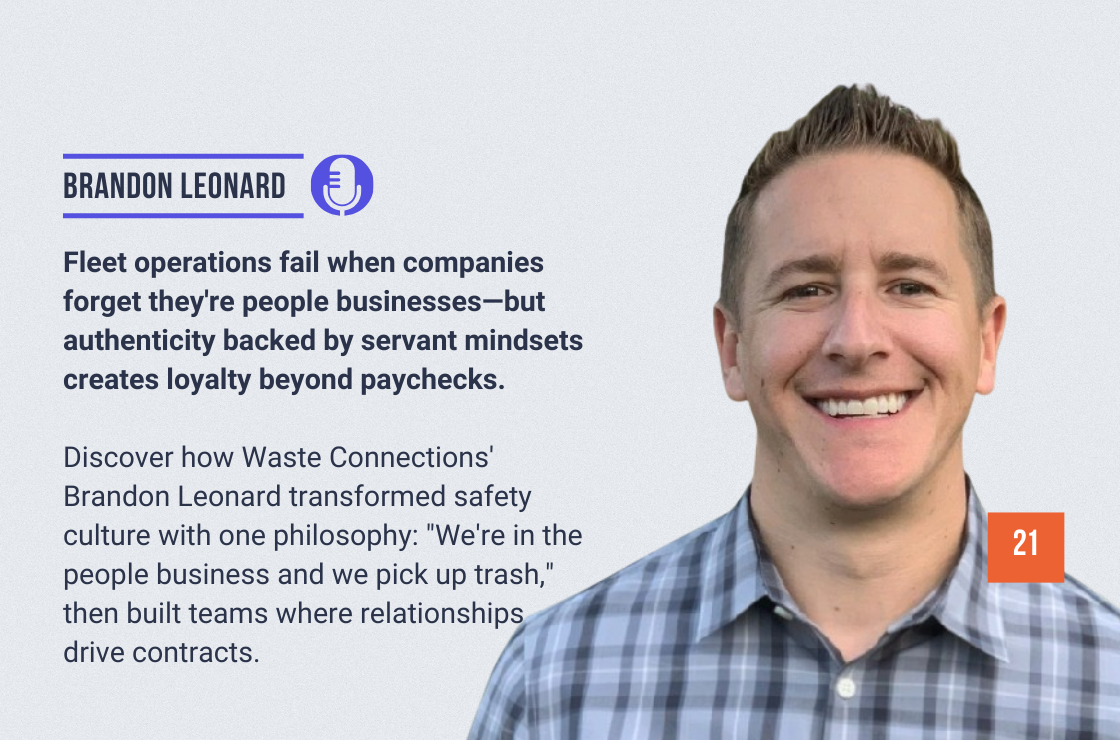
Brandon Leonard is the Region Safety Manager at Waste Connections, one of North America’s leading waste and recycling service providers. With a career spanning over two decades—from washing trucks at 17 to becoming a director of operations before transitioning to safety leadership—Brandon brings a frontline, operations-first perspective to fleet safety. In his current role, he leads safety strategy across a complex operating environment where drivers navigate residential streets, tight alleys, heavy equipment, and constant public interaction starting as early as 3 AM. Brandon’s approach centers on servant leadership, hiring the right people, and building safety cultures where employees feel empowered to make the right decisions. His philosophy is simple but profound: “We’re in the people business and we pick up trash.”
Brandon Leonard is Region Safety Manager at Waste Connections with over 20 years of fleet experience. He leads safety strategy across waste and recycling operations, emphasizing servant leadership, people-first culture, and empowering frontline employees to make safe decisions in complex operating environments.
Here’s a glimpse of what you’ll learn:
- [1:11] How washing trucks at 17 led to a safety leadership career
- [4:45] What a day in the life of a waste collection driver actually looks like
- [7:46] Unique safety challenges in waste management operations
- [10:39] Balancing safety, performance, and service reliability
- [14:16] Interview questions that reveal safety mindset
- [17:48] Why onboarding never stops at day 15
- [22:07] Using DriveCam to coach behavior, not punish outcomes
- [28:35] Managing change without overcomplicating safety programs
- [32:44] The one thing every safety leader must genuinely do
In this episode…
Waste collection drivers start their routes between midnight and 6 AM. They navigate blind spots, hydraulic systems, and residential streets where impatient drivers create daily risks. They shake containers at 3 AM to make sure no one is sleeping inside. They build relationships with customers who see them multiple times every month. And they do all of this in rain, snow, sleet, heat, and cold.
This isn’t typical fleet operations. This is waste management—and it demands a different approach to safety.
According to Brandon Leonard, the key isn’t compliance checklists or disciplinary hammers. It’s culture. It’s hiring people who genuinely care. It’s leaders who serve their teams instead of just managing them. It’s technology that coaches drivers to prevent incidents, not just react to them.
After transitioning from operations to safety leadership 6½ years ago, Brandon discovered something critical: Safety managers don’t drive results directly. The district managers, supervisors, and frontline leaders do. Brandon’s job is to influence them, equip them, and ensure they have every resource needed to keep their teams safe.
His insight: Strong safety practices are what make consistent service possible. Reliability comes from drivers who feel empowered to make the right decisions—including the decision to say “I’m not comfortable servicing that stop.”
In this Roadrageous episode, Brandon reveals how Waste Connections builds safety cultures that scale, why “be safe but hurry up” creates pressure that leads to incidents, and what happens when you genuinely care about people in an industry that never stops moving.
Quotable Moments:
- “We’re in the people business and we pick up trash. That’s what we do. But who we are is we’re in the people business.”
- “If there’s not a driver that reports directly to you, how do you affect change? Those are the ones you gotta influence.”
- “We expect high performance, but never at the expense of safety. Never at the expense of safety.”
- “Telling people to be safe, but to hurry up doesn’t work. You know, we have found that out time and time again.”
- “We want to coach to prevent, not coach to react. And that’s taking care of your employees.”
- “If you don’t care about people, you shouldn’t be in leadership. I’m convinced on that.”
- “Safety is more than compliance. You have to genuinely care about people. And that always won’t be popular.”
- “Everybody wants to do great work. They’re not doing it wrong because they want to do it wrong.”
Action Steps:
- Ask deep-diving interview questions. Don’t accept yes/no answers. Ask “What does safety mean to you?” and “Give me a time when you were unsafe and how you corrected it.”
- Extend onboarding beyond day 15. Treat onboarding as 90 days minimum, continuously checking in to see how new employees are adapting and what they need.
- Train leaders on servant leadership. Don’t just train drivers—teach supervisors and managers how to get to know their people, serve them, and build trust.
- Build workflows around technology. Use DriveCam and telematics to coach behavior proactively, not just react to incidents with discipline.
- Defend drivers when AI gets it wrong. Review every alert and remove false positives—this builds trust in the system.
- Empower drivers to refuse unsafe stops. Make it clear that saying “I’m not comfortable” is not just allowed—it’s expected.
- Start change management with “why.” Explain the reason behind policy changes instead of just announcing new rules.
- Keep safety programs simple. Overcomplicated processes confuse everyone—simplicity scales better.
- Build teams that challenge the status quo. If people don’t feel comfortable disagreeing with you, you’re failing as a leader.
- Measure what matters, but never at the expense of people. Productivity and KPIs matter, but “be safe and hurry up” creates dangerous pressure.
The Hidden Complexity of Waste Collection
When people think about waste collection, they picture a simple pickup. The reality is far more complex.
Drivers start between midnight and 6 AM, conducting pre-trip inspections and attending tailgate meetings where supervisors deliver safety messages tailored to daily conditions—ice, school zones, construction areas.
Then they operate trucks with hydraulics, manage extreme blind spots, navigate tight alleys, and deal with an impatient public. On the commercial side, they face a challenge most fleets never encounter: people sleeping in dumpsters.
“Containers can sometimes be used as shelter,” Brandon explains. “We’re servicing it at 3 AM. We train to shake it just to make sure somebody’s not in there. You may or may not be surprised—there’s a lot of time there’s people sleeping in there. That’s scary for the person and our drivers.”
Beyond safety concerns, the job is intensely physical. Automation helps, but drivers still work in all weather conditions, getting out to move containers in rain, snow, sleet, extreme heat, and cold.
And they’re doing something else critical: building customer relationships.
“A lot of times they’re the reason we get to re-sign contracts,” Brandon says. “They’re not only picking up the trash—they’re also getting contracts by just great service and great humanity.”
The “Be Safe But Hurry Up” Problem
Every fleet struggles with the tension between safety and productivity. Brandon confronts it head-on.
“Productivity matters. Numbers matter. KPIs matter,” he acknowledges. “But telling people to be safe, but to hurry up doesn’t work. We have found that out time and time again.”
The message creates cognitive dissonance and generates pressure where judgment lapses happen.
But Brandon also challenges the inverse: “Slow doesn’t automatically mean safer. If you’re going 35 on a 75-mile-an-hour highway, that’s not safe.”
The solution isn’t speed or slowness—it’s empowerment.
“We expect high performance, but never at the expense of safety. Reliability comes from drivers who feel empowered to make the right decisions all the time.”
That empowerment means drivers can refuse unsafe stops: “I’m not comfortable servicing that. Maybe we figure out another way.”
This works because drivers see conditions supervisors don’t. Construction changes traffic patterns. New buildings create visibility issues. What was safe last year might not be safe today.
“Every operator moves at different rates. What is safe to them is different than what’s safe to somebody else. In order to know how you drive your team, you have to know each person individually.”
This is where servant leadership comes in—a concept Brandon returns to repeatedly: “You serve your people, and they serve you back. Everybody serves each other. It creates a great work environment.”
Hiring for Safety: The Questions That Matter
Most safety failures don’t start on the road. They start in the interview.
“Don’t just hire butts in seats,” Brandon warns. “When you’re down three or four drivers, it’s easy to make those decisions. But usually you’re just in that vicious cycle for six months to a year.”
Here’s what doesn’t work: “Is safety a value to you?” → Expected answer: “Yes” → Information gained: None
Here’s what works:
- “What does safety mean to you?”
- “Give me a time when you were unsafe, how that made you feel, and how you corrected it.”
- “Have you seen coworkers do something unsafe, and how did you respond?”
“You’re asking questions and getting to know who they are,” Brandon explains. “They’re authentically answering because they don’t expect those.”
But the interview isn’t about finding perfect candidates: “If you’re a great leader, you can develop them any way you need to—as long as they have the humility and you do as well to learn from one another.”
The key hiring criterion isn’t experience. It’s genuine care about safety and others.
Onboarding That Never Ends
Waste Connections has a 15-day onboarding program with 23 modules. But Brandon’s philosophy goes deeper: Onboarding doesn’t stop at day 15.
“You have to continuously talk to this employee to see how they’re doing. Onboarding is 90 days, six months—it could be whatever it is. There shouldn’t be a set date.”
Instead of cramming modules, drivers complete two per day—a pace designed for retention, not just completion.
“If you throw a whole bunch of knowledge at them, they just started. They’re nervous anyways. They’re never going to retain any of that information.”
The program prioritizes culture over tactics:
First: Who we are as a company, our culture, our values
Then: How to drive a truck, use equipment, follow procedures
“We want to get their buy-in, get their family’s buy-in to who they are working for.”
This inverts the typical approach. Most companies teach job tasks first and hope culture follows. Waste Connections teaches culture first and integrates tasks into that framework.
DriveCam: Exoneration Over Discipline
Every truck has onboard cameras. But Brandon’s approach separates average programs from exceptional ones.
“DriveCam is one of our number one tools. But we want to coach to prevent, not coach to react.”
The technology includes AI-based triggers that alert drivers in real-time: distraction, drowsiness, following distance, risky situations.
But here’s the difference: They view cameras as exoneration tools first, coaching tools second, and disciplinary tools last.
“It exonerates our employees a lot more than it hurts them. When it can show everything they’re doing right—because they do so much right—it helps them get confidence in the system.”
Brandon sees proof in driver behavior:
“A lot of times our drivers will come in and say, ‘Hey, heads up. This is what I did. You may not have seen it yet on camera. Let’s talk about it.’ Or they hit the button and say, ‘Look at this incident I avoided by being alert and aware.'”
That’s not fear. That’s trust.
Brandon compares professional drivers to professional athletes: “Football players are viewing their game film a ton, looking at what they’re doing wrong or right. Now we have that for drivers so they can learn from it.”
But this only works if leaders coach rather than just discipline.
“If you use this as a disciplinary tool and don’t put the time and energy to make them better—doing ride-alongs, taking them to lunch, getting to know them—you’re failing them.”
When AI Gets It Wrong
Technology isn’t perfect. Brandon’s response: Defend your drivers.
“You can’t allow AI to coach your employees. AI is not right 100% of the time. It’s your job to defend your employees and say, ‘This guy’s doing everything right. We need to remove this.'”
This builds invaluable respect and trust.
Brandon also warns against soft coaching: “‘I don’t agree with how they scored this event, but I still got to coach you on it.’ That takes everything away from what you’re trying to deliver when it comes to culture.”
Either the behavior was unsafe and needs correction, or it wasn’t and should be removed. Half-hearted coaching destroys credibility.
Training Leaders, Not Just Drivers
Most fleet safety programs focus exclusively on drivers. Waste Connections invests heavily in leadership development.
“It’s not just drivers you’re training. It’s district managers, division vice presidents. Training never stops for any of us.”
But the training isn’t about safety procedures—it’s about serving people.
“We bring people to corporate for specific trainings—not how to be safer, how to get to know your people better. How do you serve your people that then will follow you to be safer?”
This reflects Brandon’s core belief: Safety is the standard. Leaders must go above that.
“We can’t just be content with saying, ‘We’re safe.’ You’ve got to continue serving your people to make sure they have everything they need—whether it’s questions, gloves, or steel toe boots.”
The measure of success: “When they feel comfortable telling you what they need, everything works out.”
Change Management: Start With Why
Brandon’s approach to change management comes down to three principles:
1. Start with Why
“People need to understand why you’re doing something—not just because it’s a policy. People are far more willing to embrace change when they understand the reason behind it.”
2. Get Input (Even If You Can’t Change the Outcome)
“If you get people’s input, at least they had a word in it. Doesn’t mean you have to do what they said, but you have to listen.”
3. Keep It Simple
“Simple scales a lot better every time. There are so many times I look at other people’s safety processes—it gets so complicated. There’s a reason why safety is struggling when things are overcomplicated.”
Brandon also challenges a common impulse: Don’t change just to change.
“If the old regiment’s working, why are you changing it? If it’s not simpler and making the employee’s jobs easier, it’s not worth doing.”
Most importantly: Build teams that can challenge you.
“If people don’t feel comfortable saying, ‘I don’t think this will work,’ then I’m failing as a leader. I have to listen to them.”
Advice for Aspiring Safety Leaders
Brandon’s counsel for those new to fleet safety:
1. Safety Is More Than Compliance
“You have to genuinely care about people. Wear your heart on your sleeve. When people know you care, that’ll drive influence in anything you do.”
2. Humility Matters More Than Credentials
“Certifications and degrees help. But don’t ever replace humility, curiosity, and the ability just to listen.”
3. Expect Emotional Difficulty
“This job gets hard. When you’re getting reports of incidents or fatalities—those are the worst things. When you care about people, those get hard.”
4. Care or Leave
“If you’re going to be just a metric-driven person on spreadsheets, I’m not sure you’re going to have a long career in safety. You got to care about people. That’s the number one thing.”
Brandon’s ultimate summary: “Safety is a people business.”
Key Takeaways
✓ Ask deep-diving interview questions that reveal authentic safety mindset—not yes/no answers
✓ Extend onboarding beyond day 15—treat it as 90+ days of continuous check-ins
✓ Balance productivity and safety by empowering drivers to refuse unsafe stops
✓ Use DriveCam to exonerate and coach proactively—not just discipline reactively
✓ Defend drivers when AI alerts are wrong—this builds trust in technology
✓ Train leaders on servant leadership and getting to know their people
✓ Start change management by explaining “why”—not just announcing new policies
✓ Keep safety programs simple—complexity creates confusion and resistance
✓ Build teams where people feel comfortable challenging your decisions
✓ Care genuinely about people—metrics matter, but people come first always
Conclusion
Brandon Leonard’s 6½ years in safety leadership—built on a foundation of 20+ years in operations—offers a masterclass in building safety cultures that actually work.
His approach isn’t about checklists, compliance audits, or disciplinary hammers. It’s about hiring people who care, training leaders to serve, empowering frontline employees to make safe decisions, and using technology to prevent incidents rather than just document them.
Most importantly, he demonstrates that the most effective safety programs aren’t built on fear or enforcement. They’re built on relationships, trust, and a genuine commitment to putting people first.
“We’re in the people business and we pick up trash,” Brandon reminds us. “But who we are is we’re in the people business.”
For fleet leaders committed to building safety cultures that scale—cultures where drivers come to you when they make mistakes, where employees feel empowered to refuse unsafe work, and where technology enhances coaching instead of replacing it—Brandon’s methodology provides both inspiration and practical framework.
Resources mentioned in this episode:
About Brandon Leonard
Brandon Leonard is the Region Safety Manager at Waste Connections, where he leads safety strategy across complex waste and recycling operations spanning residential, commercial, landfill, and material recovery facilities. With over 20 years of experience in transportation and logistics—including roles at UPS and as director of operations at an over-the-road trucking company—Brandon brings a unique operations-first perspective to safety leadership.
His career began at 17, washing trucks and working his way through dispatch, fleet management, and operational leadership before transitioning to safety six years ago. Brandon’s approach centers on servant leadership, hiring people who genuinely care about safety, and building cultures where frontline employees feel empowered to make the right decisions. Under his leadership, Waste Connections has implemented comprehensive DriveCam programs, AI-based behavior coaching, and extended onboarding processes that prioritize culture over compliance.
Brandon is known for his people-first philosophy, captured in his statement: “We’re in the people business and we pick up trash.” He believes that if leaders don’t genuinely care about people, they shouldn’t be in leadership—a conviction that drives his approach to training, technology adoption, and change management across the organization.
Sponsor for this episode:
This episode is brought to you by IMPROVLearning.
At IMPROVLearning, we’re dedicated to transforming driver education through innovative, research-backed training methods. Our SPIDER™ Driver Training platform combines humor with proven brain-training techniques to help drivers anticipate and avoid dangers on the road.
Technology like DriveCam and AI-based alerts provides incredible visibility into driver behavior. But technology alone doesn’t change outcomes—trained drivers do.
SPIDER training develops the cognitive skills that complement your fleet technology investments: hazard recognition, space management, and split-second decision making under pressure.
To learn more about how IMPROVLearning complements your coaching strategy and technology investments, visit improvlearning.com.
 Learner Login