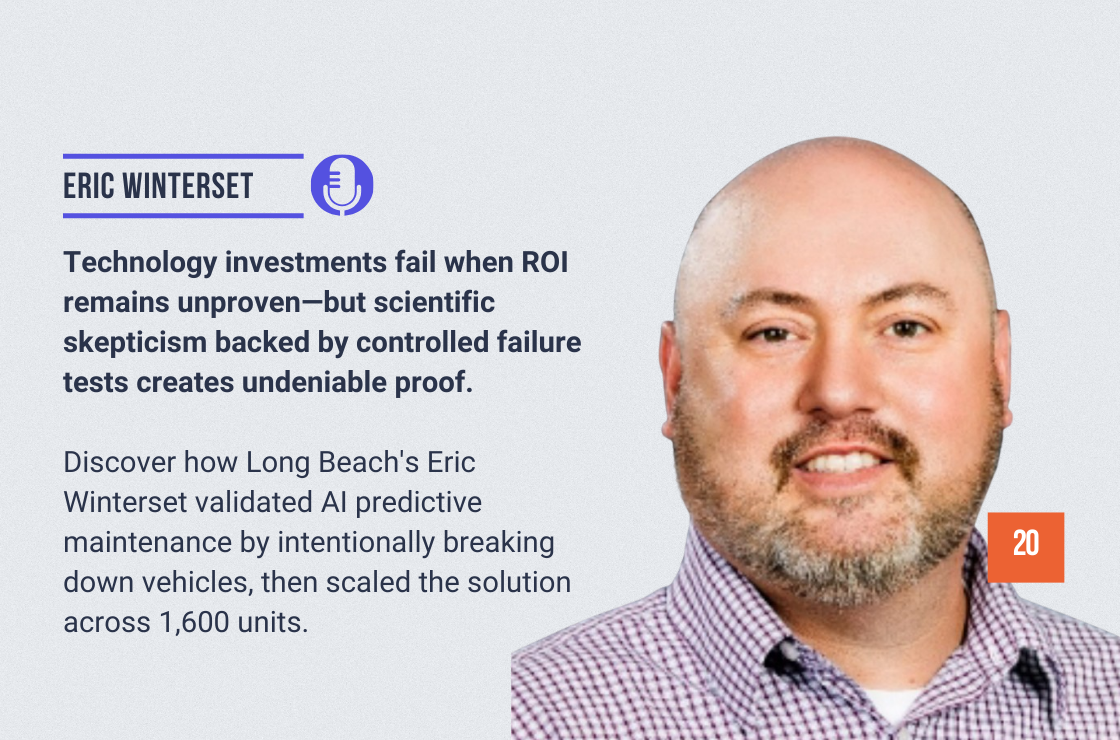
Eric Winterset is the Fleet Services Bureau Manager for the City of Long Beach, overseeing one of the most progressive government fleets in the country. With nearly 30 years of fleet experience spanning private sector operations at Ryder Transportation, transit systems, and now municipal government, Eric leads a comprehensive fleet operation managing 1,600 rolling stock units across diverse applications—from refuse trucks navigating century-old alleys to helicopters, boats, and zero-emission vehicles. Under his leadership, Long Beach has become an early adopter of AI-powered predictive maintenance, automated tire monitoring systems, and innovative EV infrastructure solutions, while maintaining one of only three municipal towing and lien sale operations in the United States.
Eric Winterset is the Fleet Services Bureau Manager for the City of Long Beach with nearly 30 years of fleet experience. He leads one of the most progressive government fleets in the country, overseeing 1,600 vehicles while pioneering AI-powered predictive maintenance and zero-emission technology adoption.
Here’s a glimpse of what you’ll learn:
- [1:11] How equipment repair led to a 30-year fleet career
- [3:51] Why Long Beach refuse drivers face unique challenges
- [11:39] The AI predictive maintenance revolution happening now
- [14:40] How tire monitoring posts will eliminate surprise breakdowns
- [16:23] Real sustainability strategies beyond buying EVs
- [19:03] Why EV manufacturers are pausing production—and what it means
- [23:33] The hidden training challenge nobody talks about
- [28:07] What private sector managers need to know about public fleets
In this episode…
Municipal fleets operate under a microscope. Every dollar spent is taxpayer money. Every decision faces scrutiny. Every vehicle supports critical public services.
So how do you modernize a 1,600-vehicle operation serving police, fire, refuse, helicopters, boats, and beach maintenance—while navigating alleys built in the 1800s?
According to Eric Winterset, it starts with technology. But not just any technology—the kind that prevents breakdowns before they happen.
After nearly three decades in fleet management, Eric has seen the industry transform. From his early days as a wrench at his father’s equipment repair shop to supervisor at Ryder Transportation at age 27, to now leading one of the most innovative municipal fleets in the nation, he’s witnessed what works when you’re balancing safety, sustainability, reliability, and innovation at massive scale.
His insight: The future of fleet management isn’t about collecting more data—it’s about deploying intelligent systems that act on data before problems cascade into costly failures.
In this Roadrageous episode, Eric reveals how Long Beach is pioneering predictive AI, automated tire monitoring, and flexible EV infrastructure while managing operations that never stop.
Quotable Moments:
- “It’s the daily fires or daily challenges that kind of keep your blood moving throughout the day.”
- “I actually let stuff break down ’cause I wanted to prove the theory. And then boom, like three, five days later, it called it exactly.”
- “Eventually what’s going to happen is it’ll predict the repair, look into your system to see if you have the part, and reach out to the vendor to order the part for you. We call it the Holy Grail.”
- “The industry has kind of changed like a lot in the last couple of months. We were talking today about the Ford F-150 Lightning just got canceled until 2027.”
- “When I got to the public sector, the first thing that I wish I would have known is patience.”
- “We’re going through that evolution now where you’re seeing all these companies, some drop off, some bought—survival of the fittest.”
- “I never had that. I didn’t think the government actually thought about that stuff. Once I got into this operation, it was more run like a business than I actually thought.”
Action Steps:
- Pilot AI predictive maintenance with a test fleet. Start with 50-100 vehicles to prove the concept before full deployment.
- Document baseline metrics before implementing new technology. Track current downtime, availability rates, and roadside failures.
- Build processes around telematics and AI alerts. Technology is worthless without coaching protocols and follow-up actions.
- Test tire monitoring systems at entry/exit points. Automate tread depth measurement to schedule replacements proactively.
- Start EV infrastructure with flexible solutions. Use solar chargers and propane-powered trailers before permanent installation.
- Pilot EVs extensively before fleet-wide adoption. Rotate vehicles through departments to build buy-in and identify duty cycle fit.
- Develop vehicle-specific training programs. Separate light duty, medium duty, and specialized equipment training tracks.
- Create transparent reporting on lifecycle costs. Show how technology investments reduce total cost of ownership.
- Build relationships with innovative vendors. Early adopter partnerships provide access to emerging solutions.
- Stay flexible on timelines. Government procurement takes longer—build buffer time into every project.
The Alley Problem Nobody Talks About
When you think about municipal fleet challenges, narrow alleys probably don’t top the list. But in Long Beach, they define daily operations.
“Some of these alleys were built in the 1800s,” Eric explains. “These bigger vehicles have to squeeze down the back of these alleys and maneuver around poles and trees. Some of these alleys, I probably wouldn’t even take my own vehicle down.”
Refuse drivers navigate obstacles that would make most commercial drivers quit: moving trash cans to create clearance, backing out when utility poles block through-passage, coordinating with utility companies about wire heights.
“It’s like going through a maze every single day,” Eric says.
This isn’t just about skilled driving—it’s about vehicle selection, route planning, technology adoption, and driver appreciation. Long Beach is testing smaller trucks for the tightest corridors, but for years, drivers have managed these challenges with nothing but experience and determination.
The lesson: Behind every routine pickup is expertise most people never see.
The AI Revolution: Predictive Maintenance That Actually Works
Four years ago, Eric partnered with Pitstop to pilot AI-powered predictive maintenance on a subset of vehicles. The concept: algorithms analyze diagnostic trouble code sequences to predict failures before they happen.
“If code one, two and three were sequenced together, it could tell you in 3 to 5 days your turbo is going to fail or an O2 sensor is going to go bad,” Eric explains.
The skeptic in Eric needed proof. So he let vehicles break down to test the predictions.
“I’d get the emails and I’d be like, I’m not gonna say anything. And then boom, like three, five days later—it was specifically a street sweeper—it broke down and it called it exactly in the range it was going to break down and what exactly the repair was.”
That was the turning point. Eighteen months ago, Long Beach integrated AI across all 1,600 rolling stock units.
The impact: Fleet availability jumped from 90% to 93%.
But Eric sees even bigger possibilities ahead: “Eventually what’s going to happen is it’ll predict the repair, look into your system to see if you have the part, then reach out to the vendor to order the part for you. The part will come in before you even know you need that store. We call it the Holy Grail.”
Tire Monitoring: The Next Breakthrough
AI predictive maintenance covers engine diagnostics. But one critical wear item remains mostly manual: tire tread depth.
Eric is now piloting automated tire monitoring posts at facility entry points.
“They can read the tread depth, and then it could plan for a replacement,” he explains. “Let’s say tread depth is at six and we change at four. In a month, we need to schedule that unit in, make sure we have the tires in stock. Then it doesn’t become an out-of-service truck the morning of because someone realizes this thing has no tread.”
Tire pressure monitoring already integrates through ECMs. But tread depth requires visual measurement—until now.
This seemingly small innovation has massive implications: fewer roadside failures, extended tire life, improved safety for operators and the public, and elimination of surprise downtime.
The EV Infrastructure Challenge
Eric faces a problem shared by fleet managers nationwide: EV mandates are moving faster than infrastructure buildout.
“Building infrastructure out is a huge challenge. The utilities are way behind. Takes two, three, five years to build out. Obviously, funding is a big issue because they’re not cheap.”
Long Beach’s solution: flexible, temporary charging systems that bridge the gap.
Solar chargers move between locations until permanent infrastructure arrives. Renewable propane EV trailers provide Level 3 charging for heavy-duty applications like EV dump trucks. Charge pods wire into existing panels where power capacity allows.
“When it does get built out, we can use that in another site. Or eventually what it’ll end up being is emergency power,” Eric explains.
But here’s the twist: Even as Long Beach builds infrastructure, vehicle availability is shifting.
“The Ford F-150 Lightning just got canceled until 2027 and the VW Buzz just got canceled yesterday for a year,” Eric notes. “From our standpoint, we have to sit back and go, are we going to have options to buy these EVs for some of these operations?”
Long Beach has ordered 75 Ford Lightnings and 17 BrightDrop vans—both now paused or canceled. The medium-duty range remains particularly challenging, with limited options that fit municipal duty cycles.
The Vehicle Selection Dilemma
Finding the right EV equivalent for traditional fleet workhorses creates unexpected challenges—not just technical, but cultural.
“The biggest challenge is equivalent to an F-250. There’s no F-250 or F-350 equivalent. There’s only an F-150 Lightning that doesn’t have the weight capacity,” Eric explains.
Sometimes duty cycles allow scaling down to smaller EVs. But when operations require medium-duty capability, options narrow dramatically.
The Isuzu platform works technically but represents a radical departure: “It’s totally different than what the operators are used to driving. They’ve driven a utility box for so many years. Now you’re asking them to drive a van with all the tools inside on shelving.”
Eric’s solution: extensive piloting with department rotation.
“We bought some pilots, rigged them out with different shelving, different configurations, then we rotate those to other departments to see if they’re willing to adopt this new type of platform. It’s been very successful as opposed to just giving them 10 new vehicles and saying, these are what you’re getting.”
This collaborative approach builds buy-in before large-scale adoption—a lesson that extends beyond EVs to any fleet transformation.
The Training Nobody Sees
Vehicle technology changes. But do training programs keep pace?
Eric has implemented comprehensive EV training at multiple levels.
Basic EV Safety covers all personnel: “Don’t touch the orange wires. Everybody goes through that class.”
Specialized OEM Training targets specific mechanic teams: “Our light duty mechanics would only get specific Ford F-150 Lightning training or specific Chevy Bolt training. So they know exactly how to work on that exact vehicle.”
This specialization reduces risk while improving repair efficiency. Mechanics aren’t generalists trying to work on everything—they become experts on specific platforms.
“We want to make sure that people are safe,” Eric emphasizes. That’s not marketing language—it’s operational priority in an environment where high-voltage systems create serious hazards.
The Towing Operation You Didn’t Know Existed
Most cities contract towing to private companies. Long Beach operates its own full-service towing and lien sale operation—one of only three municipalities nationwide that do.
“At any one time there’s a thousand vehicles in there for various reasons—accidents, towed for tags, abandoned cars,” Eric explains.
But this isn’t predatory towing. “We don’t just drive around and tow people’s vehicles. We have to get a call from either the PD or parking enforcement.”
The operation extends far beyond enforcement: DUI checkpoints, marathon route clearing, Grand Prix track cleaning with street sweepers, and bi-weekly public lien sales.
One emerging challenge: RVs used as housing.
“Most cities are dealing with RVs that are abandoned or people are living in,” Eric notes. Long Beach coordinates across departments—fleet, PD, parking enforcement, health, homeless services—to connect people with housing assistance while managing vehicle removal.
It’s fleet management intersecting with social services, public health, and community support.
The Real Difference Between Private and Public Sector
Eric’s transition from Ryder Transportation to municipal government revealed unexpected realities.
“When I got to the public sector, the first thing that I wish I would have known is patience. In the private sector, you can get stuff done pretty quickly. When I got to the public sector, there’s a lot of processes in place.”
Procurement timelines alone require mindset shifts: Bids stay open four weeks minimum. Council approvals take six weeks. Everything moves slower—not from inefficiency, but from accountability requirements around taxpayer dollars.
But Eric also discovered something surprising: “It was more run like a business than I actually thought. I never had that. I didn’t think the government actually thought about that stuff.”
Long Beach actively manages lifecycle costs, monitors productivity, seeks vendor cost reductions, and tracks key performance indicators just like private fleets.
The stereotype of wasteful government spending? “Somewhat not true, at least in our operation I can speak for,” Eric says.
The Exciting Times Ahead
Despite challenges—supply chain issues, manufacturer pullbacks, infrastructure delays—Eric remains enthusiastic about the industry’s trajectory.
“Probably hasn’t been a change like this in a hundred years when industry started in 1925 or 1930. We’re kind of in the same capacity as what they went through a hundred years ago.”
He draws parallels to the automotive industry’s early consolidation: “All these EV companies coming out. Then it was like the big three made it. Even Mercedes and Benz were two different companies—they got merged in Germany so they could make it.”
That same shakeout is happening now. Some manufacturers will fail. Some will merge. The survivors will define the next generation of fleet operations.
For those entering the industry, timing couldn’t be better. “It’s an exciting time to get in the industry, not only in fleet management, but to become mechanics. We visit high schools all the time to try to get them interested in our field.”
The mechanics of tomorrow won’t be covered in grease. They’ll be computer programmers and diagnostic specialists working on high-voltage systems, AI-integrated platforms, and zero-emission powertrains.
“You’re going to need a more analytic, computer savvy person to work on these in the future,” Eric explains. “It can bring on a whole level of other potential students and future technicians that have a different skill set for this industry.”
Key Takeaways
✓ Start AI predictive maintenance with pilot programs to prove ROI before full deployment.
✓ Combine predictive diagnostics with tire monitoring for comprehensive vehicle health management.
✓ Build flexible EV charging infrastructure that can relocate as needs evolve.
✓ Pilot EV platforms extensively across departments before large-scale orders.
✓ Separate training by vehicle type and specialization for safety and efficiency.
✓ Use telematics data to match EV duty cycles with actual operational requirements.
✓ Expect longer procurement timelines in government—plan accordingly and build patience.
✓ Challenge assumptions about public sector efficiency—many municipal fleets operate like businesses.
✓ Stay flexible as the EV market consolidates and matures.
✓ Recruit next-generation technicians by emphasizing technology over traditional mechanics.
Conclusion
Eric Winterset’s nearly 30 years in fleet management represent both the past and future of the industry. From starting as a wrench at his father’s shop to pioneering AI predictive maintenance at a major municipal fleet, his journey reflects the technological transformation reshaping how vehicles are managed, maintained, and modernized.
His approach—pilot extensively, build buy-in collaboratively, stay flexible as markets shift—offers a practical framework for any fleet facing similar pressures around sustainability, reliability, and cost control.
Most importantly, he demonstrates that innovation doesn’t require abandoning fundamentals. Whether managing century-old alleys or cutting-edge EVs, the core mission remains unchanged: Keep vehicles available, operations running, and communities served.
For fleet leaders committed to navigating the AI, EV, and sustainability revolution without losing sight of practical operations, Eric’s methodology provides both strategic vision and operational discipline.
Resources mentioned in this episode:
About Eric Winterset
Eric Winterset is the Fleet Services Bureau Manager for the City of Long Beach, where he oversees 1,600 rolling stock units serving police, fire, refuse, marine operations, aviation, and beach maintenance departments. With nearly 30 years of fleet management experience, Eric has led operations at Ryder Transportation, transit systems, and now one of the most progressive municipal fleets in the nation.
Under his leadership, Long Beach has pioneered AI-powered predictive maintenance across the entire fleet, achieving 93% vehicle availability. The city is recognized as an early adopter of zero-emission technologies, flexible EV infrastructure solutions, and automated tire monitoring systems. Long Beach operates one of only three municipal towing and lien sale operations in the United States, processing approximately 1,000 vehicles at any given time.
Eric serves on the board of Long Beach City College, helping develop curriculum that prepares next-generation fleet technicians for high-voltage systems, AI-integrated platforms, and zero-emission powertrains. His approach emphasizes pilot programs, collaborative implementation, and flexibility in the face of rapid industry transformation.
Sponsor for this episode:
This episode is brought to you by IMPROVLearning.
At IMPROVLearning, we’re dedicated to transforming driver education through innovative, research-backed training methods. Our SPIDER™ Driver Training platform combines humor with proven brain-training techniques to help drivers anticipate and avoid dangers on the road.
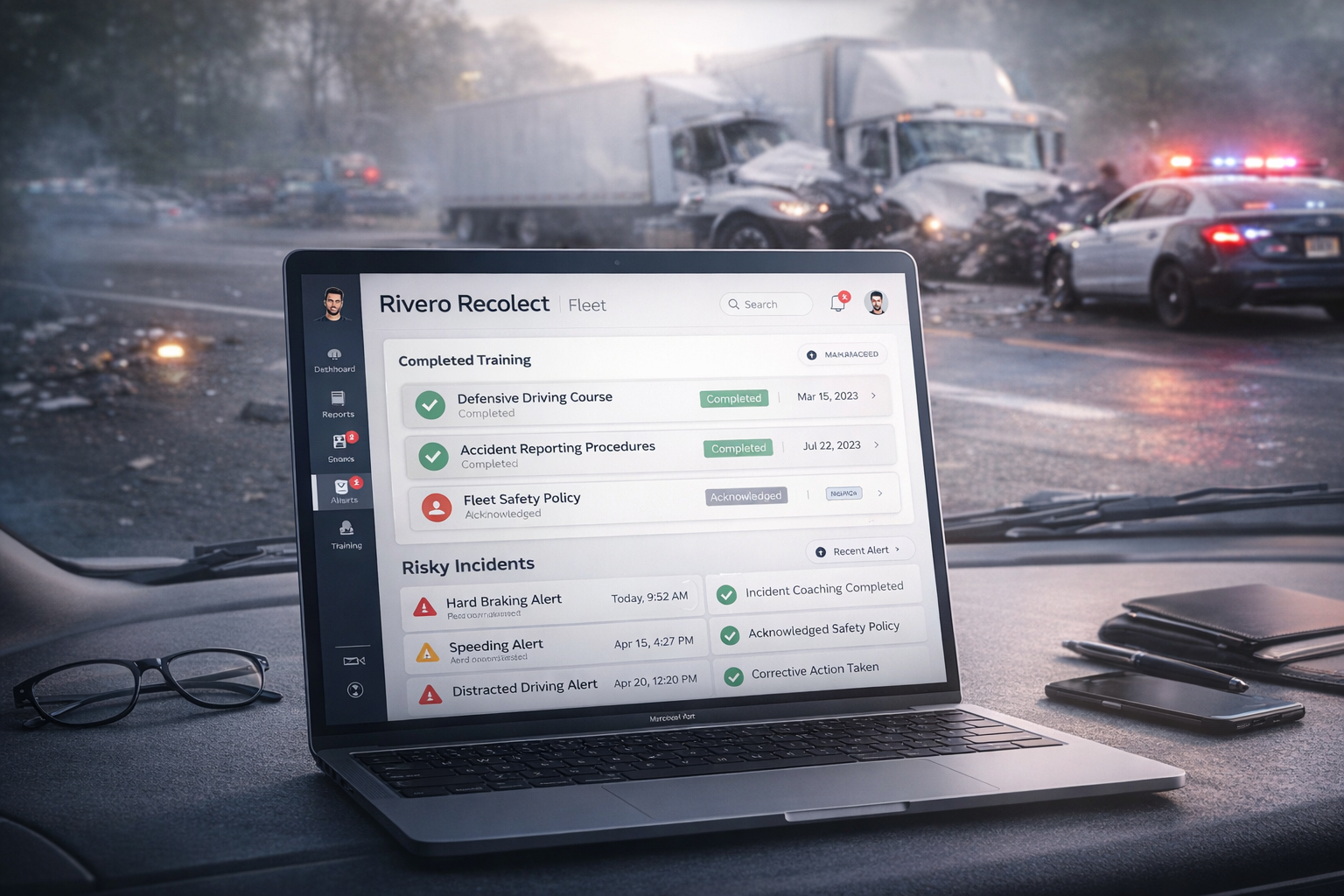
Technology like telematics, AI diagnostics, and fleet cameras provides incredible visibility into driver behavior. But technology alone doesn’t change outcomes—trained drivers do.
SPIDER training develops the cognitive skills that complement your fleet technology investments: hazard recognition, space management, and split-second decision making under pressure.
To learn more about how IMPROVLearning complements your telematics and coaching strategy, visit improvlearning.com.
 Learner Login