Justin Copeland is the Vice President of Safety at United Road Services, with a career dedicated to enhancing driver compliance, analyzing data-driven safety trends, and developing impactful training programs. Justin stands at the forefront of transportation safety leadership, with his commitment to fostering a culture of safety that not only empowers drivers but also sets industry standards for excellence. His unique journey from over-the-road driver to safety executive brings real-world perspective to corporate safety initiatives, making him a trusted voice in fleet risk management and driver development.
Here’s a glimpse of what you’ll learn:
- [3:00] Justin’s unexpected path from Army service and criminal justice degree to trucking safety leadership
- [6:00] The unique challenges of car hauling operations – 80-foot equipment with articulated steering systems
- [8:00] Why loading and unloading represents the most dangerous aspect of car hauling operations
- [11:00] How quality metrics in car hauling differ from traditional freight – measuring damage claims alongside safety scores
- [14:00] The leadership support required to implement aggressive safety culture changes from the top down
- [18:00] How economic pressures affect both new and used vehicle transportation markets
- [24:00] Creating training programs based on real-time data and industry trends rather than generic content
- [29:00] The revolutionary “Hours of Service Stand Down” policy that dropped violations from 79% to the low 30s
- [35:00] Building buy-in through effective dates, enforcement dates, and over-communication strategies
- [38:00] Why being “coachable” is the most important trait for safety professionals
In this episode…
Fleet safety programs often struggle with consistency and driver buy-in, especially in specialized operations where complex equipment and unique regulatory challenges create additional risk factors. Many carriers implement safety policies reactively, responding to violations after they occur rather than preventing them proactively. With driver turnover rates high and regulatory pressure mounting, how can fleet safety leaders create lasting cultural change that actually reduces incidents and improves compliance scores?
According to Justin Copeland, success comes from combining data-driven training with bold leadership decisions that demonstrate unwavering commitment to safety standards. He highlights how United Road’s revolutionary “Hours of Service Stand Down” policy – where any HOS violation results in immediate driver suspension until the violation clears enforcement systems – dropped their violation rate from 79% to the low 30s in just 10 months. This dramatic improvement required complete leadership support and extensive communication, proving that transformational safety culture changes are possible when executed with consistency and conviction.
In this episode of Roadrageous, hosts Liam Hoch and Chad Lindholm sit down with Justin Copeland, Vice President of Safety at United Road Services, to discuss how specialized operations like car hauling require tailored safety approaches and innovative policy solutions. They explore the unique challenges of 80-foot articulated car carriers, the importance of quality metrics alongside traditional safety measures, and how real-world driver experience translates into effective safety leadership. Justin also shares practical strategies for implementing dramatic policy changes while maintaining driver relationships and operational efficiency.
Quotable Moments:
- “First I want to ask you to prioritize your own personal safety as number one. Because if you operate in such a way that you ensure you get home in one piece, that will take care of the equipment, the cargo, the customer and everybody else on the road around you.”
- “Information is power. Knowledge is power. So I want to make sure that our fleet has everything useful to them.”
- “At no point do I ever want to hear from a driver: ‘I wasn’t told that, or you didn’t share that with us.'”
- “The safety department, we are a support department. Sometimes our job is to say no, but we would rather be support first.”
- “Be coachable. Understand that you grow in places where you are likely not very comfortable.”
Action Steps:
- Implement data-driven training: Base training topics on real-time trends within your organization rather than generic industry content.
- Establish clear communication protocols: Create effective dates and enforcement dates for new policies, allowing time for driver adaptation.
- Focus on proactive prevention: Address compliance issues before they become violations through regular audits and education.
- Build leadership support: Ensure C-suite commitment to safety initiatives, especially when implementing strict policies.
- Develop quality metrics: Track specialized metrics relevant to your operation alongside traditional safety measures.
- Create mentorship programs: Foster coachability and continuous learning throughout the safety organization.
Transforming Fleet Safety Through Bold Leadership and Strategic Communication
In a recent episode of Roadrageous, hosts Liam Hoch and Chad Lindholm welcomed Justin Copeland, Vice President of Safety at United Road Services, to discuss the unique challenges of specialized transportation safety and how bold leadership decisions can create dramatic improvements in fleet compliance.
From Driver to Safety Executive: The Power of Real-World Experience
Justin’s journey to safety leadership began unexpectedly after military service and a criminal justice degree led him to trucking during Michigan’s early 2000s recession. What started as a six-month temporary solution became a 22-year career that took him from behind the wheel to corporate safety leadership. This driver-first perspective influences every aspect of his safety philosophy, ensuring policies are both effective and implementable in real-world operations.
Key Discussion Points:
The Unique World of Car Hauling: Justin provided detailed insights into car hauling operations, which use 80-foot stinger-steer equipment with articulated turning points that create unique handling challenges. Unlike traditional freight operations, car haulers face their greatest risks during loading and unloading operations, often performed roadside or in challenging environments where a fallen vehicle could prove fatal.
Specialized Training Requirements: The complexity of car hauling requires extensive training programs, with new drivers spending 3 days to 2 weeks in controlled environments learning to operate multiple hydraulic decks and configure loads like “Lincoln log sets.” Justin emphasized that developing proficiency takes 38-40 weeks, highlighting the investment required for specialized operations.
Quality Metrics Integration: Beyond traditional safety metrics, United Road tracks quality measures including damage claims and customer-noted delivery issues. Modern vehicle complexity means minor scratches can result in thousands of dollars in repairs due to integrated sensors and specialized components, making damage prevention crucial to operational success.
Economic Impact Awareness: The discussion explored how economic pressures affect both new and used vehicle markets, with United Road’s diversified approach allowing them to pivot between market segments as conditions change. This flexibility proved valuable during COVID-related supply shortages and continues to provide stability during current economic uncertainties.
The Revolutionary Hours of Service Stand Down
The centerpiece of the conversation was United Road’s innovative approach to hours of service compliance – a policy so strict that Justin knows of only one other carrier implementing similar measures.
The Challenge: United Road faced a crisis with HOS violations reaching 79%, creating serious regulatory and operational risks that demanded immediate action.
The Solution: Implementation of an “Hours of Service Stand Down” policy where any HOS violation, regardless of severity, results in immediate driver suspension until the violation clears from enforcement systems – potentially up to seven days.
The Process: Success required meticulous planning including:
- Extensive over-communication about upcoming changes
- Separate effective dates and enforcement dates to allow adaptation
- Complete leadership support despite initial operational disruption
- Consistent enforcement without exceptions or wavering
The Results: In just 10 months, violation rates dropped from 79% to the low 30s, demonstrating that dramatic safety culture changes are achievable with proper execution.
Building Sustainable Safety Culture
Justin’s approach to safety culture emphasizes support over enforcement, focusing on proactive prevention rather than reactive punishment.
Communication Strategy: United Road’s bimonthly training program reaches both company drivers (required) and contracted drivers (80-90% voluntary participation), with content based on real-time organizational data rather than generic industry topics.
Leadership Alignment: Every manager from frontline supervisors to the CEO completes the same training drivers receive, ensuring consistent messaging and informed conversations about safety topics.
Mentorship and Coachability: Justin emphasized that the most important trait for safety professionals is being “coachable” – remaining open to learning and growth even in uncomfortable situations.
The Support-First Philosophy
Rather than positioning safety as enforcement, Justin advocates for safety departments as support organizations that help solve operational challenges while maintaining compliance.
Driver-Centric Approach: Policies focus on getting drivers home safely each day, with the understanding that personal safety awareness naturally extends to equipment, cargo, and public safety.
Relationship Building: The goal is maintaining positive driver relationships while achieving safety objectives, recognizing that sustainable culture change requires buy-in rather than fear-based compliance.
Continuous Improvement: Regular data analysis drives ongoing program refinements, ensuring training and policies remain relevant to current challenges rather than historical issues.
Conclusion
Justin Copeland’s approach to fleet safety demonstrates that transformational change is possible when organizations combine data-driven decision making with unwavering leadership commitment. His success with the Hours of Service Stand Down policy proves that even the most aggressive safety measures can be implemented successfully when supported by clear communication, consistent enforcement, and genuine concern for driver welfare.
The key insight: lasting safety culture change requires more than policy updates – it demands leaders willing to make difficult decisions, maintain consistency under pressure, and prioritize long-term safety benefits over short-term operational convenience. By focusing on support rather than enforcement and maintaining open communication throughout the process, safety leaders can achieve dramatic improvements while strengthening rather than damaging driver relationships.
Resources mentioned in this episode:
Sponsor for this episode: This episode is brought to you by IMPROVLearning.
At IMPROVLearning, we’re dedicated to transforming driver education through innovative, research-backed training methods. Our SPIDER™ Driver Training platform combines humor with proven brain-training techniques to help drivers anticipate and avoid potential dangers on the road. With over four million students trained, we know that learning sticks best when it’s engaging, short, and actively tested — resulting in fewer crashes, violations, and safer drivers overall.
To learn more about how IMPROVLearning makes roads safer one driver at a time, visit improvlearning.com.
Short Format
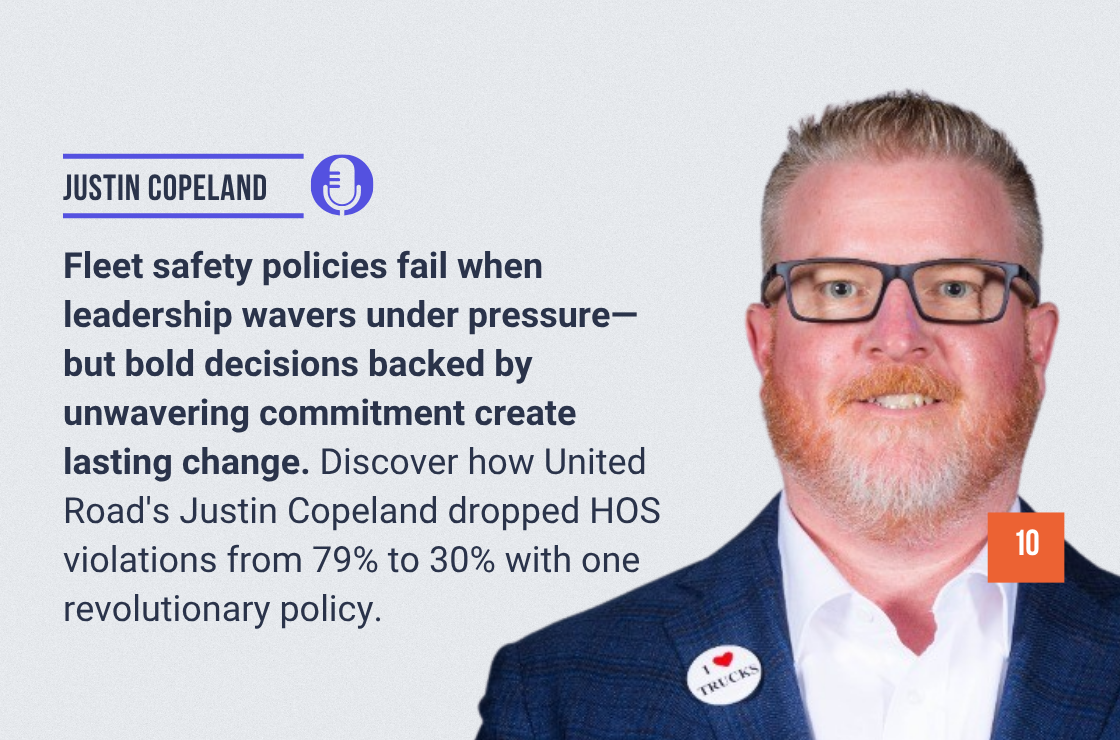
Fleet safety policies fail when leadership wavers under pressure—but bold decisions backed by unwavering commitment create lasting change. Discover how United Road’s Justin Copeland dropped HOS violations from 79% to 30% with one revolutionary policy.
 Learner Login