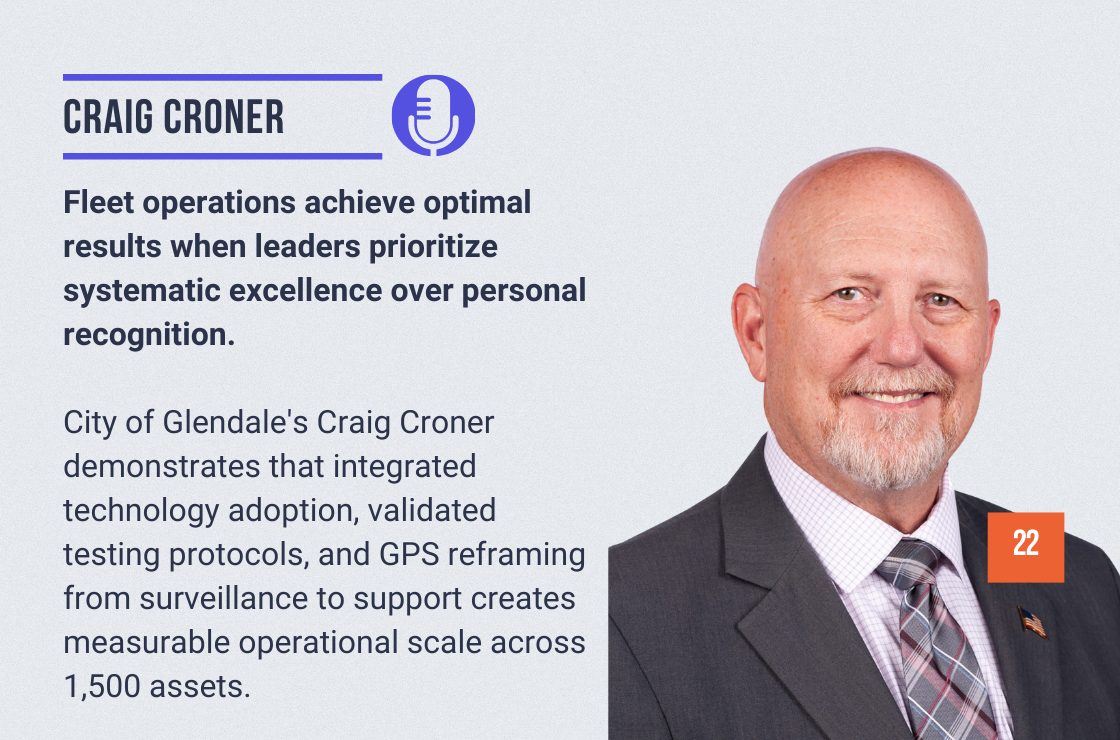
Craig Croner is Deputy Director of Fleet Operations for the City of Glendale, Arizona, with 30+ years of fleet management experience across public and private sectors. He was inducted into the 2025 Public Fleet Hall of Fame and serves as a nationally recognized advisor on fleet strategy, safety integration, and technology adoption. With a team of 36 managing 1,500 assets across police, fire, waste, and municipal operations, Craig understands the complex, invisible infrastructure that keeps cities moving.
Craig Croner is Deputy Director of Fleet Operations for the City of Glendale with 30+ years of experience. He leads 1,500 assets and 36 staff across diverse municipal operations—from police and fire to waste and landfill operations—with a focus on technology integration, safety, and supporting frontline crews.
Here’s a glimpse of what you’ll learn:
- [1:27] From high school shop class to 30 years in fleet leadership
- [5:32] What “invisible infrastructure” really means in municipal operations
- [8:11] Managing everything from police cars to combine harvesters
- [10:06] Why onboarding safety training is non-negotiable
- [12:17] The evolution from paper files to integrated fleet management systems
- [13:22] How GPS technology evolved from “Big Brother” to an exoneration tool
- [17:43] The parking lot story: How GPS saved a driver’s reputation
- [21:04] The cardiac event rescue: GPS technology that saved a life
- [22:57] Advice for new fleet managers entering the industry
- [27:44] Why “adaptive” is the future of fleet operations
In this episode…
Most cities run invisible. Fire trucks arrive. Police respond. Waste trucks pick up trash. Citizens experience these services without thinking about the infrastructure that makes them possible.
That infrastructure is fleet operations.
According to Craig Croner, fleet’s job is simple: get out of the way. Make vehicles work so operators never think about them. That invisibility masks incredible complexity — managing 1,500 assets, integrating GPS and telematics, maintaining OSHA compliance, and enabling critical missions.
After 30 years in fleet management — from high school mechanic to government fleet leader to 2025 Public Fleet Hall of Fame inductee — Craig has seen one transformation stand out: how GPS technology evolved from feared surveillance into a tool that exonerates drivers, saves lives, and changes how organizations approach behavior change.
In this Roadrageous episode, Craig reveals how “Big Brother” technology became a trust-builder, why testing beats rushing, and why the best fleet leaders accept that their greatest success is remaining invisible.
Quotable Moments:
- “I’ve been working on police cars and fire trucks since I was 17 years old.”
- “Hopefully they get to do their job without thinking about the vehicle. That’s our job.”
- “When a fire truck responds to a fire, the last thing I want them thinking about is how that truck is going to operate.”
- “You have to be really good at multiple fields. You can’t specialize in just one.”
- “The first thing that comes to an operator’s mind is, ‘Oh, it’s Big Brother looking at me.'”
- “We’re not looking to catch you doing something wrong. We’re looking for ways to exonerate you.”
- “In a million years, I would never have thought I could use GPS technology in a situation like that. But it’s powerful.”
- “Fleet management isn’t for the weak or thin-skinned. It’s demanding, but it’s rewarding.”
- “We’re the silent source that gets things done.”
Action Steps:
- Define fleet’s support role clearly. Ensure operators never have to think about vehicle reliability.
- Invest in onboarding safety training. Day one should include full safety certification.
- Build integration into your technology strategy. GPS, telematics, and maintenance platforms should work together.
- Test and pilot before scaling. Know your ROI before expanding technology investments.
- Reframe GPS as support, not surveillance. Focus messaging on efficiency, optimization, and driver protection.
- Use GPS for driver exoneration stories. Build trust through real-world examples.
- Combine compliance data with operational data. Automate maintenance workflows.
- Be on the cutting edge, not the bleeding edge. Adopt proven technologies first.
- Create mentorship culture. Pass knowledge forward.
- Accept invisibility. Success means enabling others to perform their jobs seamlessly.
The Invisible Infrastructure That Runs Cities
When people think about city services, they think about firefighters, police officers, and sanitation workers. They rarely think about the teams ensuring those vehicles are always operational.
“Hopefully they get to do their job without thinking about the vehicle,” Craig explains. “That’s our job.”
Craig manages everything from police cars to landfill equipment. In the public sector, fleet leaders must be generalists, understanding equipment operation, procurement strategy, and lifecycle cost management.
Safety and Technology Integration
For Craig, safety starts on day one. Comprehensive onboarding covers vehicle lifting, equipment operation, and regulatory compliance.
“There’s nothing worse than hearing about a tire flying off a vehicle because proper procedures weren’t followed,” Craig says.
Craig has witnessed fleet operations evolve from paper systems to fully integrated platforms where GPS data and maintenance software work together to identify issues before they become failures.
The Big Brother Problem: How GPS Became an Exoneration Tool
When GPS technology first appeared in fleet vehicles, operators feared surveillance. Craig helped shift that perception by emphasizing efficiency, safety, and driver protection.
The most powerful outcome was driver exoneration during accident investigations.
The Parking Lot Story
In one case, GPS data proved a compliance officer was not at fault in a collision. The data provided clear evidence of vehicle position, speed, and impact dynamics, protecting the employee from wrongful blame.
The Cardiac Event: When GPS Became a Family Support Tool
A code compliance officer suffered a cardiac event and became non-responsive at the VA hospital. His wife, searching for answers, contacted the supervisor. GPS immediately confirmed the vehicle location at the hospital and relayed it to the family. The technology didn’t alert emergency responders or activate rescue protocols—instead, it gave the spouse the critical information she needed to locate her husband and connect with hospital staff. This single detail transformed GPS from a surveillance tool into genuine family protection,
Testing Before Scaling: The Right Way to Adopt Technology
Craig emphasizes pilot programs and ROI evaluation before full deployment. Organizations often fail when they implement technology without clearly defining objectives.
Advice for New Fleet Managers
Craig encourages new leaders to seek mentors, pursue certification through professional organizations, and remember fleet operations exist to support frontline services.
The Future: Adaptive
Craig believes adaptability defines the future of fleet operations. Technology, regulations, and operational demands will continue to evolve. Successful leaders remain flexible and committed to continuous learning.
Key Takeaways
- Fleet success means operational invisibility
- Comprehensive safety onboarding prevents incidents
- System integration improves efficiency
- GPS builds trust through exoneration and safety support
- Pilot technology before scaling
- Mentorship strengthens industry knowledge transfer
Conclusion
Craig Croner’s career represents leadership in invisible infrastructure. His approach shows that successful fleet operations depend on safety, integration, thoughtful technology adoption, and enabling frontline teams to perform critical missions without disruption.
Resources Mentioned
About Craig Croner
Craig Croner is Deputy Director of Fleet Operations for the City of Glendale, Arizona, leading a team of 36 managing 1,500 assets across multiple municipal departments. He is a nationally recognized fleet advisor and 2025 Public Fleet Hall of Fame inductee.
Sponsor for this Episode
This episode is brought to you by IMPROVLearning.
IMPROVLearning delivers research-backed driver education through the SPIDER™ Driver Training platform, combining behavioral science and cognitive training to help drivers anticipate and avoid roadway risks.
 Learner Login