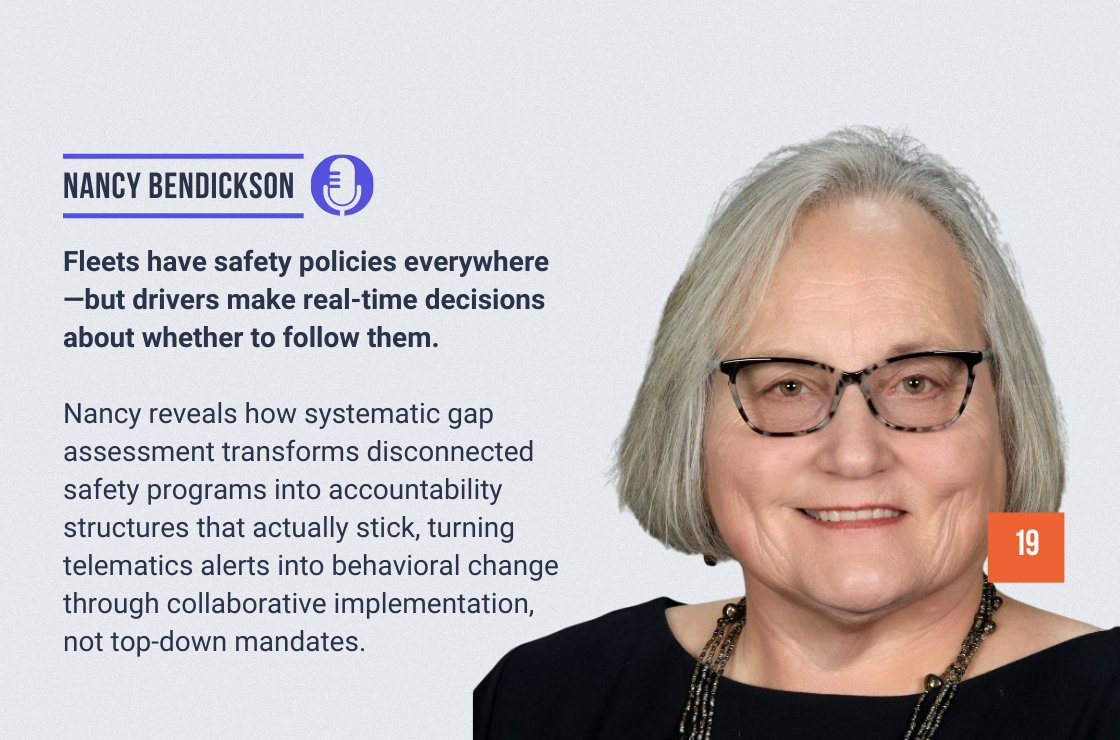
Nancy Bendickson is a Managing Consultant at Aon with over 40 years of experience in safety leadership, risk control, and strategic loss prevention. As Aon’s GRC thought leader for transportation and food safety, she partners with large casualty clients to analyze loss data, uncover key risk drivers, and build targeted strategies that meaningfully reduce risk across fleet operations, occupational safety, and general liability exposures. Nancy has led global safety initiatives for multinational corporations, managed complex fleet task forces spanning continents, and contributed her expertise to the EMS Safety Foundation—all while maintaining an unwavering focus on turning safety strategy into measurable results.
Nancy Bendickson is a Managing Consultant at Aon with 40+ years of experience in safety leadership and risk control. As Aon’s thought leader for transportation safety, she partners with large clients to analyze loss data and build strategies that meaningfully reduce risk across fleet operations.
Here’s a glimpse of what you’ll learn:
- [2:59] How a dietetics degree led Nancy into fleet safety
- [6:12] The gap assessment framework: Your starting point
- [10:54] The most common safety gaps that undermine programs
- [15:15] Why telematics data without processes creates liability
- [18:45] How fleet cameras complement telematics data
- [30:51] Why collaborative implementation outperforms mandates
- [40:29] Making telematics implementation effective in 2025
In this episode…
Every fleet has safety policies. But drivers make real-time decisions about whether to follow them. So why do organizations struggle to move from policy to practice?
According to Nancy Bendickson, it’s not a policy problem—it’s a gap problem. Most fleets don’t even know their actual starting point.
After 40+ years helping multinational corporations reduce risk, Nancy has seen what works. She’s investigated complex international incidents, led global fleet task forces, and conducted audits for some of the world’s largest organizations.
Her insight: There’s a critical gap between collecting safety data and changing driver behavior. Between implementing telematics and turning alerts into coaching conversations. Between developing programs and building accountability that makes them stick.
In this Roadrageous episode, Nancy reveals the systematic approach that closes this gap.
Quotable Moments:
- “When I get a new assignment, I need to figure out what’s the current state. Where are their pain points?”
- “We have telematics data now. How well are you managing that data? Do you have processes in place?”
- “As a consultant, I can only go so far, but if we can gain some buy in and have this ongoing strategy, we’re going to have more success.”
- “Now we have a true picture of what happened. We can know, yep, I need to settle that one right away, because we know we’ve got fault there.”
- “The big lot in life for us in casualty risk control is: how can I impact that total cost of risk?”
- “You got to be flexible and ready to move and change as the client is providing focus for you.”
Action Steps:
- Start with honest assessment. Conduct a comprehensive gap assessment across all 8 critical areas before implementing changes.
- Examine all dimensions: Management support, driver selection, training, vehicle management, substance abuse programs, incident management, driver monitoring, and accountability.
- Build processes around technology. Telematics is only valuable with coaching, corrective action, and continuous monitoring.
- Combine data sources. Telematics tells you what happened. Cameras show why. Together, they create complete safety intelligence.
- Gain genuine buy-in. Collaborative planning outperforms top-down mandates every time.
- Define accountability in the field. Drivers need to know what’s expected, why it matters, and what happens if they don’t comply.
- Measure what matters. Focus on reducing total cost of risk—frequency, severity, and sustainable culture.
- Stay flexible. The best safety programs evolve as organizational needs change.
The Real Gap: Assessment
Fleets aren’t lacking safety policies—they’re drowning in them. What’s missing is honest evaluation of where they actually stand.
“When I get a new assignment, I need to figure out what’s the current state,” Nancy explains. “Where are their pain points? What are their trends for losses?”
This starting point determines everything else. Without it, safety programs become compliance theater.
Nancy’s gap assessment examines eight critical areas: management support, driver selection, training, vehicle management, substance abuse programs, incident management, driver monitoring systems, and accountability/role clarity.
Each reveals systematic weaknesses most organizations overlook.
The Telematics Trap
Here’s where most fleets stumble: They implement telematics, receive alerts about harsh braking and speeding, then do nothing.
“We have telematics data now,” Nancy observes. “How well are you managing that data?”
This is the real gap. Not data collection, but data management. Effective telematics requires four interconnected processes:
1. Event Detection & Prioritization — Triage incidents. Distinguish critical events from minor violations requiring coaching.
2. Driver Coaching — Develop structured conversations about observed behaviors. This requires trained coaches approaching it constructively.
3. Corrective Action — Implement measurable steps when behavior change is needed, with follow-up verification.
4. Continuous Monitoring — Track results. Are repeat offenders improving? Is the fleet trending safer?
Without these processes, telematics creates liability while failing to improve safety.
The Power of Cameras
Telematics tells you what happened. Fleet cameras tell you why and who was at fault. Together, they create complete safety intelligence.
“Now we have a true picture of what happened,” Nancy explains. “We can know immediately if we need to settle a claim because we know who had fault.”
Forward-facing cameras provide rapid incident assessment, liability defense, and powerful coaching material that drives lasting behavior change.
Why Collaboration Works
The most common failure: Solutions are prescribed from above. Operations resists. Safety becomes invisible.
“As a consultant, I can only go so far,” Nancy says. “If we can gain some buy in and have this ongoing strategy, we’re going to have more success.”
Successful programs follow a different path: Assess collaboratively → Identify priorities → Build strategies → Establish governance → Maintain flexibility.
The difference? Genuine organizational alignment from the start.
The Hidden Gap: Accountability
Many fleets have excellent policies documented. But drivers in the field make moment-to-moment decisions about whether to follow them.
“Do the people out in the field truly have clearly defined accountabilities?” Nancy asks.
When accountability is clear and consistently enforced, safety initiatives move from paperwork into real-world decisions.
Reducing Total Cost of Risk
Nancy’s mission is straightforward: “How can I impact that total cost of risk for a client?”
This means managing four dimensions: reducing claims frequency, managing severity, demonstrating strong loss control, and creating sustainable safety culture.
What’s Next: 2025
Almost every fleet now has telematics. The competitive advantage no longer goes to organizations that deploy technology—it goes to those that develop capabilities to act on telematics data effectively.
“Our next focus is: what can we do to help with making telematics implementation more effective?” Nancy says.
Key Takeaways
✓ Start with honest assessment. Know your current state before implementing changes.
✓ Examine all 8 gap areas systematically. Don’t skip dimensions that seem less critical.
✓ Build processes around technology. Telematics without action creates liability.
✓ Combine data sources. Telematics + cameras = complete picture.
✓ Gain genuine buy-in. Collaborative planning outperforms mandates.
✓ Define accountability clearly. Drivers need to know what’s expected and why.
✓ Measure what matters. Focus on reducing total cost of risk.
✓ Stay flexible. The best programs evolve as needs change.
Conclusion
Nancy Bendickson’s 40+ years in safety represent a masterclass in changing safety outcomes. Her approach—honest gap assessment followed by collaborative, targeted improvement—provides a concrete framework any organization can follow.
Most importantly, she demonstrates that safety leadership is about flexibility, learning, and maintaining focus on one core mission: reducing risk and saving lives.
For fleet leaders committed to building safety programs that actually work, her methodology offers both proven strategy and inspiring evidence of what’s possible.
Resources mentioned in this episode:
Sponsor for this episode:
This episode is brought to you by IMPROVLearning.
At IMPROVLearning, we’re dedicated to transforming driver education through innovative, research-backed training methods. Our SPIDER™ Driver Training platform combines humor with proven brain-training techniques to help drivers anticipate and avoid dangers on the road.
With over four million students trained, we know that learning sticks best when it’s engaging, short, and actively tested.
Effective fleet safety requires more than telematics data—it requires drivers who can anticipate risks and make split-second safety decisions under pressure. That’s exactly what SPIDER training delivers.
To learn more about how IMPROVLearning complements your telematics and coaching strategy, visit improvlearning.com.
 Learner Login