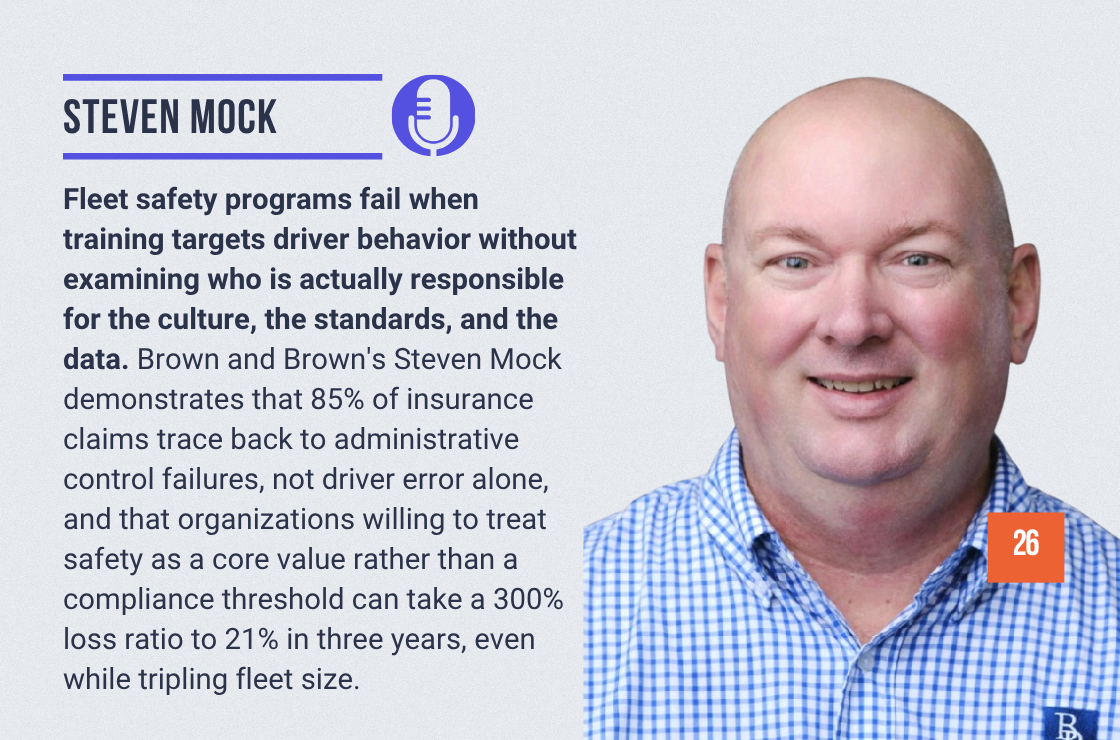
Steven Mock is the Risk Mitigation Director at Brown and Brown, one of the largest insurance and risk management firms in the United States. With more than 18 years of experience spanning safety training, compliance, underwriting, and operational leadership, Steve helps organizations identify where their risk exposure is greatest and close the gaps before claims happen. His background runs from Marine Corps communication technician to technical trainer at Comcast to fleet safety director, before moving into his current role advising clients across industries on risk control and safety culture. He holds an MBA from Florida Gulf Coast University and a Bachelor’s degree in Technology Management from the State College of Florida. He is a Certified Safety Professional (CSP), Certified Instructional Trainer (BCSP), Associate in Risk Management (ARM), OSHA Authorized Outreach Trainer for Construction and General Industries, National Safety Council Defensive Driving Instructor, and Licensed Insurance Agent. He also chairs the education committee for the Florida Pest Management Association.
Steven Mock is Risk Mitigation Director at Brown and Brown with 18 years of experience in safety training, compliance, and operational risk control. He specializes in closing the gap between policy and practice, with a track record that includes taking a fleet from a 300% loss ratio to 21% in three years while tripling its size.
[Podcast Audio Embed Placeholder]
Here’s a glimpse of what you’ll learn:
- [2:00] From Marine Corps to Comcast: how Steve found his way into safety
- [3:44] The collision on I-75 that turned a safety advocate into a true believer
- [7:33] Why safety culture lives in the heart, not just the mind
- [8:05] The picture frame on the visor and why it works
- [11:23] Why frontline supervisors are your real safety gatekeepers
- [14:20] The toothbrush story: how autopilot behavior creates risk
- [21:07] Why both new drivers and 20-year veterans are your highest-risk groups
- [26:30] The financial case for safe production over production at any cost
- [29:52] Why OSHA compliance makes you a C student
- [36:17] The NIOSH hierarchy of controls applied to fleet
- [39:08] How 85% of insurance claims trace back to leadership failures
- [42:29] Why unused telematics data does not protect anyone
- [42:58] 300% to 21% loss ratio in three years: what actually changed
- [46:29] Publicly praise, privately reprimand
In this episode…
Most fleet safety programs are built on the assumption that the driver is the problem. The data says otherwise.
Steven Mock has spent 18 years working at the intersection of insurance, safety, and behavior change. As Risk Mitigation Director at Brown and Brown, he sees what actually drives claims. It isn’t distracted drivers or bad hires. It’s outdated training manuals, telematics systems nobody reads, and policies that exist on paper but not in practice. In other words, leadership.
His number: 85% of insurance claims trace back to a failure of administrative controls.
In this Road Rageous episode, Steve breaks down how fleet risk is really created, why the safety-versus-productivity argument is backwards, and what it takes to build a culture where safety is a core value instead of a checkbox. He also shares the I-75 collision that still drives him 15 years later, and the picture frame on the visor that changed how an entire team thought about why they drive.
Quotable Moments:
- “Defensive driving really works. If anything would have gone wrong, I was prepared. I was ready to evade at any time.”
- “It starts with winning the hearts, not just the minds.”
- “Driving is easy. Defensive driving, being a professional driver, that’s hard work.”
- “I’ve been doing this 20 years. Awesome. You’ve been doing it wrong for 20 years.”
- “Safety is not a priority. Safety should be a core value. There’s a big difference.”
- “The maximization of profit is the minimization of loss.”
- “If you’re compliant with OSHA, congratulations, you’re a C student.”
- “85% of your claims occur because of a failure of administrative controls. That’s a culture problem.”
- “Please do not treat your telematics like I treat my Peloton. Actually use it.”
- “We went from a 300% loss ratio to 21% in three years while tripling the size of the fleet.”
- “Publicly praise, privately reprimand.”
Action Steps:
- Build emotional buy-in before you build compliance programs. Connect drivers to their personal reason for driving safely. Hearts before minds.
- Train your frontline supervisors first. They are your real safety gatekeepers. If they are not enforcing the standard consistently, nothing else holds.
- Interrupt autopilot deliberately. Rotate inspection stickers, adjust vehicle settings, run teach-back sessions. Keep driver attention active rather than habituated.
- Stop treating OSHA compliance as the finish line. Compliance is a C. Set a culture goal of B-plus or better.
- Audit your administrative controls before your next claim. If your training materials are more than three years old, that is a risk exposure.
- Use telematics data the same way you use your P&L. Pull scorecards regularly. Share rankings. Reward the top performers, coach the rest.
- Apply the hierarchy of controls to every fleet risk decision. Know where your intervention sits: elimination, substitution, engineering, administrative, or PPE.
- Publicly recognize your safest drivers. Use data to make the case for who deserves recognition, and make it visible to the team.
- Treat every new hire as your next claim or your next safety leader. Run an MVR before the offer. Set driving expectations from day one.
- Remember: safe production is not slow production. Safety embedded into operations consistently outperforms safety treated as a separate function.
The Crash That Changed Everything
Steve did not set out to be a safety professional. After leaving the Marine Corps, he became a technical trainer at Comcast, where every trainer was also responsible for safety instruction. He was good at it. He believed in the message.
Then one Friday afternoon, driving home from a defensive driving class in Leesburg, the vehicle ahead of him started weaving on I-75. He backed off. Seconds later, the driver took a hard left, crossed the median, and hit a Silverado. What followed looked like a Hollywood movie explosion.
“If anything would have gone wrong, I was prepared. I was ready to evade that potential collision at any time. Because I had the ability to see down the road, I had that distance, I had continually scanned my area.”
The techniques he had been teaching for years had worked in real time. He survived because he had been paying attention.
When he looked up the driver in the news, he found she was an 18-year-old valedictorian heading home from Gainesville after getting accepted to college. She had wanted to be an oncologist.
“This is, at this point, 15 years ago, and it still feels like it just happened. That is kind of my driving force behind why I do what I do. I want to get everyone home safe every day.”
Winning the Heart, Not Just the Mind
Most fleet safety programs try to win minds. Steve argues the real work is winning hearts.
At a previous company where he managed a fleet that grew from 200 to 600 vehicles, he and his COO introduced picture frames for vehicle visors. The label read: “This is my reason for driving safe.” Employees put a photo of whatever mattered most to them inside and looked at it every day before going out.
“We had employees that had their spouse in there, their kids, their dog. One guy had his bass boat. It’s like, hey, I want to get home because I want to go fishing. Got it. Rock on.”
To confirm drivers were actually engaging with it, managers rotated coded stickers during weekly vehicle inspections. Colors and shapes changed each week so teammates couldn’t share answers.
“I’m a big believer in attitude and culture as the driving force of great driving behavior. It starts with winning the hearts, not just the minds.”
That heart connection, he argues, is what separates a compliance program from a safety culture. Safety cannot just be a policy employees are aware of. It has to be something they believe in.
Autopilot Is the Enemy
The most dangerous thing about experienced drivers is that they stop thinking. Driving becomes automatic, and automatic behavior bypasses judgment.
Steve uses the toothbrush story in every class. Can you reach for your toothbrush without looking? Of course. Because you put it in the same place every day. Now move it. Flip the toilet paper. Swap the shampoo and conditioner. What happens?
“Why would we be upset? It’s because we disturb the norm. We change the way that our brain perceives what we say is normal, what we’ve always done.”
The same autopilot that makes driving feel effortless is what gets drivers into trouble. Scanning ahead 12 to 15 seconds, checking mirrors every 5 to 8 seconds, maintaining following distance: these require active, conscious effort. Most drivers are not applying them consistently, most of the time.
“Driving is easy. Defensive driving, being a professional driver, that’s hard work. That takes a lot of vigilance.”
Pattern disruption is the fix. Moving seats, adjusting mirrors during inspections, rotating stickers: small interventions designed to break the habituated behavior that leads to incidents.
The Experience Paradox
A common assumption in fleet risk management is that new drivers are the highest risk. The data tells a more complicated story.
“It’s the driver with less than a year with the company, and it’s the drivers with more than 20 years with the company. Those are the ones that are going to have the most collisions typically.”
New drivers lack familiarity. But 20-year veterans have something equally dangerous: certainty. They have driven the same routes in the same vehicles through the same conditions for so long that they stopped paying attention years ago.
“I’ve been doing this 20 years.” Steve’s answer: “Awesome. You’ve been doing it wrong for 20 years. Way to go.”
The fix is the same for both groups: continuous reinforcement, teach-back sessions where employees train each other, and frontline supervisors who inspect what they expect rather than just check boxes.
“Those frontline supervisors are critical. They are really your gatekeepers for behavior and the trends. If they’re not enforcing the standard, how many of your employees are actually going to adhere to it?”
Safe Production Is Not Slow Production
Labor is the highest business expense for most companies. Insurance is typically the second highest. Safety failures drive up both.
“Safe production is like the Energizer Bunny. It does not stop. You keep that workforce happy and healthy and you’re going to have so much less downtime, so much less lost productivity, fewer claims, which results in lower premiums.”
Steve’s summary of the financial logic: “The maximization of profit is the minimization of loss.”
He also challenges the idea that OSHA compliance is a meaningful benchmark: “If you’re compliant with OSHA, congratulations, you’re a C student. Way to go. You’re doing the minimum.” His ask of every client is to aim for at least a B-plus.
And on the core question: “Safety is not a priority. Safety should be a core value. There’s a big difference.”
Priorities shift. Core values don’t.
The 85% Problem
Steve uses the NIOSH hierarchy of controls as his framework for every client conversation. From top to bottom: eliminate the risk, substitute it, apply engineering controls, use administrative controls, and deploy PPE.
85% of insurance claims occur because of a failure of administrative controls.
“That’s leadership. That’s management. That’s your training…”
He recently reviewed materials for a client who couldn’t understand their high collision rate. Their training manual was last updated in 1987.
“When it says version one from 1987, there you go. That’s a problem.”
Telematics Is a Tool, Not a Trophy
“Please do not treat your telematics like I treat my Peloton. Actually use it.”
Data is numbers on a spreadsheet. Information is what those numbers are telling you.
Starting with 200 vehicles and a 300% loss ratio, he scaled to 600 vehicles and 21% loss ratio.
“So it works, if you work it.”
Publicly Praise, Privately Reprimand
“Publicly praise, privately reprimand.”
“Anyone can be a leader. The title does not matter.”
Key Takeaways
- Defensive driving techniques are not theoretical. They are the difference between witnessing a collision and being in one
- Safety culture requires emotional connection, not just procedural compliance
- Drivers at both ends of the experience spectrum carry the highest collision risk
- 85% of insurance claims result from failures of administrative controls
- Telematics data must be used actively
- Safe production improves productivity
- Compliance is the floor
- Leadership drives culture
Conclusion
Steve Mock has seen fleet risk from every angle…
Resources mentioned in this episode:
About Steven Mock
Steven Mock is the Risk Mitigation Director at Brown and Brown, where he leads strategic risk management initiatives designed to reduce client exposure and strengthen operational performance…
Sponsor for this episode:
This episode is brought to you by IMPROVLearning.
To learn more, visit improvlearning.com.
 Learner Login