Picture yourself in a safety training session where every slide looks almost the same. The information matters, the instructor knows their stuff, and everyone gets why they’re there. Still, after a few definitions and bullet points, people start to lose focus.
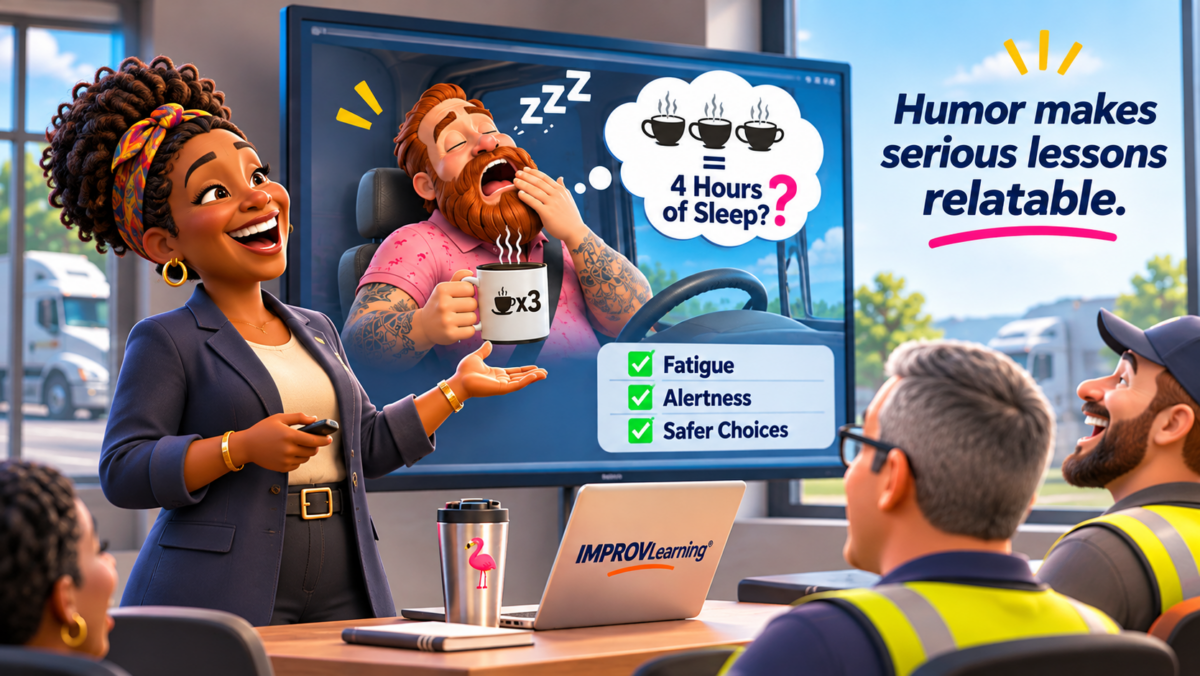
Now, imagine the instructor shares a silly story about a driver who thinks three cups of coffee can replace four hours of sleep. Someone laughs. Someone else relates. Suddenly, everyone is paying attention again. The safety lesson hasn’t changed, but the way people experience it has.
The psychology behind a good laugh
Humor might seem spontaneous, but psychologists have spent years studying why we find things funny and how laughter shapes our experiences.
In Humor in Psychology: Coping and Laughing Your Woes Away, psychologist Heather S. Lonczak looks at several theories about humor’s effects. One is an incongruity theory, which says humor often comes from the unexpected. We expect one thing, but something else happens. Think of a driver who claims to be great at multitasking, only to spend minutes searching for sunglasses already on their head.
The joke is in the gap between their confidence and what they do. In training, that gap can also teach us about attention’s limits. But humor does more than surprise us. Lonczak’s review also highlights research linking positive humor to better moods, stronger social bonds, and more enjoyable learning. Not all humor works the same way, though. Supportive, relatable humor can help people connect, while aggressive or mean-spirited humor can do the opposite.
A funny lesson still needs to teach something
One interesting finding from Lonczak’s review comes from Askildson’s (2005) research with college students in language classes. In that study, 72% of students said humor made them more interested in the subject, and 82% said their instructor’s humor made them more approachable. Another 82% felt humor made the classroom better for learning. These results show what students think, not whether they remember more in the long run.
The study was also about language classes, not driver training. Still, it gives organizations ideas for making safety education more engaging. A driver who sees how silly it is to try to save five minutes by making risky choices might start to question their own habits. The joke opens the door for reflection. And when humor ties directly to the lesson, it gives learners something to think about beyond just the punchline.
Safety is serious, but learning doesn’t always have to feel that way
At IMPROVLearning, we use comedy in our teaching because we believe important lessons can be engaging without losing their seriousness. Distracted driving, fatigue, and speeding aren’t funny. But the assumptions people make about their own skills can be easy to relate to. A funny scenario can help learners see those assumptions without feeling personally attacked. That’s important because safety training isn’t just about telling people what they should already know.It’s about helping them notice familiar behaviors, question their choices, and think about safer options.
Of course, humor alone can’t prove someone has learned a skill or will act differently on the road. That takes real instruction, practice, and follow-up. But when humor grabs attention, builds connection, and supports the lesson, it can be a helpful part of the process. The next time someone laughs during a safety lesson, the real question isn’t whether the training was fun. It’s whether the humor helped them notice something worth remembering. After all, the goal isn’t to make safety a joke. It’s to make the lesson stick.
References
Askildson, Lance. (2005). Effects of humor in the language classroom: Humor as a pedagogical tool in theory and practice. Arizona Working Papers in SLAT. 12.
Lonczak, H. (2020, July 8). Humor in psychology: Coping and laughing your woes away. Positive Psychology. https://positivepsychology.com/humor-psychology/
Martin, R. A., & Ford, T. (2018). The Psychology of Humor: An Integrative Approach. Academic Press.
 Learner Login