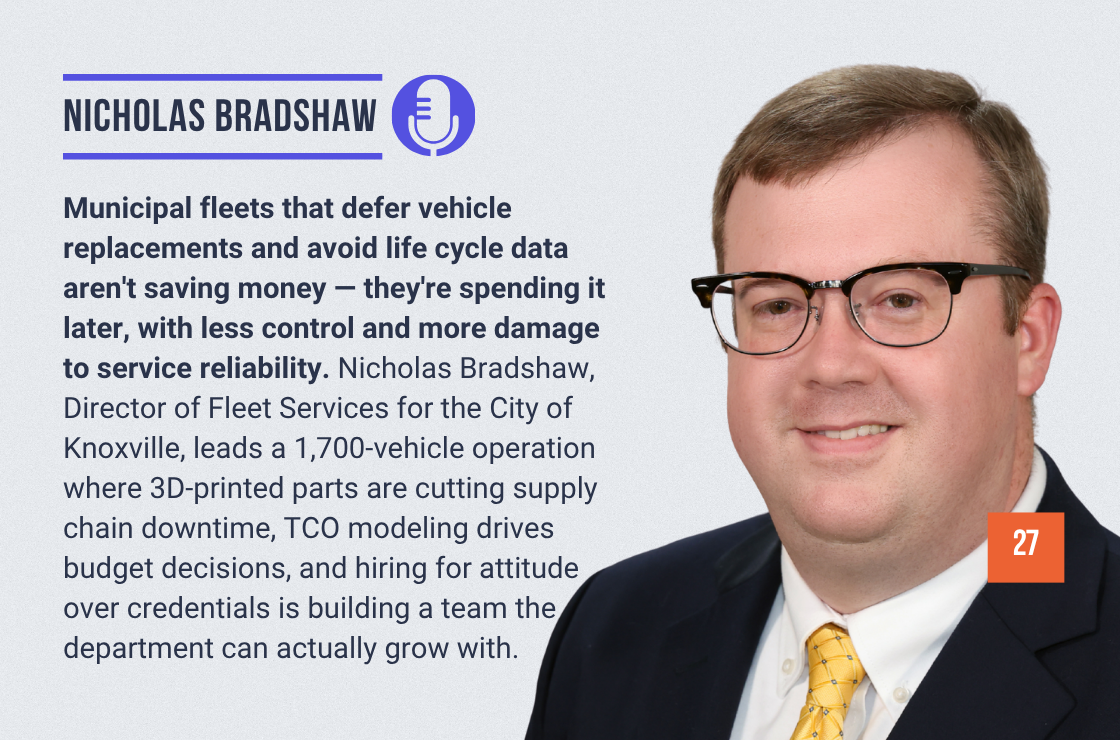
Nicholas Bradshaw is the Director of Fleet Services for the City of Knoxville, overseeing roughly 1,700 vehicles supporting essential public services. He joined the city 17 years ago, earned a master’s in public administration from the University of Tennessee, and worked through HR and public works before becoming deputy director of fleet in 2017 and director in 2020. His HR background shapes how he hires for fit, builds teams, and drives professionalism across every level of the department. He is active in the American Public Works Association and is a vocal advocate for elevating the visibility of public sector fleet management.
Nicholas Bradshaw is Director of Fleet Services for the City of Knoxville. With an HR and public administration background, he leads a 1,700-vehicle municipal fleet with a focus on people-first hiring, life cycle analytics, innovation through 3D printing and telematics, and professionalizing the fleet industry from the inside out.
Here’s a glimpse of what you’ll learn:
- [1:11] How a career in building inspections and HR led to fleet leadership
- [2:32] Why an HR background changes how you hire and manage a fleet team
- [4:24] Fleet as the invisible backbone of city operations
- [6:52] The case for life cycle data and total cost of ownership modeling
- [9:15] Why fleet is on the leading edge of municipal innovation
- [12:18] How Knoxville is using 3D printing to solve supply chain problems
- [18:22] Telematics, fuel management, and moving from reactive to proactive maintenance
- [24:44] Why fleet technicians are really IT professionals now
- [27:00] Advice for anyone considering a career in public fleet management
In this episode…
If everything is running smoothly, nobody thinks about fleet. The plows show up, the fire trucks respond, the inspectors get to their sites. The city keeps moving. And somewhere in the background, a small team of professionals made all of that possible.
Nicholas Bradshaw has spent nearly a decade leading fleet operations for the City of Knoxville, and he is tired of fleet being treated as an afterthought. In this Roadrageous episode, he makes the case for why municipal fleet deserves a seat at the leadership table, not just when things go wrong, but as a strategic function that drives financial performance, service reliability, and innovation citywide.
From 3D-printed parts to total cost of ownership modeling to hiring for attitude over credentials, Nicholas brings a perspective shaped by HR, public administration, and years of working every corner of city government.
The Invisible Department
Nicholas is direct about why fleet gets overlooked. If you are doing the job well, nobody notices. The fire truck shows up. The pothole crew gets there. The police cars are on the road. Decision-makers are focused on outcomes, not the infrastructure behind them.
“I think just by its nature, you’re in the background,” he says. “And hopefully, if you’re doing your job well, the equipment’s on the road and the operators aren’t thinking about maintenance. They’re thinking about delivering services.”
The risk is that invisibility becomes neglect. Budgets get cut. Replacements get deferred. Fleet leaders keep patching aging equipment because asking for money feels harder than avoiding the conversation. Nicholas sees that pattern all the time.
“You keep vehicles beyond their recommended life cycle, you slap band-aids on there and give it another year. And when you look at the big picture, your city and your residents are losing money with short-sighted reactive approaches like that.”
The answer is not louder complaints. It is better data.
The Business Case for Life Cycle Management
Nicholas runs his fleet like a business. Every dollar spent on parts, labor, and outside charges gets tracked. That data builds into life cycle models that tell him exactly when a vehicle crosses the line from cost-effective to liability.
“Everything’s got a maintenance curve. There’s a point where the maintenance cost really goes up. You can identify that point with data. And you should be purchasing that replacement vehicle before that point.”
The payoff is not just financial. It is credibility. When Nicholas walks into a budget conversation with TCO modeling behind him, elected officials and finance leaders respond. The case is clear, the numbers are real, and the ask makes sense.
“Most decision makers are pretty responsive when you can make a good business case for something. It ends up being more financially sound for your city and your residents.”
Fleet leaders who skip this step, who defer and patch and avoid, are not saving money. They are spending it somewhere else, just later and with less visibility.
3D Printing: Building Parts When the Supply Chain Fails
Post-COVID supply chain disruptions hit fleet operations hard. Back orders, parts shortages, extended downtimes. Equipment sat idle. Services slowed. The traditional model of waiting for a part to ship from a manufacturer was not working.
Knoxville’s answer was to stop waiting. Nicholas and his team invested in a large-scale 3D printer and started manufacturing components in-house.
“We were able to purchase a large scale 3D printer and start making a lot of our own parts and components. With a handheld scanner for mapping and design, we can manufacture all kinds of various components in-house. That’s done such wonders in terms of reducing downtime. And you can make things for pennies on the dollar.”
The proximity to the University of Tennessee and Oak Ridge National Laboratory gave Knoxville access to partners and expertise that accelerated the program. Technicians received training on design and fabrication. The city leadership supported the investment.
Nicholas is a few months into the program and already seeing returns. The bigger lesson is the mindset: when the system fails you, build a workaround and own it.
Telematics and the Move From Reactive to Proactive
Knoxville has run telematics for over a decade. Nicholas remembers what came before. You would radio a truck and ask what street they were on. That world feels distant now.
“Now we have all the diagnostic info, seat belt alerts, crash alerts. I know within seconds if a vehicle is involved in an accident. We know speed, fuel levels, and lots of excellent driver coaching information.”
The city runs three unstaffed fuel sites, managed entirely through fuel management software with full accountability and reporting. Fleet management software ties it all together, tracking labor hours, parts expense, and work order assignments in a way that makes cost-per-vehicle analysis possible.
The initial rollout faced the usual resistance. Drivers did not want to be tracked. Union concerns surfaced. Nicholas acknowledges it was a process. But the resistance feels “quaint” now. GPS tracking is simply part of operating a professional fleet.
“How bizarre would it be to not have a vehicle with a GPS and not even know where it is? That seems sort of strange to me now.”
Hiring for Fit: The HR Advantage
Nicholas spent years in the city’s HR department before moving into fleet, and that background shapes how he builds his team more than any technical training ever has.
His core belief is simple: you are your people. The department will go exactly as far as the team takes it. Which means the hiring decision matters more than almost anything else.
“Resumes are important and skills are important, but I’ve found the longer I’ve been in this role that a person with the right attitude, work ethic, and approach is often more important than a particular set of skills when you look at new candidates.”
Skills can be taught. Attitude is harder to install after the fact. Nicholas looks for curiosity and a problem-solving instinct that shows up in people who work with their hands. He asks candidates to tell the story of something they took apart as a kid just to understand how it worked.
Professionalizing Fleet From the Inside Out
Nicholas wants fleet to be taken seriously. Not just by city administrators or elected officials, but by fleet professionals themselves. That starts with how the industry presents itself.
He points to certifications, APWA, NAFA, manufacturer credentials, as a foundation. Not for their own sake, but because credentials signal that you take the work seriously. Customers and administrators notice when a fleet team operates with discipline and professionalism.
“When you take yourself seriously and professionally, they see that and they tend to take you more seriously as well.”
The job title change from mechanic to technician was not cosmetic. It reflected a real shift. Light vehicle specialists today are less grease-and-wrench and more diagnostic and software. Calling them technicians is accurate, and it positions them correctly within the organization.
Nicholas also pushes fleet leaders to advocate for their value through data, results, and relationships with leadership. Fleet does not get credit by staying quiet. You have to tell the story.
Quotable Moments:
- “Fleet is not the stepchild. The other departments that deliver services can’t do their job without us.”
- “We are our people. We will go as far as they take us.”
- “Everything’s got a maintenance curve. You can identify that point with data, and you should be purchasing that replacement vehicle before that point.”
- “When you take yourself seriously and professionally, they see that and they tend to take you more seriously as well.”
- “How bizarre would it be to not have a vehicle with a GPS and not even know where it is? That seems sort of strange to me now.”
- “You can make parts for pennies on the dollar. That’s done such wonders in terms of reducing downtime.”
- “Keep fleet in mind. It’s an excellent field where you can really make an impact and make a difference in your community.”
Action Steps:
- Build life cycle models with real data. Track every dollar of parts, labor, and outside charges by vehicle. Build TCO models that tell you when to replace, not just when something breaks.
- Make the business case before you need the money. Prepare cost analysis before budget season. Elected officials and finance leaders respond to clear financial arguments, not repair anecdotes.
- Explore in-house parts fabrication. Invest in a large-format 3D printer and handheld scanner. Partner with local universities or technical institutions to accelerate design capability.
- Introduce telematics as a protection tool first. Lead with exoneration when rolling out cameras and GPS. Show drivers examples of the technology protecting them. Adoption follows trust.
- Hire for attitude and fit over credentials. Look for curiosity, work ethic, and a problem-solving instinct in interviews. Ask candidates to describe something they took apart just to understand it.
- Invest in professional certifications. Pursue APWA, NAFA, and manufacturer certifications for staff at every level. Credentials signal seriousness to city leadership and open career pathways.
- Advocate for fleet at the leadership table. Share data, outcomes, and innovation stories with administrators and elected officials proactively. Fleet does not earn visibility by staying quiet.
Key Takeaways
- Fleet is the invisible infrastructure behind every city service, and fleet managers must proactively tell that story
- Life cycle data and TCO modeling are the tools that turn budget conversations from requests into business cases
- Knoxville is using 3D printing to manufacture parts in-house, cutting downtime and cost during supply chain disruptions
- Telematics moved fleet from reactive to proactive, and the initial resistance to GPS and cameras now feels like a distant memory
- Hiring for attitude and fit produces better long-term results than hiring for credentials or experience alone
- Professionalizing fleet, through certifications, analytics, and business-minded operations, earns credibility with city leadership
- Fleet touches every department in a city and offers career opportunities across finance, HR, technology, and operations
Conclusion
Nicholas Bradshaw did not set out to run a fleet department. He came up through inspections and HR, built expertise in people management and public administration, and found his way to fleet through challenges that needed someone willing to take them on.
The City of Knoxville fleet reflects his philosophy: professional, data-driven, innovative, and built around people. From 3D-printed parts to TCO modeling to intentional hiring, every decision connects back to one belief. Fleet is not a background function. It is the foundation everything else rests on.
For fleet professionals looking to raise the visibility and performance of their operations, Nicholas offers a clear path: take yourself seriously, build the data infrastructure, make the business case, and never stop advocating for your team.
Resources mentioned in this episode:
About Nicholas Bradshaw
Nicholas Bradshaw is the Director of Fleet Services for the City of Knoxville, overseeing roughly 1,700 vehicles supporting essential public services. He joined the city 17 years ago, earned a master’s in public administration from the University of Tennessee, and worked across HR and public works before becoming deputy director in 2017 and director in 2020. He brings an HR-informed approach to hiring and team development alongside a data-driven philosophy toward life cycle management and innovation. He is an active member of APWA and a consistent advocate for professionalizing the public sector fleet industry.
Sponsor
IMPROVLearning — At IMPROVLearning, we are dedicated to transforming driver education through innovative, research-backed training methods. Our SPIDER Driver Training platform combines humor with proven brain-training techniques to help drivers anticipate and avoid dangers on the road. Nicholas Bradshaw’s point is clear: technology creates visibility, but trained people make good decisions when the data is not enough. SPIDER training develops hazard recognition, space management, and split-second decision-making under pressure. Visit improvlearning.com.
 Learner Login