The Visibility Rule: What Drivers Can’t See, They Won’t Improve
There is a moment in almost every safety program when the same realization hits everyone at once.
The data was there. The pattern was there. The opportunity to coach was there.
But for the person who most needed to see it, the driver, it might as well have been invisible.
That is the problem with hidden metrics. They may exist in the system, but they do not yet exist in behavior.
A harsh-braking trend buried in a dashboard does not change a habit. A speeding pattern no driver ever sees does not trigger reflection. A supervisor cannot coach what a driver never recognizes as a pattern in the first place.
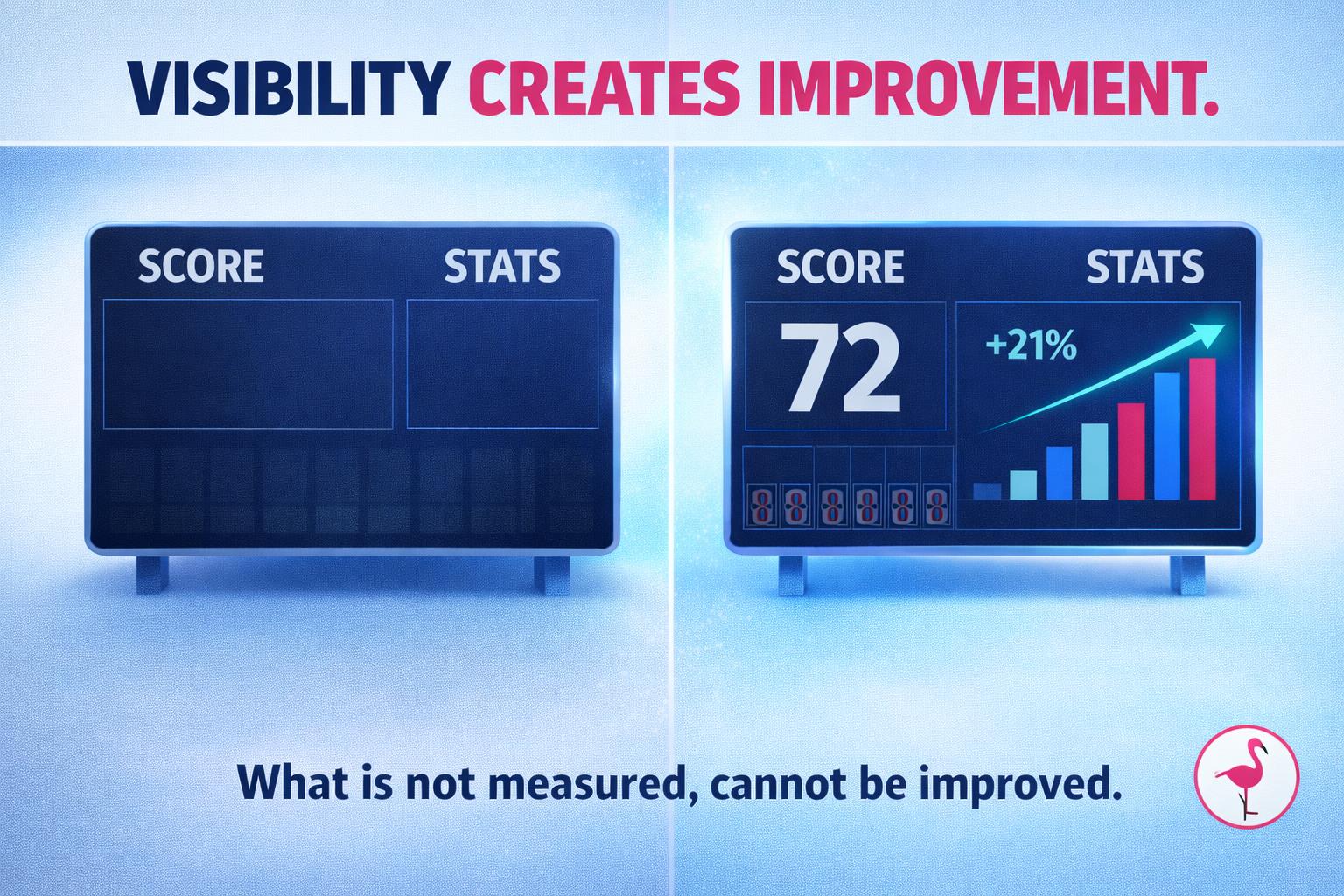
And that is why visibility matters so much. Not because dashboards are fashionable. Not because scorecards look impressive in quarterly reporting. But because behavior change begins when performance becomes visible enough to interrupt autopilot. Research in behavior change consistently identifies feedback and self-monitoring as core mechanisms that help people adjust what they do, and NICE guidance likewise highlights feedback and monitoring as key elements of behavior-change interventions.¹,²
Data Does Not Change Behavior. Seen Data Does.
Most fleets already measure something: speeding, harsh braking, acceleration, cornering, seat belt use, idle time, exceptions, trends.
But measurement alone is not the same as improvement.
That distinction matters. In the behavior-change literature, monitoring becomes useful as a change strategy when it is paired with observation, reflection, or feedback, not when data is simply collected in the background.¹,² In practice, many organizations gather excellent data and still leave it locked inside manager-facing systems, reviewed only after a complaint, an incident, or a claim.
That is not a behavior-change loop. That is a storage locker.
Visibility changes the job the data is doing. A weekly driver scorecard, a simple team dashboard, or a personal progress report takes the same underlying information and gives it psychological weight. The question shifts from “What is the system tracking?” to “How am I actually driving?”
That is when intention begins.
The Science Is Clear: Feedback Pulls Behavior Into Awareness
Safe driving is not usually derailed by ignorance alone. More often, it slips through routine.
Drivers operate in familiar patterns. They manage pressure, traffic, fatigue, repetition, and time demands. Over time, even risky behaviors can start to feel normal simply because they are repeated often enough.
Visibility interrupts that normalization.
A 2025 systematic review of 34 real-world driving studies found evidence that driver feedback improves driving behavior, with findings suggesting it can significantly reduce crash risk, while also noting that long-term effects still need more study.³ That matters because safer driving is rarely the result of one reminder. It is more often the product of repeated noticing, repeated adjustment, and repeated reinforcement.
This is where visibility earns its keep.
A driver who sees that hard-braking events spike on late-day routes is no longer working from vague advice. A supervisor who sees the same pattern can coach a specific setup habit: earlier deceleration, more following distance, cleaner approach into stops and turns.
The goal is not to overwhelm people with numbers. The goal is to make the right pattern visible at the right time.
Because awareness is not soft. Awareness is operational.
Supervisors Need More Than Reports. They Need Coaching Sightlines.
Visibility is not only for the driver. It is for the supervisor too.
Without clear scorecards or behavior trends, coaching tends to become generic. “Slow down.” “Be careful.” “Watch it out there.” Those phrases may be well-intended, but they are too broad to compete with real-world driving habits.
Supervisors coach better when they can see better.
A 2017 study of commercial drivers evaluating an in-vehicle monitoring system found that the largest decline in risky driving behaviors occurred when feedback included both supervisory coaching and in-cab warning lights, while lights-only feedback was not significantly different from the control group.⁴ That is an important distinction. Visibility is helpful. Shared visibility plus coaching is more powerful.
Instead of reacting after a claim, a supervisor can respond to a trend. Instead of coaching personality, they can coach behavior. Instead of saying “do better,” they can point to what better actually looks like.
That is a very different conversation.
And usually, a much more useful one.
Visibility Turns Safety Into a Daily Standard
The real power of visibility is not surveillance. It is salience.
What people see regularly, they are more likely to remember. What they remember, they are more likely to act on. What gets reinforced repeatedly has a much better chance of becoming habit. Behavior-change guidance and taxonomy frameworks both support the role of feedback and monitoring in helping people stay aware of performance and adjust behavior over time.¹,²
That is why visible safety metrics matter so much:
- Weekly driver scorecards keep performance top of mind
- Team dashboards normalize safety as a shared standard
- Personal progress reports make improvement feel real, not theoretical
This is especially important in safety culture. When performance signals stay hidden, safety can start to feel like a slogan. When they are visible, safety becomes concrete. It becomes something people can discuss, improve, and take ownership of.
And ownership changes everything.
A driver who sees progress begins to connect safer choices with visible results. A supervisor who sees progress can reinforce momentum before it slips. A team that sees patterns can stop treating safety as an annual training topic and start treating it as a living operational discipline.
That is the Visibility Rule in action.
What Gets Seen Gets Coached
There is an old management phrase that says what gets measured gets managed.
Close.
But in driver safety, the more useful version is this:
What gets seen gets coached. What gets coached gets improved.
If a driver never sees the score, the pattern, or the trend, change is less likely. If a supervisor cannot see what is improving, repeating, or deteriorating, coaching becomes slower and softer than it needs to be.
Visibility does not solve everything. But it does something essential: it brings behavior into the light.
And once behavior is visible, it has a chance to become intentional.
That is where safer fleets begin.
References
- Michie, S., Richardson, M., Johnston, M., Abraham, C., Francis, J., Hardeman, W., Eccles, M. P., Cane, J., & Wood, C. E. (2013). The behavior change technique taxonomy (v1) of 93 hierarchically clustered techniques: Building an international consensus for the reporting of behavior change interventions. Annals of Behavioral Medicine, 46(1), 81–95.
https://doi.org/10.1007/s12160-013-9486-6
- National Institute for Health and Care Excellence. (2014). Behaviour change: individual approaches (PH49).
https://www.nice.org.uk/guidance/ph49
- Kontaxi, A., Ziakopoulos, A., & Yannis, G. (2025). Exploring the impact of driver feedback on safety: A systematic review of studies in real-world driving conditions. Transportation Research Part F: Traffic Psychology and Behaviour, 114, 118–140.
https://doi.org/10.1016/j.trf.2025.05.028
- Bell, J. L., Chen, G.-X., Kirk, R. D., Leatherman, E. R., & Taylor, M. A. (2017). Evaluation of an in-vehicle monitoring system (IVMS) to reduce risky driving behaviors in commercial drivers: Comparison of in-cab warning lights and supervisory coaching with videos of driving behavior. Journal of Safety Research, 60, 125–136.
View article
 Learner Login