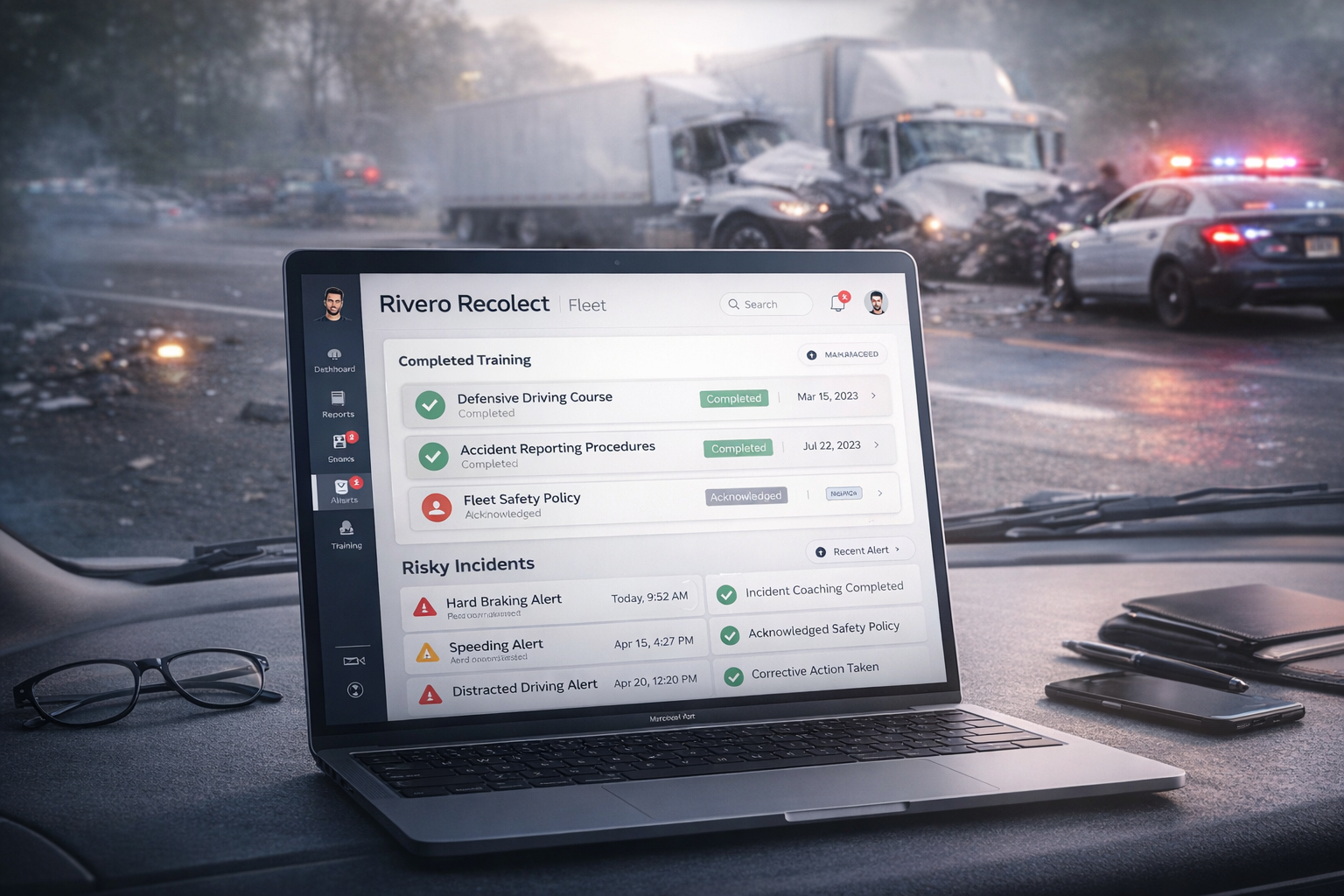
A vehicle collision usually starts as an operations issue.
Then it becomes a claims issue.
And very quickly, it becomes a documentation issue.
Because once the lawyers, adjusters, underwriters, or auditors get involved, the conversation shifts. They are no longer focused only on what the driver did in that moment. They want to know what the employer did before the crash to prevent it – and what the employer can prove.1 2
That is why documented driver safety training matters. Not because it sounds responsible. Because in the real world, records help show whether a company had control of its safety program, responded to risk, and followed through when warning signs appeared.
Why this matters more than many fleets realize
Every fleet says safety is a priority. That part is easy.
The harder question is whether the company can produce a clean record trail showing:
- what drivers were trained on,
- when they were trained,
- whether policies were acknowledged,
- whether risky behavior triggered follow-up,
- and whether the company responded consistently.2 3 4
That record trail can matter a great deal after a crash.
Nationwide says driver training should happen at hire and at least annually thereafter, and it explicitly notes that proof of training may be valuable in defending allegations of negligence in accident litigation.3 That is a very important sentence. It tells you documented training is not just a learning issue. It can become part of the company’s legal defense.
Zurich makes a similar point from the liability side. Its risk guidance discusses negligent hiring, negligent retention, and negligent entrustment claims, and recommends periodic driver safety training, regular MVR checks, employee acknowledgements, and documented follow-through.5 In plain English: if a plaintiff argues your company failed to manage driver risk responsibly, your records may become part of the evidence.
Insurance carriers care about this too
Insurers do not want safety theater. They want signs of control.
Travelers says a formal fleet safety program helps protect against liability from vehicle accidents and calls ongoing screening, testing, inspection, and training essential.2 That language matters. A carrier is telling you that a real program is more than a policy manual and a few course completions.
This also connects directly to cost. Travelers notes that vehicle accidents are among the most costly injury claims for businesses, with an average cost of loss related to vehicle accidents of about $70,000.6 NHTSA cites NETS data showing motor vehicle crashes cost employers $72.2 billion in 2018.7
So when a fleet keeps poor records, the exposure is not theoretical. Crashes hit margin through claims, legal cost, lost productivity, renewal pressure, and reputational damage.6 7
A one-time course will not carry much weight
This is where many organizations get lulled into a false sense of security.
They assign training once, collect completions, and assume the box has been checked. But that does not reflect how driver risk actually works. Experienced drivers drift. Habits creep in. Telematics alerts pile up. Supervisors get busy. Coaching gets delayed. Then a crash happens.
OSHA’s guidance points to ongoing fleet safety practices, including training for new drivers, annual refreshers, and regular safety talks.1 FMCSA’s safety audit framework is built around reviewing records to verify that basic safety management controls are in place.4 If your documentation is scattered, inconsistent, or thin, you may have a safety program in spirit but not in a form that holds up under scrutiny.
That is the real issue. When the pressure is on, fragmented records are almost as bad as missing ones.
What strong documentation actually looks like
A strong training trail should tell a simple, credible story, like this:
- The company set expectations.3
- The driver was trained.1 3
- The company maintained required qualification and safety records.4
- Risk signals were monitored.5
- Follow-up happened when needed.3 5
That is what gives the record value.
For FMCSA-regulated carriers, some of this is mandatory. FMCSA says motor carriers must maintain a qualification file for each employed driver, and its Safety Audit process is specifically designed to verify safety management controls through review of records.4 That does not mean every fleet has the same documentation burden. It does mean recordkeeping is already part of the operating environment for many fleets.
The bottom line
When a collision turns into a claim, “we train our drivers” is a weak statement.
A documented record showing what was assigned, what was completed, what policies were acknowledged, what risk signals appeared, and how the company responded is much stronger.2 3 5
That kind of documentation helps fleets do three things at once:
- improve defensibility after a crash,
- show insurers and partners that safety is actively managed,
- and support a more disciplined, lower-cost risk program over time.2 3 5 6
For fleet executives, this is not paperwork for paperwork’s sake.
It is part of how you protect the business when something goes wrong.
References
- OSHA, NHTSA, NETS. Guidelines for Employers to Reduce Motor Vehicle Crashes.
https://www.osha.gov/sites/default/files/publications/MOTOR_VEHICLE_GUIDE.pdf
- Travelers. 8 Elements of a Fleet Safety Program.
https://www.travelers.com/resources/business-topics/driver-fleet-safety/8-elements-of-a-fleet-safety-program
- Nationwide. Driver Training Best Practices.
https://www.nationwide.com/business/risk-management/services-resources/resource-library/articles/driver-training-best-practices
- FMCSA. Driver Qualification File and Safety Audits (385.309, 385.311).
Link 1
Link 2
- Zurich North America. Prevent claims of negligence at your dealership.
https://www.zurichna.com/knowledge/articles/2025/02/prevent-claims-of-negligence-at-your-dealership
- Travelers. Safe Drivers for Your Business.
https://www.travelers.com/resources/business-topics/driver-fleet-safety/safe-drivers-for-your-business
- NHTSA. Countermeasures That Work: Other Strategies.
https://www.nhtsa.gov/book/countermeasures-that-work/seat-belts-and-child-restraints/countermeasures/other-strategies-1
 Learner Login