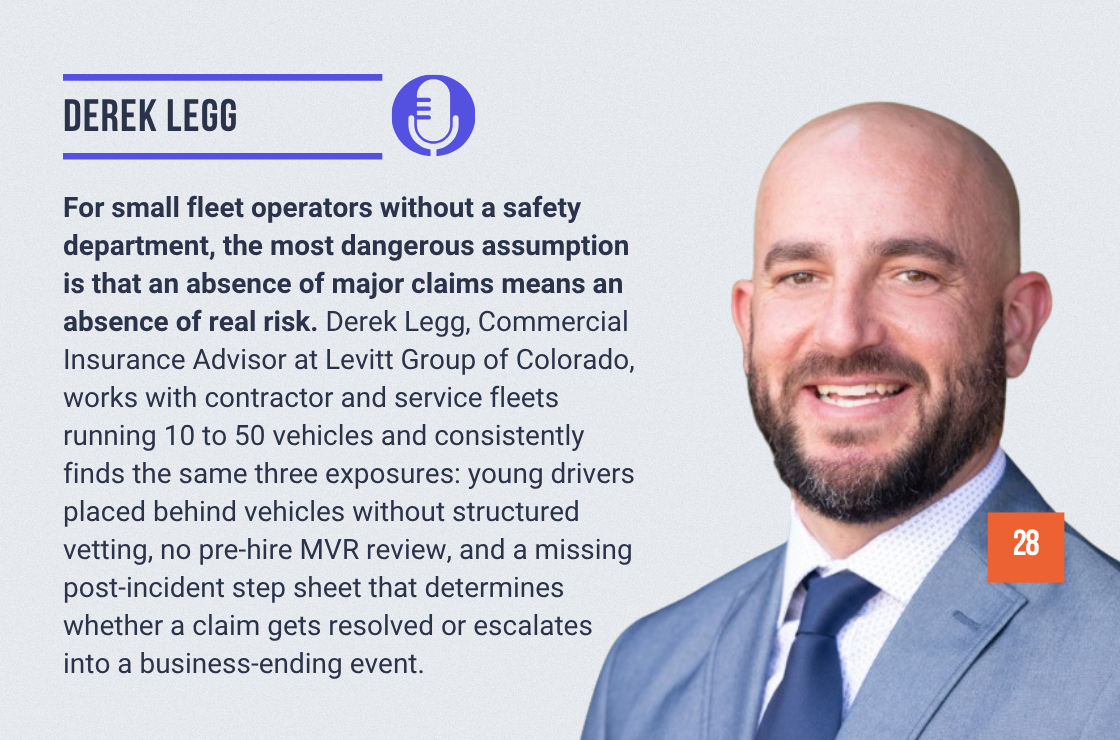
Derek Legg is a Commercial Insurance Advisor at Levitt Group of Colorado, specializing in high-exposure industries including contractors, landscapers, electrical services, towing companies, and service fleets running 10 to 50 vehicles. His work focuses on helping operators manage risk, stay insurable, and avoid catastrophic loss. A former competitive sports coach, Derek brings a team-accountability lens to fleet risk conversations. He works alongside a dedicated risk management specialist, giving clients hands-on support that goes beyond policy placement.
Derek Legg is a Commercial Insurance Advisor at Levitt Group of Colorado. He works with contractor and service fleets on risk management, insurability, and the practical steps that keep small operators protected when the unexpected hits.
Here’s a glimpse of what you’ll learn:
- [02:13] The young driver problem contractors consistently underestimate
- [03:53] Why cell phone distraction is under-coached in small fleets
- [04:34] How vehicle maintenance affects carrier decisions on premiums
- [06:46] A real claim situation and what it taught Derek about documentation
- [07:18] Applying sports coaching principles to driver accountability
- [09:23] Why smaller fleets resist telematics and what changes their minds
- [12:39] Nuclear verdicts and why they are no longer just a big-fleet problem
- [19:01] Three things every 10-truck fleet must fix this year
- [20:53] The MVR gap: most contractors hire first and check driving records later
- [22:55] What the future of commercial auto risk actually looks like
In this episode…
Small fleet operators are living in a risk environment that most of them do not fully understand. A contractor with 10 trucks is not managing a scaled-down version of an enterprise fleet program. They are running a business where a single accident, a single bad hire, or a single lapse in maintenance protocol can trigger a claim large enough to shut them down. Yet most of them are hiring without checking MVRs, skipping post-incident documentation, and relying on informal driver coaching that never gets past “be careful out there.”
Derek Legg advises commercial clients across these exact industries at Levitt Group of Colorado. He sees the same vulnerabilities repeated across accounts: young drivers placed behind company vehicles without a real vetting process, cell phone distraction that is talked about in casual conversation but never trained against, and maintenance issues that quietly stack up into carrier red flags. His approach draws from years of sports coaching and translates directly into how he talks to clients about team accountability and culture.
In this Roadrageous episode, Derek breaks down the specific exposures that small fleets overlook, explains why cameras and telematics are protection tools first and surveillance tools last, and lays out the three practical fixes every contractor fleet needs to make this year. The conversation is direct, operational, and built for the fleet owners who are making these decisions without a dedicated safety department behind them.
The Young Driver Problem Nobody Is Solving
Hiring is hard. For contractors, it has become even harder. When a landscaping company or electrical contractor needs drivers, they often take who they can get, and who they can get is frequently younger, less experienced, and carrying a driving history that insurance carriers find uncomfortable.
Derek is direct: carriers get nervous around young drivers, and they have data to back it up. The owner sees a motivated 20-year-old who shows up and works hard. The carrier sees actuarial exposure. “They’re fired up to do their job,” Derek says. “But you still have to put that person behind a vehicle and drive for you.” The issue is not the worker. The issue is whether the fleet has a structured approach to onboarding that driver into safe behavior, or whether they just hand over keys and hope for the best.
Three Blind Spots That Make Small Fleets a Liability
Cell phone distraction is the first gap Derek identifies. Most drivers know they should not be on their phones. Few have ever sat through a training session that made the consequences feel real. When every employee is one pocket away from their screen all day, the habit carries directly into the cab.
Maintenance protocols are the second. Derek sees fleets where drivers notice vehicle issues but have no clear reporting system. Carriers track towing incidents and deferred maintenance as underwriting signals. A pattern of neglect raises premiums before a single major claim occurs.
Post-incident documentation is the third. Derek recommends a step sheet: a simple document in every vehicle that tells any driver exactly what to record and report in the 30 minutes after an incident. Without it, claims get muddied, fault disputes drag on, and settlements climb. “The more information we can provide throughout that process, the better,” he says.
Know Before You Hire: The MVR Gap
Most contractors interview, offer the job, and only then check the driver’s Motor Vehicle Record. By that point, the candidate has mentally started the role, and sending someone away because of a colorful driving history creates friction the owner tries to avoid.
Derek pushes for a different sequence: make MVR review part of the conditional offer, not a post-hire formality. His team has encountered cases where a record check revealed a license already under suspension. “We actually have run into that before,” he says. Once the hire is made and something happens, the operator cannot demonstrate due diligence and the liability exposure grows significantly.
Cameras Are Protection, Not Surveillance
Resistance to dashcams is common in smaller fleets, usually centered on cost and privacy. Derek leads with the practical argument: one incident captured on camera can determine a claim outcome that would otherwise become a costly dispute. He is currently working a case where the other party is claiming fault and the camera footage will resolve it. Without footage, the commercial operator often loses by default.
The carrier incentive gap is real. Derek acknowledges that premium discounts for telematics adoption are not yet meaningful for small operators. But the math shifts entirely after one nuclear verdict, which are no longer limited to large, well-known companies.
Quotable Moments:
- “It takes one vehicle one time to really put you in a bad situation for your business.”
- “I’m going to go to bat for my clients. That’s who I represent.”
- “If you go hire them and then we find out their MVR is quite colorful, then we have an issue.”
- “You can have all the coaching you want, but if that person doesn’t have the discipline to follow through with it, it doesn’t matter.”
- “Those 20 percent usually have a bigger impact than the 80 percent going in the right direction.”
- “The more information we can provide throughout that process, the better.”
- “Hopefully education. I would love to see more education in the industry.”
- “It’s a brain struggle for me, but I’m sure I’ll get there at some point.” (on AI)
Action Steps:
- Run MVR checks before the hire is final. Make driving record review a condition of the offer. A colorful MVR discovered after onboarding creates a problem with no clean resolution.
- Build a post-incident step sheet. A simple card in every vehicle telling drivers what to document in the first 30 minutes after an accident. Documentation quality determines claim outcomes.
- Train specifically on cell phone distraction. Casual reminders are not training. Build a structured session that makes the consequences real, with specific policies and consistent reinforcement.
- Establish a maintenance communication loop. Give drivers a clear, frictionless way to report vehicle issues. Deferred maintenance shows up in claims data and affects carrier underwriting.
- Install cameras before you need them. Waiting until after a claim to invest in telematics means you have already paid the price for not having the footage.
- Talk to drivers about the business stakes. Most frontline employees do not understand how one incident affects premiums and business continuity. Make it real.
- Review umbrella coverage with your broker. Commercial auto limits that feel adequate today may not be adequate if a verdict goes against you. Umbrella policies exist to cover exactly that gap.
- Partner with a broker who brings risk management support. The right advisor adds expertise in claim navigation, driver vetting, and safety protocols that small operators cannot access on their own.
Key Takeaways:
- Young drivers are a material underwriting risk, even when they are excellent workers
- Cell phone distraction and deferred maintenance are the two most under-addressed fleet exposures in the contractor space
- MVR checks must happen before the hire is made, not after
- A post-incident step sheet is among the cheapest and most effective risk tools a small fleet can deploy
- Cameras and telematics protect drivers first, and discipline is a distant secondary use case
- Nuclear verdicts are no longer a large-fleet-only problem; branded vehicles are targets
- Team buy-in and consistent leadership behavior change fleet culture more durably than policy documents
- Education, not just premium increases, is what will move the commercial auto insurance market
Conclusion
Derek Legg is not talking to fleet managers at Fortune 500 companies. He is talking to the landscaping contractor with 12 trucks, the electrical service company with young drivers rotating in and out, and the towing operation that has never had a post-incident protocol because nothing bad has happened yet. His message: the absence of a major claim does not mean the risk is absent.
The steps he outlines do not require a dedicated safety department or a large budget. They require an operator willing to build a few simple systems and a broker who asks the right questions before a claim forces those conversations.
For small fleet operators looking to stay insurable in a tightening market, Derek’s experience offers a realistic and actionable starting point.
Resources mentioned in this episode:
About Derek Legg
Derek Legg is a Commercial Insurance Advisor at Levitt Group of Colorado, where he focuses on high-exposure commercial accounts across the contractor, service fleet, and trades industries. His work centers on helping operators understand their actual risk profile, stay ahead of carrier requirements, and build the internal protocols that keep their businesses insurable.
Before joining Levitt Group, Derek came to the insurance industry through a family connection during a relocation from Oregon to Colorado. His background in sports coaching, particularly baseball, shapes how he approaches driver accountability, team culture, and the leadership conversations that actually change fleet behavior. He works alongside David Mobier, Levitt Group’s dedicated risk management specialist, to bring clients support that goes well beyond standard policy placement.
Derek’s approach is direct and client-first. He believes that small fleet operators deserve the same quality of risk guidance that larger companies take for granted, and that the right advisor can make the difference between a recoverable claim and a business-ending event.
Sponsor for this episode:
This episode is brought to you by IMPROVLearning. At IMPROVLearning, we transform driver education through research-backed training methods. Our SPIDER Driver Training platform builds hazard recognition and decision-making skills that complement fleet technology investments.
For small and mid-size fleets without dedicated safety departments, SPIDER provides structured training that directly addresses the exposures Derek identifies: distracted driving, cell phone use, and in-cab decision-making under pressure. Technology catches what drivers do. Training changes what they decide to do.
Learn more at improvlearning.com.
 Learner Login