How small risks become normal behind the wheel, and what employers can do about it
Most risky driving does not begin with a driver making some dramatic, reckless choice.
It usually starts smaller.
A driver follows a little too closely because traffic is moving fast.
They glance at a phone because the message seems quick.
They roll through a familiar turn because they have made it hundreds of times before.
They drive a few miles per hour over the limit because the schedule is tight and the last stop took too long.
Then nothing happens.
No crash.
No ticket.
No call from a supervisor.
No immediate consequence.
So the brain learns a quiet lesson: That was fine.
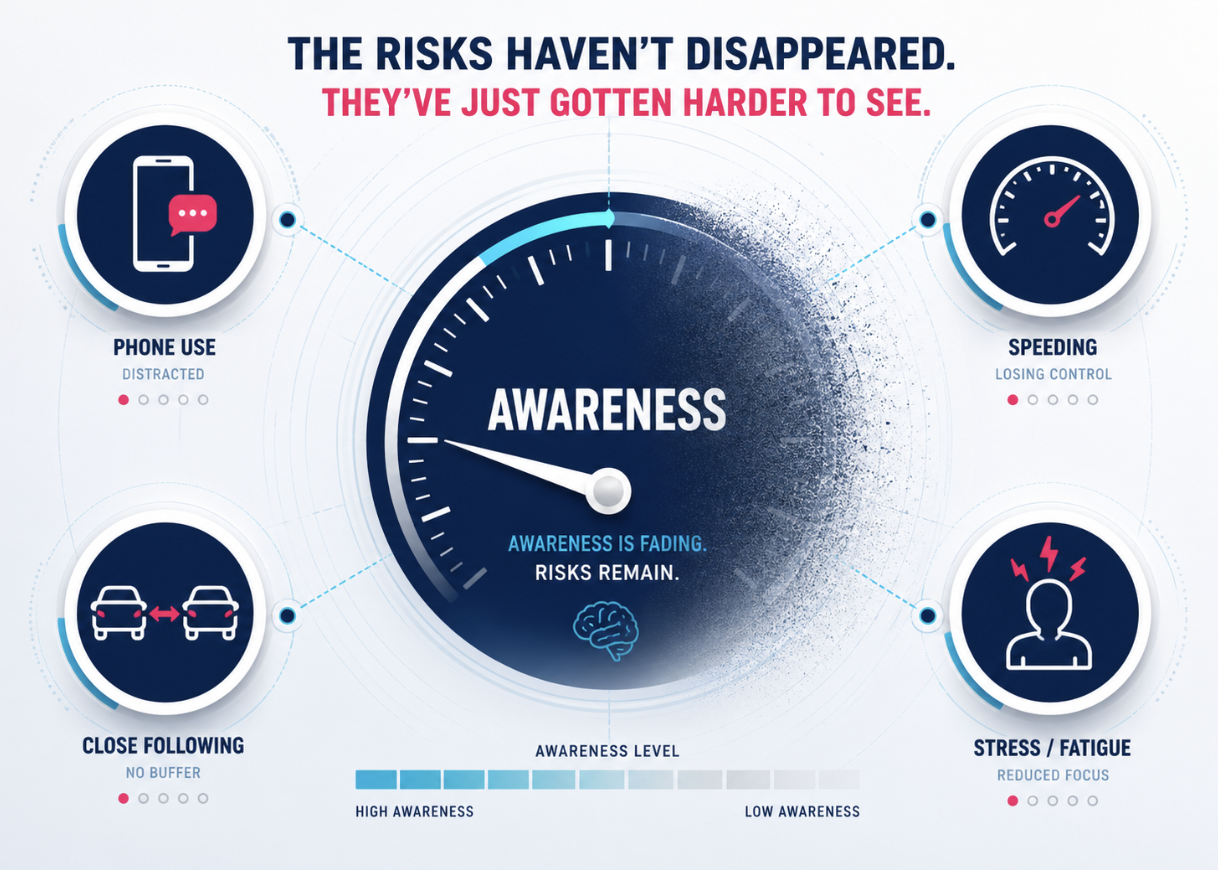
This is one of the most important and often overlooked problems in fleet safety. Risky driving is rarely just about whether a driver knows the rules. Most professional drivers already know that speed increases crash severity, distraction reduces reaction time, and close following leaves less room to recover. NHTSA has long identified these as major traffic safety risk factors.¹
The harder problem is what happens after a driver takes a small risk and gets away with it.
Over time, the behavior can start to feel ordinary. The driver may feel experienced, efficient, and in control.
That is where risk begins to hide.
The slow drift of risk perception
Human beings are very good at adapting to repeated experiences. That can be useful. It helps drivers recognize patterns, anticipate traffic flow, and make quick decisions.
But the same adaptive system can also make risk feel smaller than it really is.
When a driver repeats an unsafe behavior without immediate consequences, the perceived danger fades. Speeding becomes “making up time.” A quick glance at the phone becomes “staying responsive.” A short following distance becomes “keeping pace with traffic.”
This is not always conscious defiance. More often, it is normalization.
The AAA Foundation’s research shows a gap between what drivers know is risky and what they still do behind the wheel.³
Instead of asking only, “Did the driver know the rule?” it is more useful to ask, “What made this behavior feel acceptable in the moment?”
Experience can sharpen skill and soften caution
Experience is valuable. Drivers understand routes, vehicles, and traffic patterns.
But experience can also create a false sense of predictability.
A familiar road can feel safer simply because it is familiar. A routine stop can feel easier because it has been done before.
Research shows familiar routes can reduce attention and active scanning.⁴
Many commercial risks happen in ordinary places: the same warehouse entrance, delivery zone, or turn.
A pedestrian appears.
A vehicle stops short.
A loading area is blocked.
A customer walks behind the van.
A driver ahead hesitates.
The driver may still have the ability to respond. The question is whether attention is fully engaged before the surprise happens.
Pressure makes shortcuts more tempting
Fleet drivers do not operate in ideal conditions.
They manage traffic, schedules, customer expectations, fatigue, and stress.
Under that load, the brain looks for shortcuts.
The driver may speed because they feel behind.
They may follow closely because traffic feels aggressive.
They may check a message to keep the day moving.
They may rush a maneuver because the next task is already pulling attention.
Research connects cognitive workload and reduced driving performance.⁵
Unsafe driving is often situational. The same driver can perform differently depending on pressure and workload.
That does not excuse the behavior. It explains where prevention must begin.
Why reminders alone have limited power
Many safety programs rely on information delivery.
Here is the policy.
Here is the rule.
Here is the training.
Here is the acknowledgment.
These matter. But information has limits once behavior becomes familiar.
If a driver’s experience says, “I’ve done this many times and nothing happened,” another reminder may not interrupt the pattern.
That is the gap between awareness and behavior.
Behavior-based training works in that gap by helping drivers recognize when judgment starts to shift.
What behavior-focused training should help drivers see
- Small choices and serious outcomes: minor actions reduce recovery margin
- Routine and reduced attention: familiarity lowers awareness
- Pressure and risk tolerance: stress makes shortcuts feel reasonable
- Confidence and blind spots: experience can mask changing conditions
This shifts coaching from blame to awareness: Here is the pattern. Here is when it shows up. Here is how to catch it earlier.
Refresher training keeps the risk gauge calibrated
Training does not stop at onboarding.
Habits change. Workload changes. Risk perception shifts.
Refresher training helps reset awareness and prevent complacency.
OSHA highlights the importance of ongoing driver safety training and communication.² ⁶
What employers can do
- Train around real behavior patterns, not just policies
- Use refreshers before problems escalate
- Make coaching specific and actionable
- Connect habits to business outcomes
- Encourage driver self-reflection
At IMPROVLearning, this approach focuses on why unsafe habits form and how risk perception shifts over time.
Because safer driving starts long before a crash.
References
- NHTSA – Countermeasures That Work
- OSHA – Guidelines for Employers to Reduce Motor Vehicle Crashes
- AAA Foundation – Traffic Safety Culture Index
- Route familiarity breeds inattention
- Driver workload and performance research
- OSHA – Motor Vehicle Safety: Employers
 Learner Login