“Safety comes first.” It is one of the most familiar promises in fleet operations. But that promise is tested when safety conflicts with deadlines, delivery targets, customer expectations, and productivity metrics.
A driver may be told to slow down when conditions demand it but know that doing so could mean missing a delivery window or falling behind schedule. No one has to explicitly tell the driver to take a risk. The surrounding conditions send that message. Research into occupational driver safety points to the influence of organizational factors such as safety values, supervisory practices, role overload, and the consequences attached to different behaviors.
Newnam, Lewis, and Watson’s research uses the A–B–C framework: antecedents, behavior, and consequences, to examine how those conditions shape safe driving. This creates a more useful question for fleet leaders: What is happening around the driver that makes one decision easier than another?
The message
Most organizations do not set out to create unsafe driving conditions. They put safety policies in place, offer training, monitor how employees perform, and say that safety comes first. The challenge is that employees notice organizational priorities in more ways than just official statements.
Research on occupational driver safety has found that safety values, how supervisors act, job demands, and social interactions all play a role in workplace safety. Newnam, Lewis, and Watson used an A-B-C framework; antecedents, behavior, and consequences, to study occupational driving. They looked at how the way organizations share safety information affects safe driving. Their research highlights an important point: safety must be felt as a real priority when it competes with other demands, not just stated as one. For example, a driver might be told, “Take the time you need to be safe,” but still feel pressure to “make up those ten minutes.” The official message is about safety, but in practice, productivity may take priority.
The pressure
Newnam and colleagues looked at role overload, which is how time, training, and resources affect a person’s ability to meet job demands. Their research showed that role overload influenced the link between supervisors’ safety values and how safety information is shared. This is important because driving often involves juggling several goals at once. There is the delivery window, traffic, dispatch, and customer expectations. The driver has to balance all of these while on the road.
The researchers point out that safety often competes with pressures like speed and productivity. When these pressures clash, it is not just about whether the driver knows what is safe. It is about what the system allows them to do. If risky behavior keeps happening even after coaching, maybe the organization should look at the conditions around the behavior instead of assuming the driver did not understand.
The consequence
Behavior is shaped by consequences, including those the organization did not mean to create. Weatherly and Malott reviewed research on organizational behavior management and found that workplace performance is often influenced by consequences that are delayed instead of happening right after the behavior. This matters for fleet safety.
For example, if a driver slows down because of bad weather, the safety benefit is avoiding a crash, but the immediate result might be arriving late. These consequences do not happen at the same time. The long-term benefit of safety can be at odds with the immediate pressure to be productive. This does not mean the organization wants unsafe driving. It means the environment can unintentionally make one choice seem more important than another.
The signals
Supervisors and dispatchers are part of this environment. Drivers learn what the organization values by what happens after they make a decision. If a driver reports a hazard, takes extra time for safety, or stops instead of pushing through a dangerous situation, the response matters. Support sends one message; pressure sends another. Recognition sends one message; silence sends another.
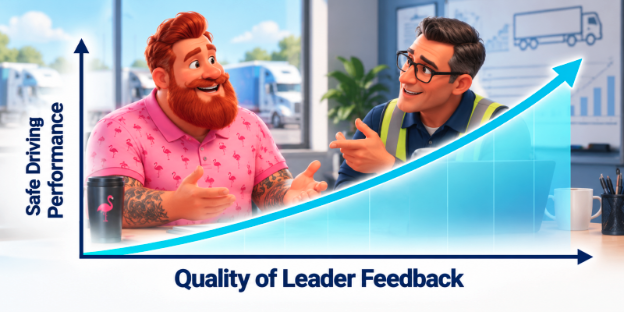
Newnam and colleagues say that “recognition and feedback are among the most powerful incentives within the workplace” and that these signals affect how employees see the importance of safety versus productivity. Their study also found that sharing safety information was tied to the quality of the supervisor-driver relationship, which was linked to safe driving. Communication is not just about giving safety instructions. It is part of the environment that helps drivers feel supported in making safe choices.
The test
Telling people what to do is not enough for a safety program to work. We also need to think about what happens when someone tries to follow those instructions. For example:
- If a driver is told to slow down in tough conditions, the environment should make it possible to do so.
- If drivers are encouraged to report fatigue, they should feel confident that reporting it will not cause new problems.
- When drivers hear that safety comes first, they should see that message backed up by the choices made by dispatchers, supervisors, and performance systems.
At this point, the focus shifts from just the individual to the bigger picture. Support the person. Look at the system. Improve the conditions.
The shift
In real-world driving, there will always be competing demands, delays, and tough decisions. The goal is not to remove every pressure drivers face, but to make sure that when pressures come up, the safe choice is not the hardest one to make.
For IMPROVLearning, this is key to creating learning that lasts. Understanding behavior means paying attention to what happens in the moment, talking about why decisions are made, and adjusting the learning environment so people can use what they have learned when it matters most.
 Learner Login