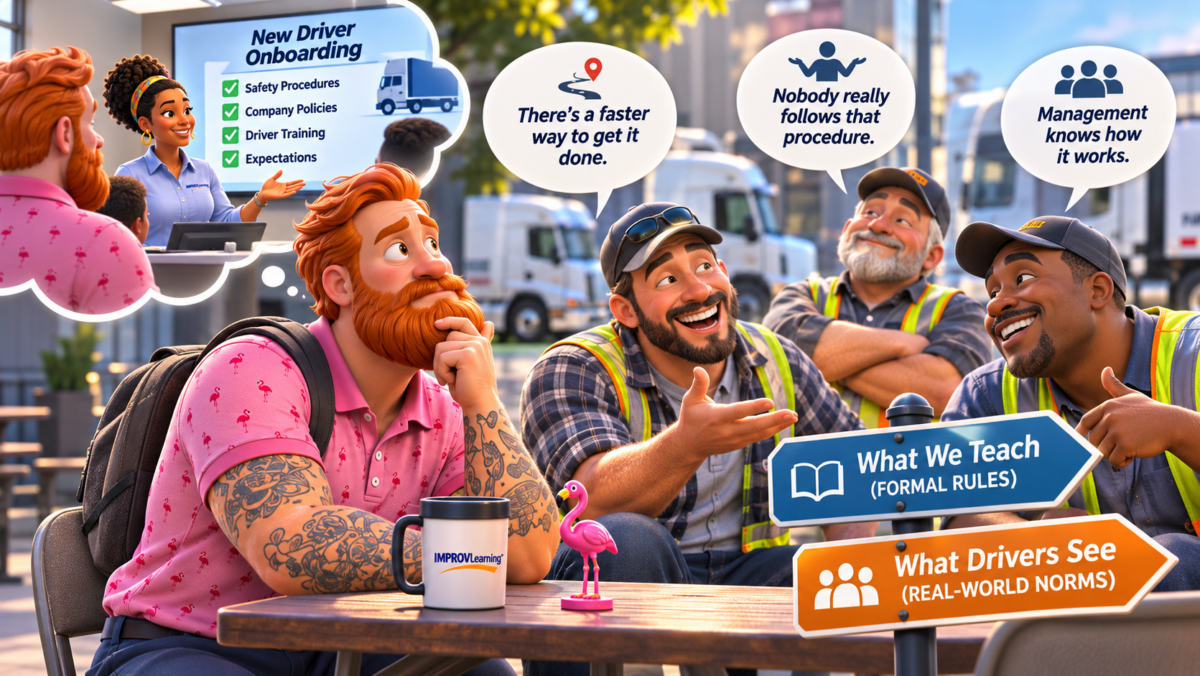
A new driver starts their first week at a trucking company. They’ve finished onboarding, reviewed safety policies, and passed the required training. They know the rules, understand what’s expected, and are ready to put their knowledge into practice. Then they meet the experienced drivers.
One jokes that nobody really follows a certain procedure. Another shares a shortcut that makes deliveries easier. A third mentions that management knows how things work and doesn’t make a fuss. No one directly tells the new driver to ignore their training. There’s no meeting where the rules are changed. Still, something important is being taught. The most influential safety instructor in a fleet might not be the person leading the training. It could be the colleague sitting next to a new driver.
The unwritten rules people learn from each other
Human behavior is shaped by more than just personal knowledge or formal instructions. We also look to others to figure out what’s normal, acceptable, and expected. In psychology, these are called social norms. Two types are especially important for workplace safety. Injunctive norms are about what people believe others approve or disapprove of.
Descriptive norms are about what people see others actually doing. In a fleet, this might mean the safety manual says drivers must follow certain procedures, but experienced colleagues often take shortcuts without any consequences. One message says what should happen. The other shows what actually happens. When these messages don’t match, employees may feel pressure to choose which to follow.
Research shows this difference matters for driving behavior. In their systematic review, The Relationship between Norms and Risky Driving Behavior, Siti Hawa Harith and Norashikin Mahmud looked at 27 studies out of 3,443 records. They found strong links between risky driving and several types of norms, including group, moral, injunctive, and descriptive norms. Results for subjective norms were mixed. The behaviors studied included speeding, dangerous overtaking, using mobile phones, tailgating, and other traffic violations. Even though the review covered different driving groups and mostly cross-sectional studies, its findings give fleet leaders an important insight: people’s driving decisions are shaped not just by what they know, but also by the behaviors and expectations of those around them.
The culture employees see can compete with the culture leaders describe
Imagine a fleet director announces a renewed focus on safe driving. The company updates its policies, offers training, and reminds employees that safety comes before productivity. But during a busy week, a supervisor praises a driver for finishing a tough delivery schedule without asking how it was done. Another employee raises concerns about an unrealistic timeline and gets little support. Meanwhile, drivers who take shortcuts are still celebrated for getting the job done. The company may truly value safety, but its daily actions might send a different message.
This is where social norms become especially important. People don’t always need direct permission to pick up a behavior. They learn what’s acceptable by seeing which actions are recognized, which are challenged, and which are ignored. Over time, these observations shape how employees understand expectations. For fleet leaders, this is a challenge that can’t be solved by policy alone. A company can teach the right procedures, but if employees keep seeing conflicting behavior, the lessons from training may compete with what’s reinforced at work.
The opposite is also true. When experienced drivers show safe practices, supervisors respond constructively to concerns, and employees see colleagues making responsible choices, those actions help set positive expectations. Social influence isn’t always a safety problem. It can also be part of the solution.
Safety training doesn’t end when employees return to work
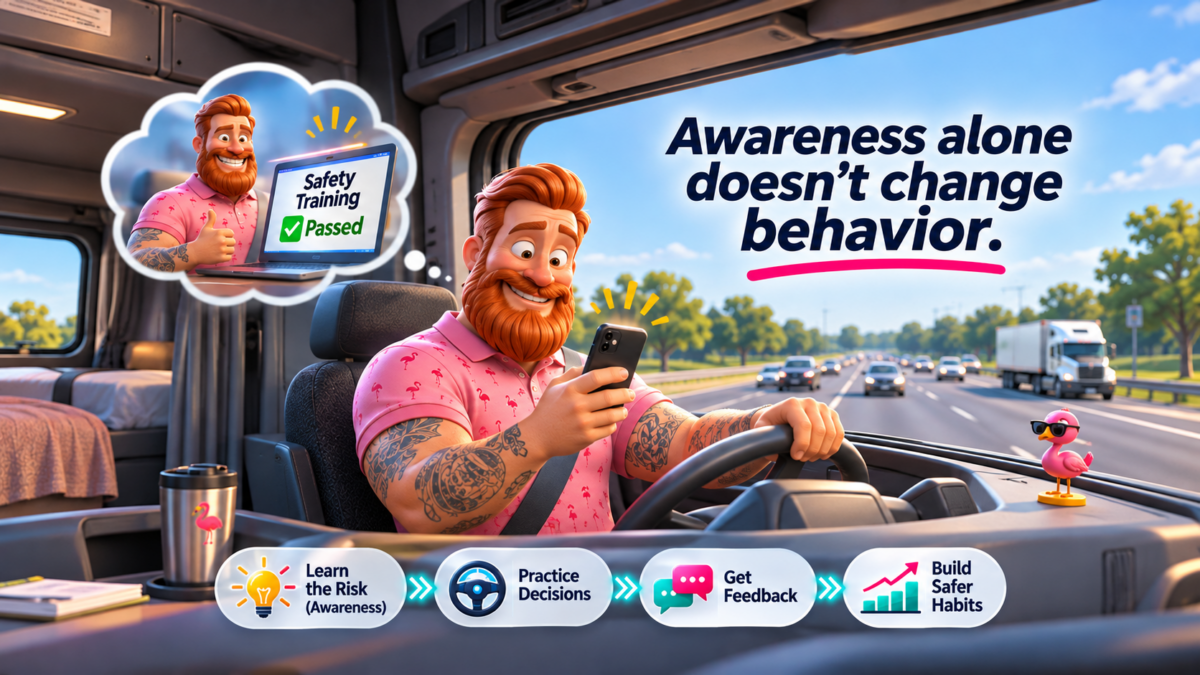
One takeaway from the research is that safety education shouldn’t be seen as a one-time event. A driver might spend an hour learning about safe following distances, but the habits built over hundreds of hours on the road may have a bigger impact on what feels normal. This doesn’t mean formal training isn’t important. It means organizations should think about what happens after the course ends.
For example, experienced drivers who mentor new employees can reinforce the same principles taught during onboarding. Supervisors can use everyday conversations to explain why a safety decision matters, not just whether a rule was followed. Leaders can also look at the informal messages their organizations send. Are drivers comfortable saying that a delivery schedule creates too much pressure? Are employees recognized for making responsible choices, even if those choices cause delays? Do experienced team members show the practices the company wants newcomers to learn? These questions reveal things that completion reports can’t fully capture.
At IMPROVLearning, we believe education is most meaningful when people can connect what they learn to the decisions they make in real situations. That connection grows stronger when the workplace supports the same behaviors. It also takes adaptability. A driver who feels pressure to take an unsafe shortcut needs more than just knowledge of the rule. They need the judgment, confidence, and support from the organization to make the right choice.
Everyone is teaching someone something
The systematic review highlights the link between social norms and risky driving, but its findings shouldn’t be taken as proof that peer behavior causes every unsafe decision. Driving behavior is shaped by many factors, and the studies mostly looked at associations, not direct causes. Still, the research encourages fleet leaders to think about an important part of safety culture.
Every organization has formal training. It also has informal teachers. These are the experienced employees who explain how things work, the supervisors whose reactions set expectations, and the colleagues whose daily choices shape what others see as normal. Some reinforce the safety message. Others may unintentionally weaken it. For leaders, the challenge is making sure the behaviors employees see match the behaviors the organization wants them to follow. Because a new driver doesn’t just learn from the training they complete. They also learn from what everyone else is doing.
Reference
Harith, S. H., & Mahmud, N. (2020). The Relationship between Norms and Risky Driving Behavior: A Systematic Review. Iranian journal of public health, 49(2), 211–220.
 Learner Login
 Contact Support