A fleet can have a comprehensive safety manual, advanced telematics, and years of driver training records. But when a serious crash leads to litigation, the questions become more difficult.
- Did the company recognize warning signs before the accident? Did supervisors respond to unsafe driving behavior?
- Was training relevant to the driver’s actual risks? And can the organization demonstrate that its efforts made a difference?
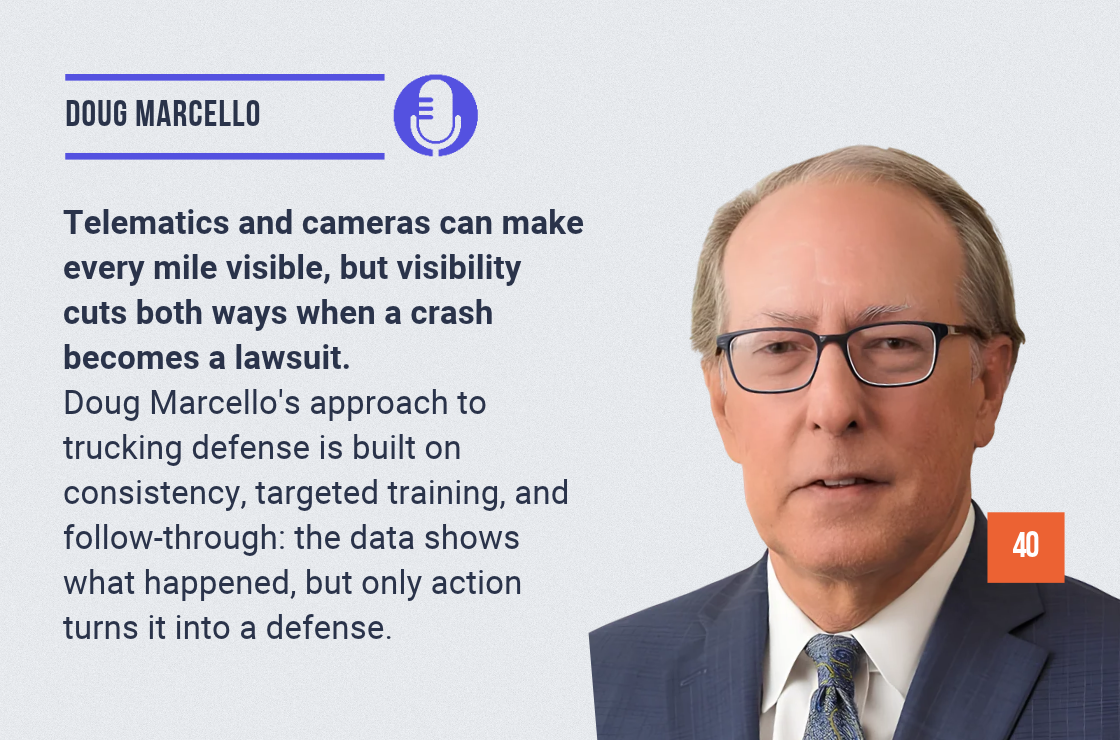
These questions sit at the center of a conversation between RoadRageous host Chad Lindholm and Doug Marcello, a trucking defense attorney at Saxton & Stump. With more than four decades of litigation experience and a commercial driver’s license, Marcello understands both the legal challenges facing trucking companies and the practical realities of commercial driving.
Their conversation explores nuclear verdicts, safety data, driver training, insurance pressures, and the role of technology in managing fleet risk. But the central argument goes beyond preparing for litigation. It is about why the decisions organizations make before an accident can determine whether their safety practices stand up to scrutiny afterward.
Here’s a glimpse of what you’ll learn
- 04:28 — Understanding nuclear verdict detonators: Why hours-of-service violations, cellphone use, fatigue, and systemic safety failures can influence trucking litigation.
- 05:45 — The importance of hiring, training, and supervision: How these three areas shape a company’s ability to demonstrate responsible risk management.
- 09:16 — The discovery fallacy: Why avoiding the examination of available safety data does not necessarily protect a fleet from legal exposure.
- 11:49 — Turning coaching into defensible evidence: How documented interventions and demonstrated driver improvement can change the story presented in court.
- 12:47 — Managing overwhelming amounts of safety data: Doug’s four-step approach to identifying, analyzing, prioritizing, and acting on information.
- 16:37 — Preparing before an accident happens: Why today’s hiring, training, and supervision decisions can become tomorrow’s evidence.
- 19:03 — Moving beyond safety slogans: Why a company’s safety culture must be demonstrated through consistent practices.
- 21:52 — Understanding litigation’s impact on insurance: How verdicts, settlements, and rising insurance pressures affect commercial trucking operations.
- 27:53 — Responding to a serious crash: Why immediate accident response and evidence preservation are essential.
- 29:44 — The hidden risks in safety manuals: How policies that are not consistently followed can become evidence against an organization.
- 35:59 — Recognizing technology’s limitations: Why safety culture, driver focus, and awareness remain essential.
- 38:28 — Avoiding the biggest safety data mistake: Why failing to act on available information creates unnecessary risk.
When an accident raises questions about the company
A serious trucking accident might start with a single moment on the road, but the legal consequences can last much longer. Marcello points out that plaintiffs’ attorneys often look into the company’s decisions before the crash. They review how the driver was hired, what training was given, whether supervisors noticed ongoing risks, and how management handled those issues. He calls certain situations “detonators,” meaning factors that can lead to especially large jury verdicts.
Based on research from the American Transportation Research Institute, he highlights hours-of-service violations, cellphone use, and fatigue as key concerns. Still, the bigger issue is not always a single driver’s error. The real question is whether that mistake points to a wider problem with the company’s safety practices. An accident might be understandable on its own. But if there is a pattern of ignored warnings, poor supervision, or unaddressed driver behavior, the company faces a much tougher challenge.
For fleet leaders, this changes how they should view safety performance. Hiring, training, and supervision are not just paperwork. They show whether the company recognizes risks and takes steps to manage them. Marcello notes that fleets cannot expect every driver to have a perfect record. What matters is finding possible weaknesses, fixing them with training, and keeping an eye on performance. He compares this to coaching professional athletes.
Even experienced people need feedback, practice, and chances to get better. The goal is not just to have a qualified driver on file. It is to have a driver whose actions show the value of the company’s safety efforts.
Safety data can protect a fleet or reveal what it missed
With telematics, dash cameras, and electronic vehicle systems, trucking litigation has changed. Information that used to be hard to get can now show details about speed, braking, driving habits, and what happened during an accident. Marcello says this can help fleets. Objective data can challenge false accounts or show that a driver was not at fault. But the same data can also show if a company ignored repeated warnings about unsafe behavior.
This is where Marcello talks about the “discovery fallacy.” Some companies think that not looking at risky information will protect them in court. Marcello disagrees, saying that data can still be found, whether management reviewed it or not. He advises companies to understand their data, spot risks, and keep records of taking action.
For example, imagine two fleets get repeated speeding alerts. The first just records them. The second spots the pattern, coaches the driver, documents the steps, and checks for improvement. If a serious accident happens later, both fleets have similar technology, but their records show very different approaches to risk.
Marcello says the key is showing that the driver improved after coaching. This also shows why just finishing training is not enough. A record of training shows participation, but proof of better driving shows if the training worked. As fleets gather more data, the challenge grows.
Marcello suggests a simple process: know what information you have, analyze what matters, focus on the most important risks, and enforce safety standards. AI can help sort and prioritize data, but it cannot replace the need to make decisions and act. A dashboard can show a problem, but it cannot prove the company fixed it.
Safety culture must go beyond the policy manual
Fleet safety programs often include detailed policies, training rules, and statements about the company’s commitment to safety. These set expectations. But Marcello warns that problems arise if the company does not follow its own rules. In court, a written policy can be compared to what actually happened.
A safety manual offers little protection if its rules are often ignored. Marcello urges fleets to review their policies, understand why each rule exists, and make sure they are ready to enforce them. The goal is not to drop important standards, but to build a safety program that matches real practices, not just good intentions.
As he says, “It’s what you live. It’s not what you say.” Consistency is crucial because safety can slip when attention fades. A serious incident might lead to more training and stricter rules, but if those efforts stop after a few months, the risks remain. Marcello compares trucking risk to hurricane season. Companies cannot predict exactly when a major event will happen, so they must stay prepared every day. This affects how training is done. Marcello suggests shorter, more frequent training sessions instead of only long annual programs. He mentions that mock juries liked regular training.
Beyond legal issues, this raises a key question: how can companies help drivers remember information, use it under pressure, and build safer habits over time? One training session can set an expectation, but real improvement needs ongoing attention, feedback, and chances to show skill. Safety culture is real when these practices are part of daily operations, not just words on paper.
The business impact goes beyond the courtroom
The discussion also looks at how lawsuits affect trucking insurance. Marcello talks about the pressure from big verdicts and rising settlements, noting that some companies and insurers may choose higher settlements instead of risking a trial. These pressures can affect insurance costs and which risks insurers will accept. For fleet operators, showing strong safety management is more important than ever.
Marcello encourages companies to be ready to show insurers both their safety programs and the results. Better crash records, regular driver coaching, documented actions, and measurable improvements help give a fuller picture of the operation. He warns that these steps do not guarantee lower premiums, but they can help companies make a stronger case for how they handle risk.
The discussion also stresses the value of working with insurance partners early, not just at renewal time. Another key point is accident response. Marcello stresses the need to save important data quickly and make sure qualified safety, risk, and legal experts are ready to act. Delays can mean losing evidence that could explain what happened. Still, even a good accident response cannot make up for years of weak safety practices. The best preparation is the work done before an incident.
Action steps for fleet and safety leaders
The conversation offers several practical ways organizations can evaluate whether their safety programs are creating meaningful protection.
- Examine hiring standards and driver qualifications. Understand the reasons behind the organization’s requirements and identify areas where individual drivers may need additional support or supervision.
- Connect training to specific risks. Use available performance information to identify behaviors that require attention and provide instruction relevant to those concerns.
- Document interventions and verify improvement. Record what action was taken and monitor whether the driver demonstrates sustained changes in performance.
- Make safety data manageable. Identify the information available, prioritize the most relevant risks, and establish clear responsibility for reviewing and acting on findings.
- Review safety policies regularly. Ensure written requirements remain relevant, practical, and consistently enforced across the organization.
- Prepare for accidents before they happen. Establish response procedures, preserve evidence appropriately, and coordinate responsibilities among safety, risk, and legal professionals.
- Build an ongoing relationship with insurance partners. Use documented safety performance and operational improvements to support discussions about risk and coverage.
Key takeaways
- The strongest defense begins before an accident. Hiring, training, supervision, and corrective action establish how an organization manages risk.
- Safety data creates responsibility. Information is most valuable when it helps fleets recognize problems and take meaningful action.
- Training must demonstrate improvement. Completion records matter, but evidence of changed driver behavior can provide a stronger picture of effectiveness.
- Safety culture requires consistency. Policies and slogans cannot substitute for practices that are followed and reinforced.
- Technology supports, but does not replace, human judgment. Fleets still need people who can interpret information, coach drivers, and make responsible decisions.
- -Preparation has business value. Proactive safety management can support litigation defense, insurance discussions, and efforts to reduce preventable losses.
Conclusion: Evidence is created every day
A fleet may not know when a routine trip will become a legal case. But it can choose how seriously it handles risks in daily operations. Every coaching session, every documented action, and every decision to fix a problem adds to the company’s safety record.
Marcello sums up this responsibility with a memorable line: “What you do today is evidence. What you do after the accident is backfill.” This idea goes beyond legal issues. A fleet should not wait for a court to find out if its training works, if its policies are followed, or if supervisors address unsafe behavior.
These questions should already be part of how the company checks itself. In the end, the best proof of a safety culture is not how many policies are written or how much data is collected. It is what the company actually did when it had the chance to make someone safer.
Resources and topics mentioned
- Saxton & Stump: Doug Marcello’s law firm, where he focuses on trucking and commercial transportation litigation.
- American Transportation Research Institute (ATRI): Research discussed in relation to nuclear verdicts and trucking operating costs.
- Federal Motor Carrier Safety Administration (FMCSA): Regulatory oversight, driver qualifications, and commercial transportation safety.
- Telematics and forward-facing cameras: Technologies that can provide objective evidence, identify unsafe driving patterns, and support accident investigations.
- Insurance captives and commercial auto insurance: Risk-sharing arrangements and underwriting considerations discussed in the episode.
- Transport Center: Doug Marcello’s transportation-related commentary and video resources.
About Doug Marcello
Doug Marcello is a trucking defense attorney at Saxton & Stump with more than four decades of experience representing trucking companies and commercial transportation organizations. He has practiced in jurisdictions across the United States and holds a commercial driver’s license, providing him with firsthand familiarity with commercial driving.
His work focuses on trucking litigation, accident response, risk management, and the role of effective safety practices in defending transportation organizations.
About RoadRageous
RoadRageous explores safer driving, smarter training, and bold ideas across the fleet industry. Hosted by Chad Lindholm, the podcast features conversations with industry innovators and thought leaders on fleet safety, driver training, risk management, and the people behind better outcomes.
 Learner Login
 Contact Support