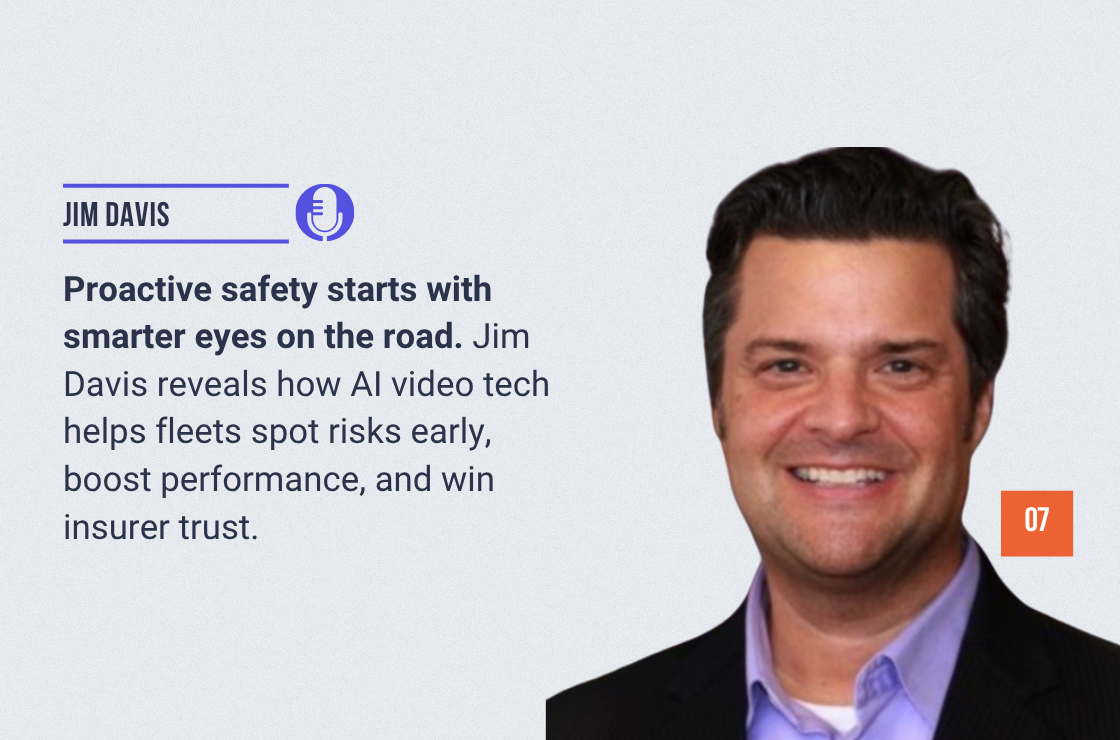
Jim Davis is the Vice President of Insurance and Risk Management at Waylens Inc., a company dedicated to advancing fleet safety through innovative AI video technology. In his role, he focuses on insurtech innovation and developing strategic partnerships within the insurance industry. Under Jim‘s leadership, Waylens has launched a predictive safety platform that integrates AI-powered video telematics with risk intelligence, enabling fleets to proactively manage driver safety.
Here’s a glimpse of what you’ll learn:
- [3:45] Jim Davis shares how a market crash led him from finance to the insurance industry
- [6:56] Balancing sales and innovation while waiting for tech to catch up
- [9:34] How Waylens integrates AI-powered video with Geotab’s telematics platform
- [12:30] The danger of collecting driver data without taking corrective action
- [15:15] Addressing driver resistance to in-cab cameras and how to build trust
- [20:22] The five core behaviors driving 60-70% of fleet claim costs
- [30:51] Why scalable, timely driver training must adapt to real-world fleet schedules
- [36:56] How fleets can use technology investments to earn insurance savings
- [40:29] Using historical telematics data to predict and prevent high-risk driver behavior
In this episode…
The road to safer fleets is paved with data. But are fleets actually using it to its full potential? As AI and telematics systems flood managers with real-time driver behavior and risk signals, the real challenge is no longer data collection but action. What does it take to truly “close the loop” on safety and turn insight into meaningful, measurable change?
According to Jim Davis, a seasoned leader in insurtech and fleet risk management, closing the loop starts at the edge — right in the vehicle. He highlights how AI-powered cameras can now detect risky behaviors like phone use or unsafe following distances in real-time and trigger customized responses, reducing the need for manual coaching. The result is a proactive safety model that prevents crashes before they happen. This shift not only reduces liability and improves driver performance but also empowers fleets to better align with insurers.
In this episode of Roadrageous, hosts Liam Hoch and Chad Lindholm sit down with Jim Davis, Vice President of Insurance and Risk Management at Waylens Inc., to talk about real-time risk mitigation at the edge. They explore how AI cameras drive down claims, why inaction on data can increase liability, and the critical role of automation in fleet safety. Jim also shares how fleets can gain insurers’ trust and unlock long-term ROI.
Quotable Moments:
- “If you want to terrify an insurance company, tell them you’re collecting data and not acting.”
- “Drivers want to be safe, but they may not have the skills to understand what they need.”
- “We’re bringing behavioral change to the organization. You got to get buy-in above. You got to get it buy-in below.”
- “Don’t buy a camera. Don’t buy a driver-facing camera. Just buy a forward-looking camera.”
- “Everybody in this industry has been battle-scarred by those early years of trying to get customers.”
Action Steps:
- “Close the loop” on driver feedback: Ensuring that data leads to coaching and measurable improvement reduces liability and improves safety.
- Integrate AI video with telematics platforms: Unifying risk data in one interface streamlines fleet operations and enhances real-time decision-making.
- “Don’t buy a camera. Don’t buy a driver-facing camera. Just buy a forward-looking camera.”
- Customize coaching thresholds: Tailoring alerts and actions to specific risk levels empowers managers and drivers with proactive mitigation.
- Engage insurance partners early: Collaborating with insurers and brokers builds trust and increases the likelihood of premium savings.
- Automate training delivery: Offering timely, engaging micro-learning enables drivers to absorb safety lessons when they are most relevant.
Navigating Fleet Safety with AI and Innovative Technology
In a recent episode of Roadrageous, hosts Liam Hoch and Chad Lindholm welcomed Jim Davis, VP of Insurance and Risk Management at Waylens, to discuss the evolving landscape of fleet safety. The conversation centered on the role of technology, particularly AI and video solutions, in mitigating risk and improving driver behavior.
The Evolution of Fleet Safety Technology
Jim Davis shared his extensive experience in the industry, tracing the development of fleet safety technology from early video systems using VCR tapes to today’s sophisticated AI-driven solutions. He emphasized the significant advancements that have enabled more effective data analysis and proactive safety management.
Key Discussion Points:
- AI-Powered Solutions: Davis highlighted the capabilities of Waylens’s AI video solutions, which can identify various driving behaviors, including unsafe following distance, lane changes, speeding, and cell phone use. He explained how integrating these solutions with telematics platforms like Geotab provides a comprehensive view of driver behavior and risk.
- Data Management and Actionability: A core theme of the discussion was the challenge of managing the vast amount of data generated by fleet safety systems. Davis stressed the importance of turning data into actionable insights, emphasizing the potential liability of collecting data without using it to improve driver behavior.
- Driver Acceptance and Privacy: The podcast addressed the issue of driver acceptance of camera technology. Davis discussed strategies for implementing camera systems in a way that respects driver privacy while still promoting safety, such as using hybrid systems that record behavior without continuously recording video.
- The Importance of Training: The conversation underscored the critical role of driver training in conjunction with technology. Davis highlighted the need for engaging and accessible training programs that can be delivered remotely and tailored to individual driver needs. IMPROVLearning’s training methods were mentioned as an example of engaging and effective training.
- Insurance Industry Perspectives: Davis provided insights into the relationship between fleet safety and insurance. He discussed the challenges of demonstrating the ROI of safety technology to insurers and the importance of data sharing and collaboration between fleets, brokers, and underwriters.
- Addressing Distracted Driving: A significant portion of the discussion focused on the dangers of distracted driving, particularly due to cell phone use. Davis and the hosts emphasized the cognitive impairment associated with cell phone use while driving and the need for technology and training to address this issue.
The Future of Fleet Safety
The episode concluded with a discussion about the future of fleet safety, with a focus on the continued advancement of AI and the potential for greater automation in risk management.
Conclusion:
Ultimately, the Roadrageous podcast episode emphasized that enhancing fleet safety requires a holistic approach. It’s not solely about deploying the latest technology, but also about effectively managing data, prioritizing driver training, and fostering collaboration across the industry. By strategically integrating these elements, fleets can significantly reduce risk, improve driver behavior, and create safer roads for everyone.
Resources mentioned in this episode:
Sponsor for this episode:
This episode is brought to you by IMPROVLearning.
At IMPROVLearning, we’re dedicated to transforming driver education through innovative, research-backed training methods.
Our SPIDER™ Driver Training platform combines humor with proven brain-training techniques to help drivers anticipate and avoid potential dangers on the road.
With over four million students trained, we know that learning sticks best when it’s engaging, short, and actively tested — resulting in fewer crashes, violations, and safer drivers overall.
To learn more about how IMPROVLearning makes roads safer one driver at a time, visit improvlearning.com.
 Learner Login