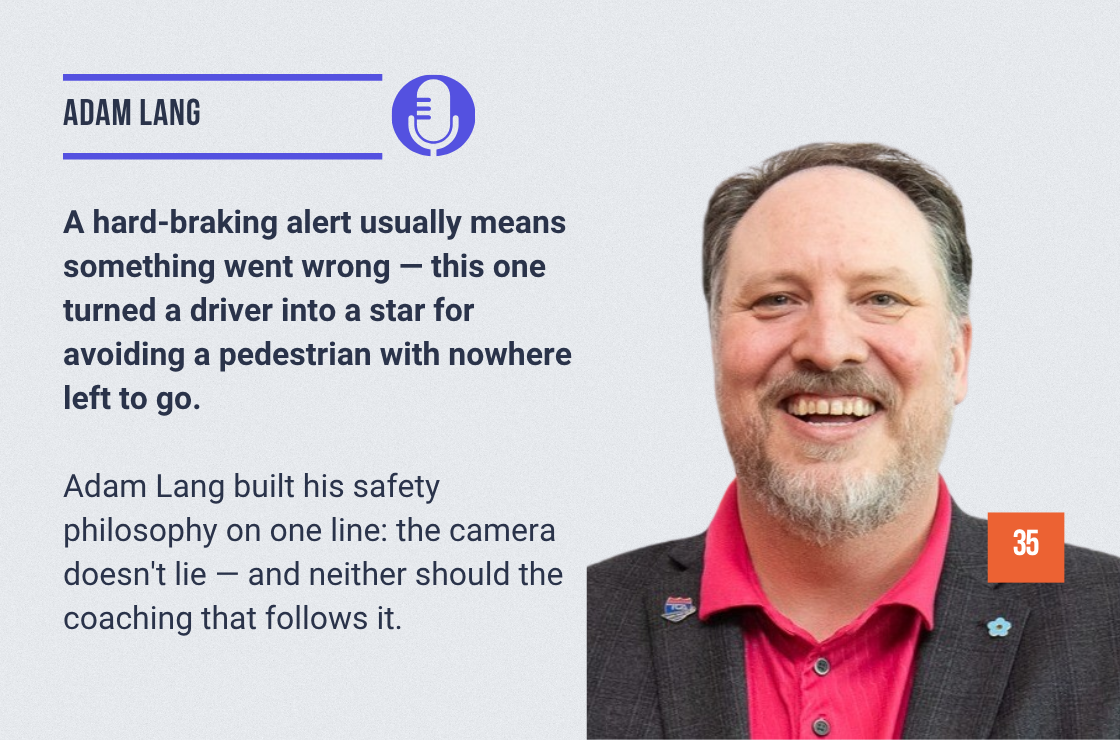
Adam Lang is the Director of Customer Advisory Services at Netradyne. He spent over a decade in the fleet industry, including significant time at Halvor Lines, where he helped lead the organization through growth from roughly 275 trucks to more than 750 while maintaining a strong safety culture and a driver-first philosophy. Today he works with fleets across North America, helping them use AI, video intelligence, and positive coaching to improve safety outcomes and operational performance.
Adam Lang is Director of Customer Advisory Services at Netradyne with over a decade of experience in fleet safety, video telematics, and driver coaching. He specializes in helping fleets move from reactive, gotcha-style safety enforcement to a proactive, data-driven coaching culture.
Here’s a glimpse of what you’ll learn:
- [1:14] How Adam got into fleet management, completely by accident
- [4:33] Scaling Halvor Lines from 275 to 750 trucks without losing the culture
- [8:36] The Paul O’Neill story: how Alcoa learned that safety investment makes money
- [14:01] Why near misses are the widening base of Heinrich’s triangle
- [18:14] Why cameras only tell part of the story until you add prediction
- [24:29] The exoneration case that changed the argument for camera adoption
- [29:48] How AI is changing what a safety team can realistically review
- [37:02] Positive coaching versus the gotcha culture, and why it’s harder in practice
- [46:05] The hard brake that became a driver star
- [51:34] Rapid fire: the most underrated safety metric, AI hype versus reality, and one wish for every fleet
In this episode…
Most fleet safety systems are built to catch what went wrong. Adam Lang has spent his career arguing that the harder, more valuable skill is recognizing when a red flag is actually a green one.
As Director of Customer Advisory Services at Netradyne, and before that a safety leader who scaled Halvor Lines from 275 to more than 750 trucks, Adam has watched fleet safety move from a system that measured the absence of bad outcomes to one that uses AI and video to catch risk before it becomes a claim.
His core belief: a hard brake, a camera alert, or a piece of AI-flagged data is only as useful as the judgment applied to it afterward.
In this Roadrageous episode, Adam breaks down how camera adoption evolved from resisted to embraced, why positive, specific coaching beats gotcha-style enforcement, how Netradyne’s AI processes risk in real time, and the story of a hard-braking alert that could have looked like a mistake and turned out to be exactly the opposite.
Quotable Moments:
- “The camera doesn’t lie. It shows what it shows. And if it’s good facts or bad facts, you own it.”
- “Investing in safety is not only the right thing to do morally and ethically, but it makes money.”
- “Human beings have this perception that they notice the negative very quickly over the positive. That’s not by accident, that’s by design.”
- “Don’t shine them. Don’t say you’re a good driver. Tell them why they’re a good driver.”
- “You can’t put that toothpaste back in the tube.”
- “What’s better if we could move to zero accidents as an industry?”
- “AI hype or AI reality? Reality, 100%, and it’s only going to accelerate.”
- “We need to be more respectful of the space and the situation that professional drivers are in.”
Action Steps:
- Build a review process that separates a bad outcome from a bad decision. A hard brake that avoids a collision deserves recognition, not a penalty.
- Use specific, behavior-based praise instead of generic praise. Tell drivers exactly what they did right, not just that they’re doing well.
- Treat near misses as leading indicators, not noise. Coaching on following distance, hard turns, and speeding before an incident happens is cheaper than coaching after one.
- Give drivers a transparent way to see their own standing and dispute alerts they believe are wrong, rather than letting frustration build silently.
- Don’t let AI replace human review entirely, especially around accidents and incidents. Use it to cut down the volume, then apply judgment to what’s left.
- Invest in safety even when the return isn’t immediately visible. The payoff shows up in culture, retention, and reduced claims over time, not in a single line item.
An Accidental Career
Adam Lang didn’t plan on trucking. He was in a completely different industry when a friend, a local HR recruiter, mentioned an opening for director of human resources at a trucking company. He interviewed, liked the people, and made the jump in 2012. He’s been in the industry ever since.
At Halvor Lines, based in Superior, Wisconsin, Adam helped the company grow from roughly 275 trucks to more than 750 over about a decade, adding an acquisition, a mixed fleet of company drivers and owner-operators, and eventually its own driver training school around the start of the COVID pandemic.
“More people equals more personalities can equal more problems, right? So we had to scale up appropriately in the various departments.”
Growth meant more driver trainers, more standardization, and more miles on the road, which meant more exposure. That exposure is what eventually pushed the company toward video.
The Paul O’Neill Lesson
Adam traces a lot of his safety philosophy back to a story he heard at a Minnesota Trucking Association meeting, about Paul O’Neill, who took over Alcoa in the early 1980s. O’Neill immediately began investing heavily in worker safety, and the company’s board, publicly traded and profit-focused, wasn’t initially on board with the spending.
“Over time, they quickly realized that investing in safety is not only the right thing to do morally and ethically, but it makes money.”
Adam is careful to note the return isn’t always immediate. A new piece of equipment shows up on a balance sheet right away. A safety culture takes years of root-cause analysis, coaching, and repetition before the numbers move.
“We’re businesses to make money, but there’s a right way to do that.”
From Word Versus Word to Video Evidence
Before cameras, fleet safety measured absence: no accidents, no tickets, no violations equaled safety. When something did happen, the narrative belonged to whoever told it best, often a police officer working from limited information, sometimes an articulate attorney shaping the story before the driver had a chance to explain.
Adam’s fleet joined the camera adoption wave in 2018, a timeline he considers late. He still sees pockets of resistance industry-wide, some of it a fair concern about driver privacy.
“The exoneration aspect, the camera doesn’t lie. It shows what it shows. And if it’s good facts or bad facts, you own it. Most of the time it’s good facts, because our drivers are professionals.”
Systems like the one Adam now works with at Netradyne compute on the edge, meaning the alert fires at the moment of the event rather than after a human reviews footage later. That design choice is what makes real-time coaching, and real-time exoneration, possible.
Gamification adds another layer. Drivers can see their own score, the fleet average, and the fleet goal, without knowing exactly who ranks where.
“They can pop it open and say, oh, I’m number 45 out of 2000. What can I do to get to number 40?”
AI as Supplement, Not Replacement
The volume of data a modern fleet generates, hours of service, CSA scores, fuel compliance, camera alerts, has made manual review impractical. Adam sees AI as the tool that makes the volume manageable, not a replacement for judgment.
“AI can help analyze huge amounts of data and process it quicker than a human can, that’s math. It’s up to us to interpret it.”
He’s candid that the systems aren’t perfect, and that they improve because customers push back on individual alerts. If a U-turn alert fires for a vehicle that was actually pulling into a parking lot, that correction feeds back into the system, benefiting every fleet using it, not just the one that flagged it. Drivers also have a formal dispute process for alerts they believe are wrong, something Adam didn’t have earlier in his career, when he’d informally ask a former driver on his team to review anonymized footage instead.
The Hard Brake That Became a Driver Star
Adam tells one story that captures his entire coaching philosophy. A hard-braking alert came through on a routine afternoon, the kind of alert that usually means something went wrong. Minutes later, a shaken driver trainer called from a truck stop.
The footage showed a driver cruising a few miles under the speed limit on a major freeway with clean following distance, doing everything right, when a pedestrian bolted across all lanes with no warning. The driver stood up on the brakes. He couldn’t merge left, the lane was occupied. He couldn’t take the ditch without losing the truck. He had one option, and he took it.
“You had no other alternative than to do that… he stood up on the brakes and he avoided colliding with a pedestrian.”
Adam converted the alert from a negative mark into a driver star, the system’s way of adding a positive to a driver’s record. He told the shaken trainee to rest at the truck stop, then get back on the road, because the instinct that just avoided a collision was exactly the instinct they wanted reinforced, not second-guessed.
Coaching Without the Gotcha
Adam is direct about why positive coaching is harder in practice than everyone agrees with it in theory.
“Human beings have this perception that they notice the negative very quickly over the positive. That’s not by accident, that’s by design.”
His fix is specificity. Vague praise doesn’t stick.
“Don’t shine them. Don’t say you’re a good driver. Tell them why they’re a good driver.”
None of that removes accountability. If a driver won’t acknowledge a mistake even with the video in front of them, Adam treats that as a different, more serious conversation.
“You can’t put that toothpaste back in the tube.”
Rapid Fire
Most underrated safety metric:
“Safety metrics which surround harsh handling, hard turns and hard acceleration, aggressive driving. The attitude drives the truck.”
One leadership trait every safety professional needs:
“Empathy. Come from a place of love. If your heart’s not in it, go do something else.”
AI hype or AI reality:
“Reality, 100%, and it’s only going to accelerate.”
One thing every fleet should do tomorrow to improve safety:
“We need to be more respectful of the space and the situation that professional drivers are in… keep off the phones.”
Key Takeaways
- A hard brake, or any safety alert, needs context before it’s judged. The same data point can represent a mistake or the exact opposite.
- Camera and video systems shifted fleet safety from word-versus-word disputes to evidence, benefiting drivers as often as it flags them.
- Investing in safety doesn’t always show an immediate return, but it compounds into a more productive, more retained workforce over time.
- Positive coaching requires specificity. Generic praise doesn’t change behavior the way naming the exact right decision does.
- AI’s value in fleet safety is processing volume, not replacing judgment. Human review still matters most around accidents and disputes.
- Growth without losing safety culture requires scaling every supporting department, not just adding trucks and drivers.
Conclusion
Adam Lang’s core message is that a data point is only as good as the judgment applied to it. A hard brake can be a warning sign or a driver star, a camera can convict or exonerate, and an AI alert can be noise or a leading indicator, depending on whether anyone stops to ask what actually happened. Building that judgment into a fleet’s culture, not just its technology, is the harder and more durable work.
Resources mentioned in this episode:
About Adam Lang
Adam Lang is the Director of Customer Advisory Services at Netradyne. He spent over a decade in the fleet industry, including significant time at Halvor Lines, where he helped lead growth from roughly 275 to more than 750 trucks while maintaining a strong safety culture and a driver-first philosophy. He now works with fleets across North America on AI, video intelligence, and positive coaching strategy.
Sponsor for this episode:
This episode is brought to you by IMPROVLearning. To learn more, visit improvlearning.com.
 Learner Login