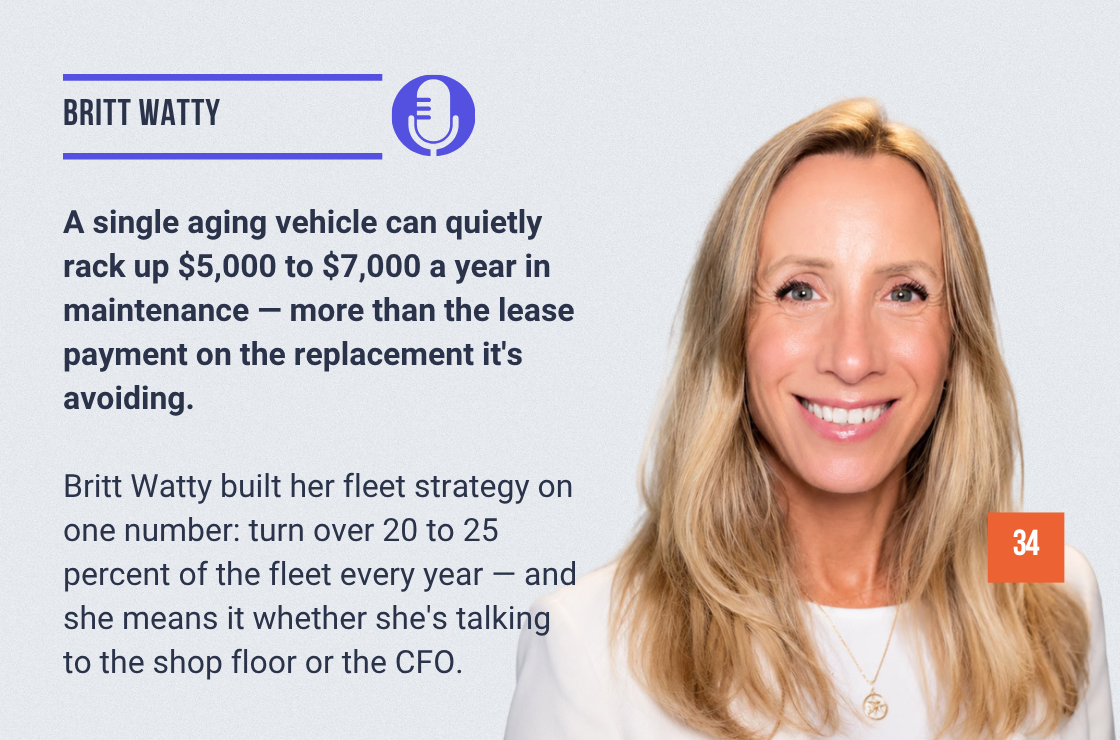
Britt Watty is a fleet strategist at Emkay Fleet Management and a longtime advocate for women in fleet leadership. Over roughly 20 years in the industry, she has helped organizations move from reactive, budget-driven vehicle replacement to a proactive, data-driven lifecycle strategy.
Here’s a glimpse of what you’ll learn:
- [1:18] How Britt got into fleet management, completely by accident
- [2:27] Walking into rooms at 26 in a male-dominated industry
- [8:43] The COVID hangover: how a reasonable short-term decision became a long-term problem
- [12:16] The number everyone compares to zero, and why that comparison is incomplete
- [14:42] The case for turning over 20 to 25 percent of the fleet every year
- [18:39] Right sizing versus right typing, and the mismatch hiding in most fleets
- [24:59] The four metrics that reveal almost everything about a fleet’s health
- [37:43] Resale value: the most overlooked line item in fleet management
- [43:55] Rapid fire: the biggest mistake, the most common myth, and one piece of advice for every fleet manager
In this episode…
Most fleet replacement conversations start with the wrong comparison. Organizations look at the vehicle payment and measure it against zero, because that’s what they assume a paid-off or aging vehicle costs them. It’s not zero. It never was.
Britt Watty has spent about 20 years helping fleets find the real number. She has watched the same pattern play out across industries: a decision that made sense during the COVID-era vehicle shortage quietly became the default years after the pressure was gone.
Her number: fleets that turn over 20 to 25 percent of their vehicles every year keep costs predictable. Fleets that don’t are usually still living in what she calls the COVID hangover.
In this RoadRageous episode, Britt breaks down why the vehicle payment is the wrong number to manage against, what a proactive replacement strategy looks like, the difference between right-sizing and right-typing a fleet, and the four data points that tell her almost everything she needs to know about a fleet’s health.
Quotable Moments:
- “How is this young blonde girl going to tell me what to do with my trucks?”
- “It’s kind of this lingering financial and operational consequence of decisions that felt reasonable in the moment, but have quietly become the real problem.”
- “The math doesn’t lie. It’s just that not everybody knows how to do the math.”
- “It’s the difference between managing your fleet and letting the fleet manage you.”
- “Cost per mile is the most honest measure of fleet efficiency.”
- “Letting the budget drive timing instead of the data. The vehicle doesn’t care what your fiscal year looks like.”
- “Stop managing your fleet reactively and start managing it strategically… I want fleet managers to manage the fleet like it matters because it does.”
Action Steps:
- Run the full cost comparison, not just the payment. Add fuel, maintenance, downtime, and lost resale on the current vehicle, then compare it to the full cost of a replacement.
- Build a replacement policy and treat it as a portfolio, not a once-a-year budget conversation.
- Aim to turn over roughly 20 to 25 percent of the fleet every year to keep age, maintenance cost, and resale value predictable.
- Audit for mismatch, not just headcount. Look for vehicles that are over-spec’d, under-spec’d, or underutilized.
- Track four numbers: cost per mile, utilization data, lifecycle cost, and maintenance cost by model year.
- Sell at the right time. Gas vehicles generally should exit before 100,000 miles, diesel around 125,000 to 150,000, with Q1 typically drawing the strongest buyer pool.
- Speak finance’s language: cost per mile, total cost of ownership, and year-over-year maintenance trends, not a single purchase request.
An Accidental Career, Earned the Hard Way
Britt Watty didn’t plan on a career in fleet. She was a business marketing major who ended up in retail sales in her twenties. An opportunity opened up internally to move into the fleet management division of the same company, and something clicked. She made the jump and never looked back.
She was 26 the first time she walked into a room to talk trucks with a client, in an industry that was, and in many ways still is, male-dominated.
“You know, how is this young blonde girl going to tell me what to do with my trucks?”
She learned the language, drivetrains, gas versus diesel, upfitting and spec requirements, because she refused to walk into a room and not be taken seriously. She sees diversity of thought as a business argument as much as a fairness one: different lived experiences and communication styles lead to better decisions, and fleet, at its core, is a relationship business.
The COVID Hangover
When the COVID pandemic hit, the automotive supply chain shut down. Fleets that were ready to replace vehicles couldn’t, and the vehicles that were available were expensive. So companies held on, ran their vehicles longer, and told themselves they’d catch up once the market stabilized.
For a lot of organizations, that catch-up never came.
“The supply chain eventually recovered, but the replacement backlog didn’t go away. It just kind of became the new normal.”
Years later, those same fleets are running vehicles that are significantly aged and higher mileage than they should be. Watty calls it the COVID hangover.
“It’s kind of this lingering financial and operational consequence of decisions that felt reasonable in the moment, but have quietly become the real problem.”
The Number Everyone Compares to Zero
Extended replacement cycles carry costs that compound quietly: rising maintenance, downtime, driver dissatisfaction and retention risk, and safety exposures from worn brakes, tires, and steering components. Every month a vehicle runs past its optimal lifecycle point, it also loses resale equity.
“Organizations tend to look at one number, the vehicle payment, and compare it to zero, because that’s what they think they’re spending on a paid-off or aging vehicle. That comparison is incomplete.”
The right comparison is total monthly cost of ownership, payment plus fuel plus maintenance plus downtime plus lost resale, against the full cost of a replacement.
“I’ve sat across from clients that are spending five, six, seven thousand dollars a year on maintenance on one vehicle. And a new vehicle might spend five hundred. That gap oftentimes covers the lease payment on a replacement unit.”
“The math doesn’t lie. It’s just that not everybody knows how to do the math.”
Replacement as a Portfolio, Not a Once-a-Year Decision
Watty draws a sharp line between treating replacement as an annual budget exercise, reacting to what’s affordable this year, and treating it as an ongoing strategy: knowing which vehicles are approaching their optimal cycle point, planning orders around model-year pricing, and timing turn-ins to hit the strongest resale windows.
Her benchmark is turning over roughly 20 to 25 percent of the fleet every year.
“It’s what keeps the average age of the fleet in a healthy range. It’s what keeps your operational costs predictable. And it’s what ensures you’re always capturing the appropriate resale value on the trucks you’re turning in.”
“It’s the difference between managing your fleet and letting the fleet manage you.”
Skipping a replacement year happens and is manageable. Skipping it consistently compounds. Three years behind becomes a backlog that a budget, a supply chain, and a finance team can’t absorb all at once, which is exactly how the COVID hangover took hold.
Right Sizing vs. Right Typing
Right-sizing is about quantity: does the fleet have the correct number of vehicles? Right-typing is about fit: is each vehicle the right one for the job? Watty estimates it’s not uncommon to find 15 to 25 percent of a fleet mismatched in some way, over-specced, under-specced, or sitting in the wrong role.
“In this day and age, I’m going to go with right typing. You can have the perfect number of vehicles and still be hemorrhaging money if you don’t have the right vehicle for the right application.”
The Four Metrics That Matter
“Cost per mile is the most honest measure of fleet efficiency, maintenance cost per vehicle by model year, that’s what reveals the aging problem most clearly.”
Cost per mile, utilization data, lifecycle cost, and maintenance cost by model year: Watty says those four numbers tell her almost everything she needs to know about a fleet’s health within the first conversation. Everything else is context.
Resale Value: The Metric Nobody Watches
As a general guideline, a gas vehicle should come out of the fleet before 100,000 miles. Diesel can typically run to around 125,000 to 150,000. Q1 tends to be the strongest resale window, since the buyer pool is largest.
“Don’t sleep on the resale value. Make sure that you’re turning the old ones in at the right time.”
Rapid Fire
Biggest mistake organizations make with replacement cycles:
“Letting the budget drive timing instead of the data. The vehicle doesn’t care what your fiscal year looks like.”
Most common fleet myth:
“That holding a paid off vehicle saves you money. It almost never does. The math doesn’t support it, but the myth persists.”
One piece of advice for every fleet manager:
“Stop managing your fleet reactively and start managing it strategically… I want fleet managers to manage the fleet like it matters because it does.”
Key Takeaways
- Deferred replacement decisions made under pressure tend to quietly become permanent unless actively unwound.
- Comparing a vehicle payment to zero is incomplete. Compare total cost of ownership to the cost of replacement instead.
- Turning over roughly 20 to 25 percent of a fleet annually keeps costs, safety, and resale value predictable.
- Right-sizing and right-typing are both necessary, and often reveal a 15 to 25 percent mismatch when analyzed honestly.
- Cost per mile, utilization data, lifecycle cost, and maintenance cost by model year capture most of what matters about fleet health.
- Resale value is one of the most overlooked levers in fleet cost management.
Conclusion
Britt Watty’s core message is less about vehicles and more about discipline. The COVID hangover didn’t happen because fleets made a bad call in 2020 or 2021. It happened because a reasonable short-term decision never got revisited once the pressure that caused it had passed. Her fix is a standing habit: run the full math, treat replacement as a portfolio, and manage the fleet like it matters, because, as she puts it, it does.
Resources mentioned in this episode:
About Britt Watty
Britt Watty is a fleet strategist at Emkay Fleet Management with about 20 years of experience in the fleet industry. She works with organizations on lifecycle replacement strategy, fleet right-sizing and right-typing, and data-driven cost management, and is a longtime advocate for women in fleet leadership.
Sponsor for this episode:
This episode is brought to you by IMPROVLearning. To learn more, visit improvlearning.com.
 Learner Login