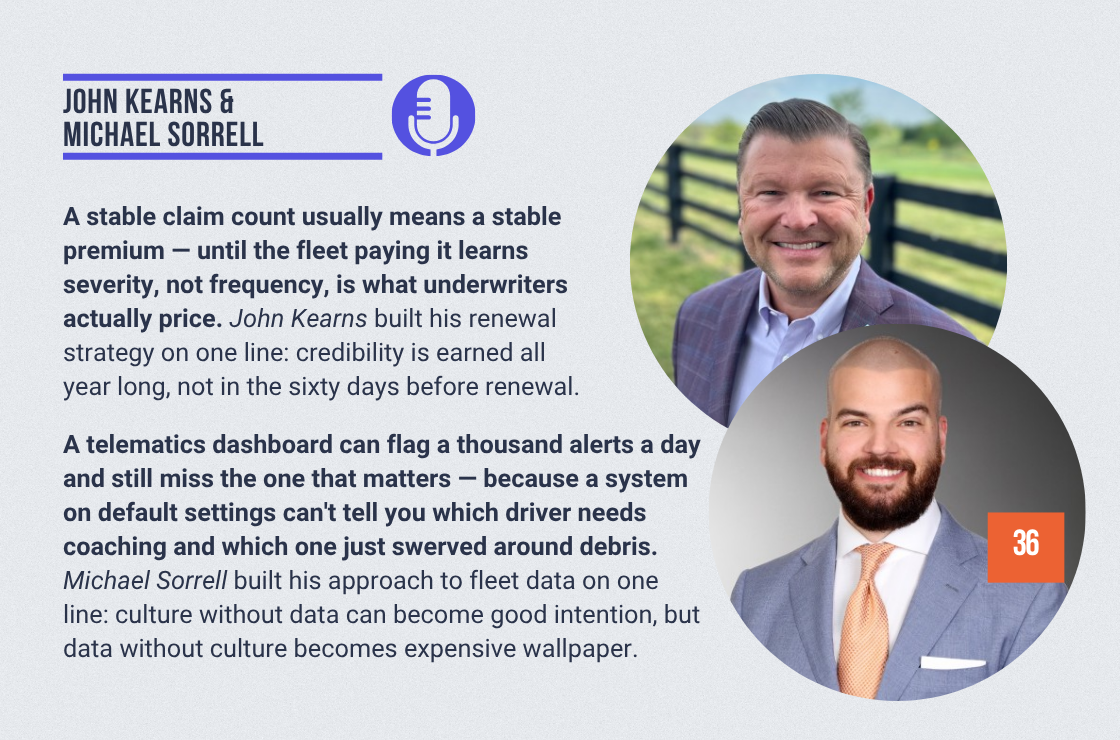
John Kearns is SVP of Safety & Risk at Alliant Insurance Services, known across the transportation industry as “The Liability Mechanic.” He spent nearly three decades working federal and state law enforcement, adult-based learning and training, and transportation risk before moving into insurance — a path that lets him read a fleet’s operation from the driver’s seat, the terminal, and the underwriter’s desk at once.
Michael Sorrell is SVP of Sales for FleetLytics at Alliant Insurance Services. He grew up in the foster care system, earned his Class A CDL specifically so he could understand trucking from the driver’s side of the windshield, and now spends his days helping underwriters see the data that fleets already have but rarely present well.
John Kearns is SVP of Safety & Risk at Alliant Insurance Services (“The Liability Mechanic”), bringing nearly three decades of law enforcement, training, and transportation risk experience to fleet safety culture and root-cause analysis. Michael Sorrell is SVP of Sales for FleetLytics at Alliant Insurance Services, combining 15+ years of insurance experience with a Class A CDL and a technology-integration lens on total cost of risk.
Here’s a glimpse of what you’ll learn:
- [1:36] John Kearns’ path from law enforcement to transportation risk, and the “liability machine” framework
- [4:27] Michael Sorrell’s road to insurance — foster care, a Class A CDL, and 15 years on the risk side
- [7:34] The biggest misconceptions fleets have about insurance companies
- [11:48] Why claim severity, not frequency, is driving premiums higher
- [18:23] Why federal violation data is lagging, inaccurate, and needs a broker who will challenge it
- [46:00] AI, autonomous driving, and why the human element isn’t going away
- [1:03:20] Building a safety culture that survives when no one is watching
- [1:11:05] Montgomery v. Creed and the compliance shift no fleet can ignore
- [1:19:03] First Notice of Loss — the reporting habit worth an 18–28% exoneration rate
- [1:28:02] Lightning round: leadership books, coffee vs. bourbon, and the hot dog debate
In this episode…
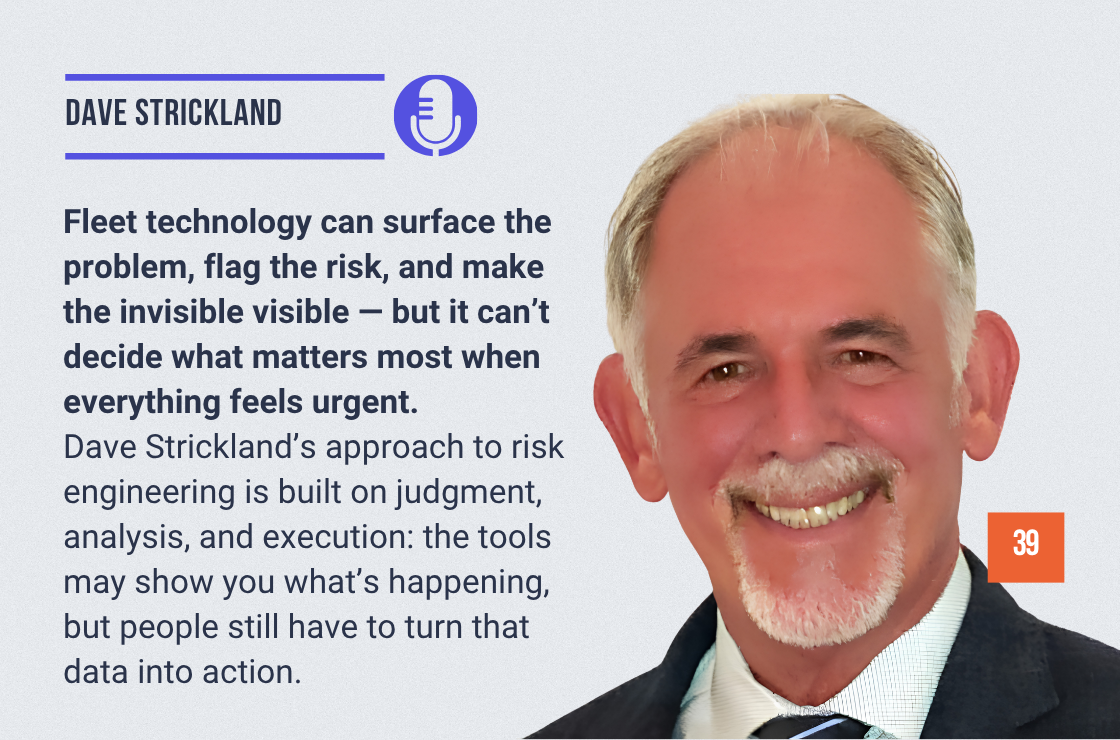
Every fleet executive has heard the same frustrating math problem: CSA scores haven’t moved, claim counts look stable, and yet the premium keeps climbing. In this Road Rageous panel, host Chad Lindholm sits down with two transportation risk experts — John Kearns, SVP of Safety & Risk at Alliant Insurance Services, and Michael Sorrell, SVP of Sales for FleetLytics at Alliant — to explain why that math problem exists, and what a fleet actually controls in response.
John and Michael bring different vantage points to the same conclusion. John spent decades in law enforcement and transportation safety before moving into insurance, and he reads every crash as “the last link in a much longer chain of decisions” — a liability machine built from hiring practices, coaching habits, maintenance follow-through, and whether anyone reviews the telematics data once it’s captured. Michael came up through the insurance side, but got his Class A CDL so he wouldn’t have to imagine what a driver’s day looks like. Together they walk through why underwriters are looking for a reason to believe a fleet’s story, why federal violation data can’t be trusted at face value, and why the fleets that win at renewal are the ones treating the other 305 days of the year as the actual audition.
Insurance Is Not a Once-a-Year Transaction
The most persistent misconception John encounters is that insurance companies are simply looking for a reason to raise premiums or decline an account. In his experience, that’s backwards.
“Credibility is earned through the way the company operates all year long — not the sixty days out from renewal.”
— John Kearns
Michael’s version of the same idea, from the broker side: underwriters aren’t hunting for reasons to say no.
“The reality is that the good underwriters are actually looking for a reason to believe.”
— Michael Sorrell
Neither man is describing a fleet that never has a bad day. Both are describing a fleet that can explain its bad days — what happened, how leadership responded, and what changed afterward. As Michael put it, underwriters can handle bad news; they struggle with surprises.
Severity, Not Just Frequency, Is Driving Premiums
Fleets frequently point to flat claim counts and ask why their premium keeps rising. John’s answer starts with the economics of trucking itself: many carriers are operating on a 1–6% margin, and the average cost of a civil claim, according to FMCSA, is roughly $200,000. On a 2% margin, paying that single claim requires generating $10 million in revenue — while the fleet keeps functioning.
“A stable claims frequency does not necessarily mean stable claim severity.”
— John Kearns
Parts and repair costs have climbed sharply — John notes that a bumper, dash, and adaptive cruise control sensor alone can now run $7,500 to $8,000 — and medical costs, litigation, and downtime compound from there. That’s why he argues fleets should stop measuring safety purely by crash counts and start tracking the behaviors most likely to produce a catastrophic event, citing ATRI research showing drivers who speed 1–15 mph over the limit are 38% more likely to be in a collision.
What a Fleet Actually Controls
Neither guest pretends a fleet can control medical inflation, litigation trends, or reinsurance capacity. But both are emphatic that the list of what a fleet does control is longer than most executives assume.
“A fleet controls far more than it sometimes believes. It controls whom it hires, what behaviors it tolerates, how quickly it responds to warning signs.”
— John Kearns
Michael frames it as separating price from position: a fleet can’t set the price of risk in the broader market, but it can make itself easier to underwrite.
“You cannot control the market, but you can control how easy you are to underwrite.”
— Michael Sorrell
Federal Data Is Lagging — and It’s Working Against You
One of the more surprising threads in the conversation: the federal FMCSA portal that underwriters often reference carries its own disclaimer warning that the data shouldn’t be held against a carrier, because it’s frequently thirty or more days stale by the time a fleet sees it. Worse, every recorded wreck is initially logged as the driver’s fault, even when it isn’t.
“Let’s say I have 10 collisions on my database. Eight of them don’t belong to me, but I haven’t touched them. The underwriter is seeing 10 collisions.”
— John Kearns
Disputing an inaccurate violation through the DataQs challenge process can take up to 120 days — often longer than the runway before a renewal. That’s why John pushes fleets to update their MCS-150 filings more often than the federally required two years, and to give their broker the full, honest picture rather than letting raw federal statistics tell the story on their own.
Telematics, AI, and the Human Component That Isn’t Going Away
Both guests are bullish on AI and telematics — with a caveat. Michael’s summary of the current moment:
“Culture without data can become good intention. Data without culture becomes expensive wallpaper.”
— Michael Sorrell
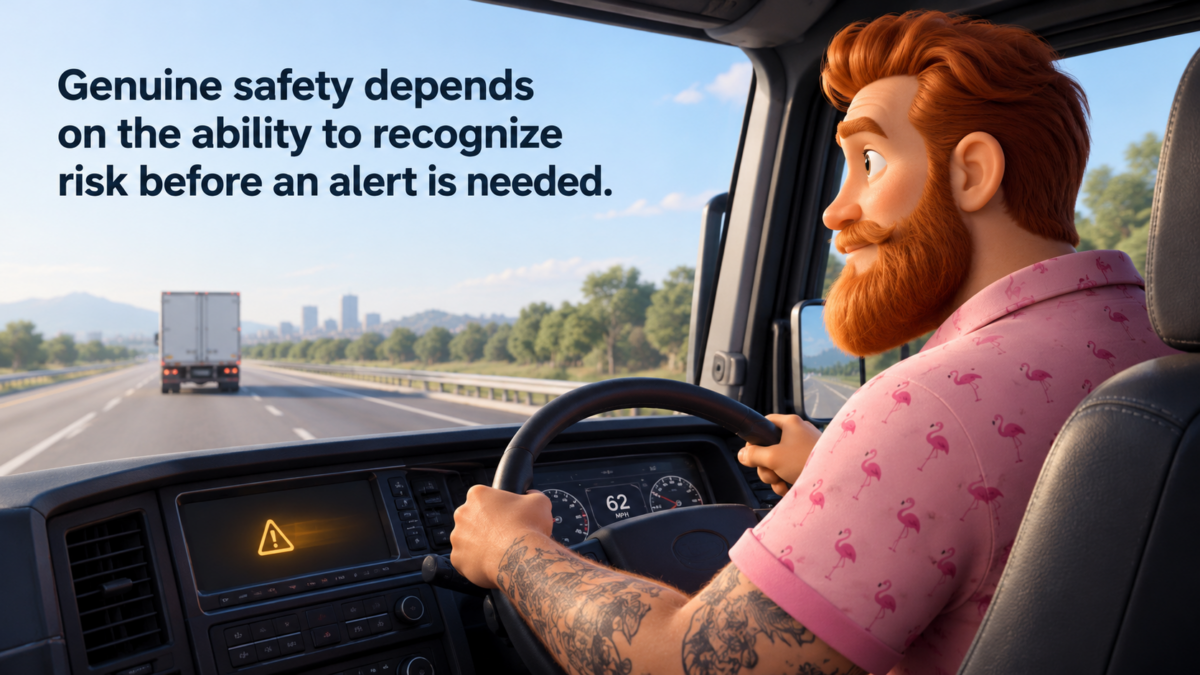
John’s caution is more technical: telematics systems still misfire. A former work zone can leave a stale 55 mph speed limit in the system long after the posted limit changes to 70, triggering false speeding events; a driver swerving to avoid road debris can register as unsafe lane weaving. Someone still has to review the flagged events before they land in a driver’s file.
“There’s a human component to it regardless of how much AI is advanced.”
— John Kearns
Both agree the fix isn’t rejecting the technology — it’s refusing to run it on default settings. Michael recommends piloting new camera or telematics rollouts with a fleet’s top drivers first, since other drivers take their cue from them, while any new policy still has to be driven top-down from ownership or the C-suite to land with authority.
Culture Is What Happens When the Policy Manual Is Closed
Pressed on what a strong safety culture actually looks like in practice, John offered a definition he’s carried since attending the Southern Police Institute’s administrative officer course.
“Culture is simply what people consistently do when the policy manual is closed and no senior leader is watching.”
— John Kearns
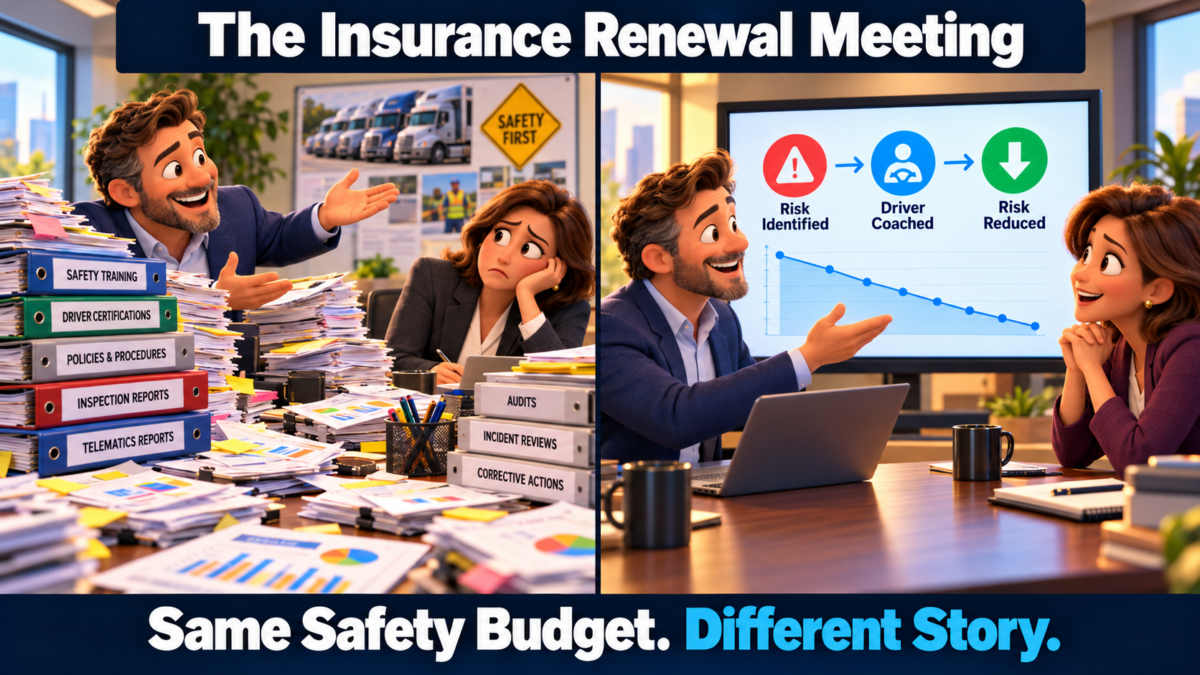
Michael’s complementary read focuses on the coaching loop: an alert gets reviewed, someone owns the next step, the driver receives fair and timely coaching, and the repeated behavior actually decreases. Skip the follow-through, and the alert becomes documentation of a problem instead of a fix for one.
A Verdict That’s Reshaping Compliance: Montgomery v. Creed
Asked about emerging risk on the horizon, Michael pointed to a case reshaping how freight brokers and shippers vet carriers.
“It was really the first time that a freight broker was responsible or held liable due to negligent hiring.”
— Michael Sorrell
The ripple effects are already visible: shippers are more closely vetting the contract carriers picking up their freight, and Michael expects a sustained push toward deeper compliance and onboarding vetting — not just a CSA portal check, but a telematics-informed look at how a carrier’s drivers actually behave on the road.
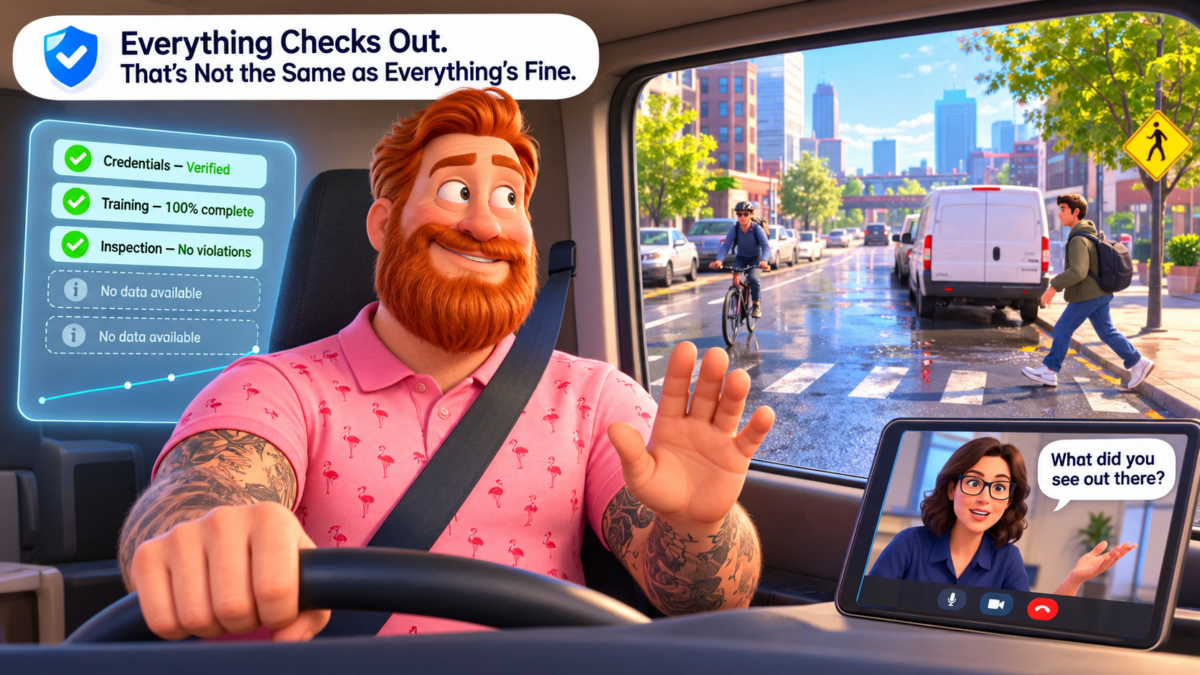
The Data-Overload Problem: Illusion of Control
With cameras, telematics, claims platforms, and MVR tools all running simultaneously, Michael warned that more data doesn’t automatically mean better decisions.
“Fragmented data can actually create the illusion of control.”
— Michael Sorrell
His concern is decision latency — the gap between when a system flags a risk and when a person acts on it. A repeated speeding flag that gets coached three weeks later hasn’t prevented anything; it’s only documented it. Some fleets receive thousands of alerts a day, which makes prioritizing the handful of high-severity behaviors — not chasing every alert — the more realistic strategy.
First Notice of Loss: The Reporting Habit Worth 18–28% in Exoneration
Perhaps the single most quotable statistic in the episode came from John, citing ATRI research on how quickly a fleet reports a triggered event to its broker or carrier.
“There’s an 18 to 22% exoneration rate for those that have first notice of loss built automatically into their system.”
— John Kearns
John noted Alliant is seeing closer to 28% internally — nearly a third of claims resolved favorably through timeliness alone. The mechanism is straightforward: video footage typically loops and is lost within two weeks, witness statements fade, and plaintiff attorneys are often requesting maximum limits before an adjuster even has visibility into what happened. Reporting within hours, not weeks, changes the outcome.
Quotable Moments
- Credibility is earned through the way the company operates all year long.
- A stable claims frequency does not necessarily mean stable claim severity.
- A fleet controls far more than it sometimes believes.
- Culture is simply what people consistently do when the policy manual is closed and no senior leader is watching.
- Fragmented data can actually create the illusion of control.
- There’s an 18 to 22% exoneration rate for those that have first notice of loss built automatically into their system.
- Underwriters cannot price what they cannot see.
Action Steps
- Start the next renewal the day after the current one closes. Treat the full policy year as evidence-building, not a countdown. Underwriters respond to a twelve-month pattern of documentation, not a sixty-day sales pitch.
- Build a first notice of loss habit. Report triggered events — near-misses and collisions alike — to your broker within hours, not days. ATRI data ties fast reporting to an 18–28% exoneration rate.
- Audit your federal portal data. FMCSA violation data can run 30+ days stale and defaults every wreck to at-fault. Use the DataQs process to challenge inaccurate entries, and update your MCS-150 more often than the required two years if your fleet size shifts by 10% or more.
- Pilot new telematics with your best drivers first. Rolling out cameras or monitoring system-wide without a trial breeds resistance. Start with top performers so adoption spreads peer-to-peer instead of top-down.
- Tune telematics away from default settings. Default speed and behavior thresholds generate false alerts. Calibrate the system to the fleet’s actual routes and operations before holding drivers accountable to it.
- Pick one risk and close the loop. Rather than launching a broad initiative, choose one issue — overdue coaching, a recurring claim pattern, an unresolved maintenance concern — assign an owner, set a date, and follow it until the risk measurably changes.
- Bring your broker in early on compliance decisions. Share telematics and claims data with your broker before an underwriter ever sees it, so the story gets framed accurately from the start.
Key Takeaways
- Insurability is built across the full policy year, not assembled in the sixty days before renewal.
- Claim severity — driven by rising parts, medical, and litigation costs — is a bigger factor in premium increases than claim frequency.
- Federal violation data is frequently inaccurate and lagging; fleets need a broker willing to challenge it rather than pass it along as-is.
- Telematics and AI are only as useful as the humans reviewing and following through on what they flag.
- A fleet’s real safety culture shows up in what happens when no one is watching, not in the policy manual.
- Montgomery v. Creed has pushed negligent-hiring liability further into freight broker and shipper relationships, raising the bar for compliance vetting.
- Fast first notice of loss reporting is one of the highest-leverage, lowest-cost habits a fleet can build.
Conclusion
John Kearns and Michael Sorrell approach fleet risk from different starting points — one built on decades in law enforcement and transportation safety, the other on the insurance and technology side, with a Class A CDL as a credibility card. But their conclusions converge on the same idea: insurability is not something a fleet requests at renewal, it’s something a fleet demonstrates all year long.
Whether the topic is a first notice of loss protocol, a telematics rollout, or a disputed federal violation, the throughline is the same. Underwriters aren’t looking for a spotless record. They’re looking for a fleet that knows its own story, can prove it with data, and can show that leadership acts on what the data says — before it has to.
Resources mentioned in this episode
About John Kearns
John Kearns is SVP of Safety & Risk at Alliant Insurance Services, known in the industry as “The Liability Mechanic.” With nearly three decades of experience spanning federal and state law enforcement, adult-based training, and transportation risk, he brings a root-cause lens to fleet safety and works with carriers to translate operational data into a credible, defensible risk story for underwriters.
About Michael Sorrell
Michael Sorrell is SVP of Sales for FleetLytics at Alliant Insurance Services. With more than 15 years of experience on the insurance and risk side, he earned his Class A CDL to better understand the driver’s perspective, and now helps fleets connect telematics, claims, and compliance data into a single view that strengthens their position with underwriters.
Sponsor
IMPROVLearning — At IMPROVLearning, we are dedicated to transforming driver education through innovative, research-backed training methods. Our SPIDER Driver Training platform combines humor with proven brain-training techniques to help drivers anticipate and avoid dangers on the road. John Kearns and Michael Sorrell’s conversation makes one thing clear: technology can flag a risk, but trained drivers make the split-second decisions that prevent it from becoming a claim. SPIDER training develops hazard recognition, space management, and decision-making under pressure — the same behaviors underwriters are ultimately pricing. Visit improvlearning.com.
 Learner Login