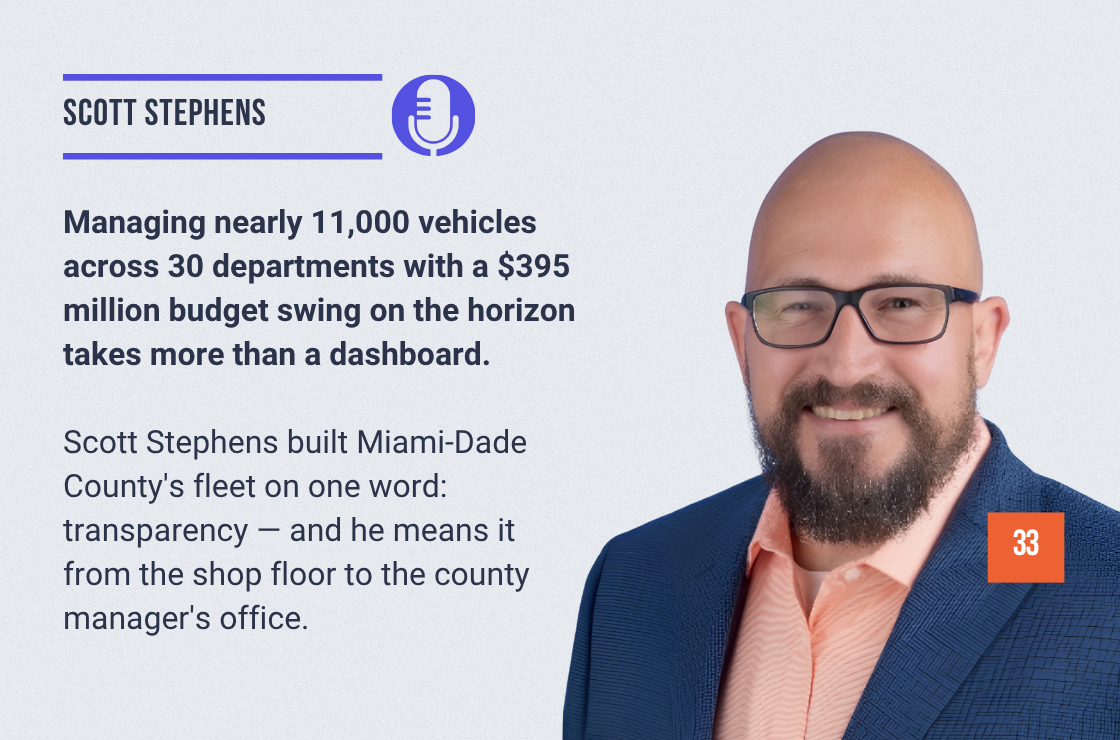
Scott Stephens is the Operational Support Manager for Miami-Dade County Fleet, where he oversees maintenance and operations for nearly 11,000 vehicles across roughly 30 county departments—from golf carts to heavy landfill equipment, encompassing 80 different equipment makes.
Scott entered the fleet industry by way of the U.S. Navy, nuclear engineering, and a temp assignment in Dallas that accidentally blossomed into a 15-year career. Over his 11 years with Miami-Dade County, he has led the implementation of two fleet management information systems, scaled the county’s EV fleet from 8 vehicles to over 430, and built a transparency-first leadership culture that his staff has internalized from the shop floor up.
Here’s a Glimpse of What You’ll Learn:
-
[1:15] How a Navy nuclear engineer ended up running fleet operations for one of the largest counties in the U.S.
-
[6:03] Why public fleets can’t adjust charging rates mid-year like private fleets can—and why that matters.
-
[8:06] The $395 million budget swing Miami-Dade is navigating right now.
-
[13:22] How the county scaled from 8 EVs to 437, and what the infrastructure scramble looked like.
-
[16:54] Why Miami-Dade is pulling back on EVs and shifting to hybrids while infrastructure catches up.
-
[24:08] What predictive analytics and AI dash cams have done for driver safety across 434 garbage trucks.
-
[29:14] The camera exoneration story that turned union skeptics into active advocates.
-
[33:19] Why Scott’s one-word definition of great fleet leadership is transparency.
-
[35:02] The engagement session that got cooling uniforms for mechanics signed off by the mayor.
In This Episode…
Most fleet organizations track vehicle availability. Fewer track the cultural availability of their leaders—whether they actually show up on the floor, ask questions, and act on what they hear. Scott Stephens does both, and he argues they are equally important to fleet performance.
As Operational Support Manager for Miami-Dade County, Scott oversees nearly 11,000 vehicles, 30 departments, and a budget environment that can shift by hundreds of millions of dollars based on a single ballot measure outcome. He navigated the county’s EV scale-up from 8 to 437 vehicles, hit the infrastructure ceiling, and pivoted to hybrids before it became a problem. He also built a data and analytics operation that is moving from dashboards toward predictive maintenance—with AI dash cams already producing a measurable drop in at-fault claims across 434 garbage trucks.
In this episode of Roadrageous, Scott covers the realities of public fleet budgeting, the EV infrastructure lessons Miami-Dade learned the hard way, the camera story that converted the union, and the leadership philosophy—built in the Navy and tested in the heat of South Florida—that he applies every morning when he walks the shop floor.
Public Fleet Budget Reality: Chasing Volatility on a Fixed Number
The fundamental challenge of a public fleet operation is structural: you cannot adjust your rates mid-year when parts prices spike, fuel costs jump, or tires get more expensive. A private fleet can change its charging scheme to absorb the hit. A government fleet is locked into what was budgeted 12 months ago and must either absorb the variance or cut something else.
“If I was a private operation, I could just change my charging scheme to make up for the deficits that happen when parts rise, tire prices jump, or fuel skyrockets. In the public sector, you’re operating on a fixed budget for a year. So you’re constantly having to reevaluate what things cost versus what you’re bringing in.”
Miami-Dade is navigating an acute version of this right now. Several former county departments have recently transitioned into elected offices, meaning funding that was once part of the unified county budget is now entirely independent. The resulting swing is approximately $395 million in one year, with a potential additional $695 million impact the following year depending on ballot measure outcomes. For a multi-billion dollar county operation, those are massive numbers requiring hard decisions across every department.
Scott’s answer to budget volatility is data. The better the data, the better the case for what to cut and what to protect. That principle shapes how Miami-Dade Fleet operates, ensuring that analytics investments are treated as a core operational expense rather than a “nice-to-have” luxury.
Scaling EVs From 8 to 437—And Learning the Infrastructure Lesson
In 2021, Miami-Dade County had just eight electric vehicles. Today, it has over 430 active on the road. The scale-up happened quickly, and the infrastructure did not keep pace—a dynamic Scott describes as the classic “cart-before-the-horse” problem that virtually every fleet navigating early EV adoption experiences.
“The first year we went out and bought 64 EVs. We had four charging stations. So we had to ramp up the infrastructure real fast.”
The response was a comprehensive, countywide EV study looking at designated parking locations, expected daily usage, vehicle suitability assessments, and replacement plans that accounted for the significantly higher capital cost of EVs. The county now manages EV charging strictly via Level 2 chargers—intentionally avoiding Level 3—and caps vehicles at an 80% charge by default to preserve battery life. This operational choice is critical given Miami’s coastal heat and humidity.
However, the county has since hit a ceiling on what can be added without major electrical infrastructure overhauls. Adding more capacity downtown, where most EV usage is concentrated, would require a $3 million microgrid investment. As a result, Miami-Dade is scaling back EV purchases and shifting toward hybrid vehicles while working through a master service agreement with Florida Power & Light to fund future grid upgrades.
Charger replacement is also emerging as a live issue. The ChargePoint units installed at the program’s launch in 2021 are already discontinued and unsupported—requiring replacement in five years rather than the ten-year horizon most plans assume. At $5,000 to $7,000 per charger, these replacement costs compound rapidly across a large footprint.
Predictive Analytics and the Camera That Changed Everything
Miami-Dade Fleet is in active transition from static dashboards to predictive analytics. The team is collaborating with its IT department to identify where AI can move operations from reactive to anticipatory, leveraging systems like Uptake and Pitstop alongside integrations from Samsara and Geotab.
But the technology already delivering immediate, measurable results is simpler: AI-supported dash cameras on the county’s 434 garbage trucks. In the 18 months since deployment, at-fault accident claims have dropped materially, and the internal dynamic around camera acceptance has flipped completely.
“When there are accidents, they always blame the big truck. You have a fender bender, it looks like the car got cut in half and the truck’s just got a dent. But now, because of those cameras, we’re able to see that a lot of them aren’t the driver’s fault. They were doing exactly what they were supposed to do.”
The turning point was a single exoneration. A driver involved in an accident believed he was going to lose his job due to a “third-strike” policy. Camera footage showed clearly that he was not at fault. He told his colleagues, they told theirs, and within weeks, the culture shifted.
“Now it’s to the point where if one of the cameras isn’t working, they won’t go out. They’re like, ‘Hey, my camera over here isn’t working. I need a camera.’ That’s how serious it’s gotten. They want them.”
The pattern mirrors older technology rollouts, like GPS units being ripped out from under dashboards in Dallas years ago only to become universally accepted later. Scott believes AI and advanced safety tech will follow the exact same arc: initial skepticism, visible benefit, and full adoption.
Transparency as the Operating System for Fleet Leadership
When asked to define great fleet leadership in one word, Scott’s answer is immediate: transparency. He views it not as a vague value statement, but as a rigid operational discipline running from the newest PM technician on the floor up to county leadership.
“Our leaders have to be transparent with their staff, with their customers, with those above them and below them. Everything that you do is for a public service… because eventually that vehicle is going to go out and service the citizen, your neighbor, or yourself.”
The second half of his leadership framework is presence. Scott’s team conducts regular, structured engagement sessions with shop staff, asking technicians directly what they need, what is broken, and what would make their jobs easier. The results have ranged from increased tool allowances and ASE certification bonuses to cooling-technology uniforms for mechanics spending entire shifts working outdoors in South Florida heat.
The uniform request came directly from the staff. It required a contract change and sign-off at the mayoral level, yet it moved faster than almost any initiative Scott had ever seen approved because it was a clear, data-backed response to a real need.
“My job is to make myself obsolete in time because at some point I’m retiring. Leadership isn’t about a speech. It’s not about talking. Words don’t mean anything. Actions do. Tell them what you’re going to do, then go do it.”
💬 Quotable Moments
“Fleet’s the front line. We’re an afterthought a lot of times. It’s our job to communicate back up: here are the issues we’re coming across, and here are the solutions we think we have.”
“We had four charging stations when we bought 64 EVs. So we had to ramp up the infrastructure real fast.”
“Now it’s to the point where if one of the cameras isn’t working, they won’t go out. They want them.”
“Transparency—from leadership, that’s the one word. Open, honest, transparent. That’s the main thing.”
“My job is to make myself obsolete in time. Leadership isn’t about a speech. Words don’t mean anything. Actions do.”
“Can’t lead if you don’t follow. If you don’t know how to follow, how can you lead those behind you?”
“Respect is earned, not given. And to earn respect, you have to show up—and when you show up, you have to do something.”
📋 Action Steps for Fleet Leaders
-
Know your infrastructure ceiling before buying more EVs. Map your infrastructure capacity before your next EV procurement cycle. If adding capacity requires utility-level upgrades, get that cost into the plan before buying vehicles, not after.
-
Budget charger replacement alongside vehicle replacement. Build a charger replacement fund from day one. Assume a 5-to-7-year replacement cycle instead of 10, and factor that cost into your EV total cost of ownership (TCO).
-
Deploy cameras and document the first exoneration story. Implement AI-supported cameras and lead with the exoneration use case. One documented exoneration will convert skeptics faster than any policy or corporate mandate.
-
Run structured engagement sessions with frontline staff. Schedule quarterly engagement sessions with shop staff. Ask what they need and act on what you hear—or explain transparently why you can’t.
-
Pilot predictive analytics on your highest-maintenance asset class. Move from basic dashboards to predictive analytics. Identify one or two vendors in your current tech stack who offer predictive maintenance integration and run a pilot before committing to a full deployment.
-
Be transparent with “No”—not just “Yes.” When no is the answer, show why. Staff who understand the reasoning behind a budget decision will carry it differently than staff who are simply told it cannot happen.
Key Takeaways
-
Public fleets cannot adjust rates mid-year to absorb cost volatility, making high-quality data and budget forecasting existential necessities.
-
EV infrastructure must be planned before procurement. Miami-Dade bought 64 EVs with only four charging stations and had to scramble—a sequencing problem that is incredibly common but highly preventable.
-
Real-world charger replacement cycles are 5 to 7 years, not 10. Any EV cost model that does not include mid-cycle charger replacement is incomplete.
-
AI dash cameras on Miami-Dade’s 434 garbage trucks produced a measurable drop in at-fault claims within 18 months, converting union opposition into active demand after a single driver exoneration.
-
Transparency is both a leadership value and an operational discipline. It applies to how leadership communicates with staff, how staff communicate with customers, and how the fleet communicates its value to county leadership.
-
Presence on the shop floor is not optional. Engagement sessions that produce real action—like cooling uniforms, tool allowances, and bonuses—build the trust that makes everything else work.
-
Vehicle availability remains the single most critical metric that every fleet leader should monitor above all others.
Conclusion
Scott Stephens did not plan to run fleet operations for one of the largest counties in the United States. He came up through nuclear engineering, found himself in a temp job in Dallas, fell into fleet, and never left. Fifteen years later, he is managing nearly 11,000 vehicles through budget volatility, EV infrastructure constraints, major technology transitions, and a political environment that could shift operational funding by hundreds of millions of dollars based on a single ballot measure.
His framework for navigating all of it is straightforward: build the data infrastructure so every decision has a defensible foundation, be transparent with everyone from the newest technician to the county manager, show up on the floor to act on what you hear, and make yourself progressively less necessary so the operation can outlast any individual. It is a leadership philosophy built in the Navy and stress-tested in the South Florida heat—and it is producing results that show up clearly in at-fault claims data, EV fleet performance, and mechanics who refuse to go out without a working camera.
Resources Mentioned in This Episode
About the Guest
Scott Stephens is the Operational Support Manager for Miami-Dade County Fleet, where he oversees maintenance and operations for nearly 11,000 vehicles across approximately 30 county departments. He spent 11 years in the U.S. Navy—including work in nuclear engineering—before transitioning to public sector fleet management with the City of Dallas in 2009. He has been with Miami-Dade County for 11 years, leading fleet management system implementations, EV program development, and a data-driven transformation moving toward predictive maintenance and AI-supported driver safety systems.
About the Sponsor
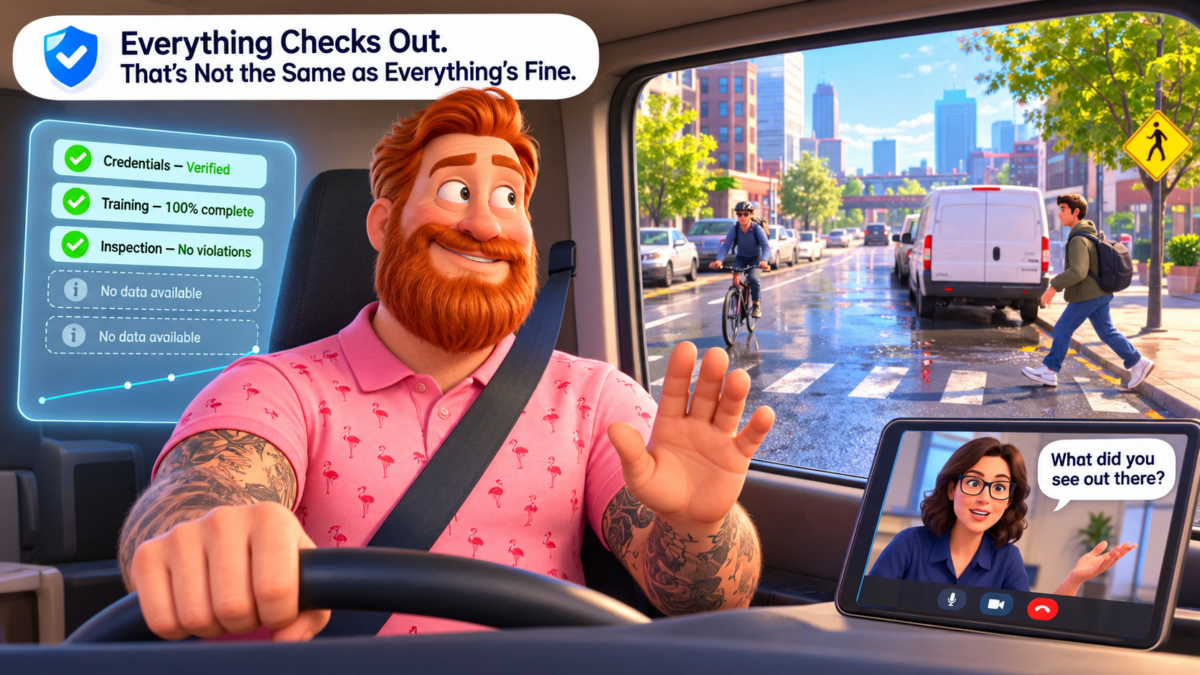
IMPROVLearning — At IMPROVLearning, we are dedicated to transforming driver education through innovative, research-backed training methods. Our SPIDER Driver Training platform combines humor with proven brain-training techniques to help drivers anticipate and avoid dangers on the road. As Scott Stephens highlights, cameras can document what happened, but trained drivers make the right decisions before an incident occurs. SPIDER training develops hazard recognition, space management, and split-second decision-making under pressure. Visit improvlearning.com to learn more.
 Learner Login