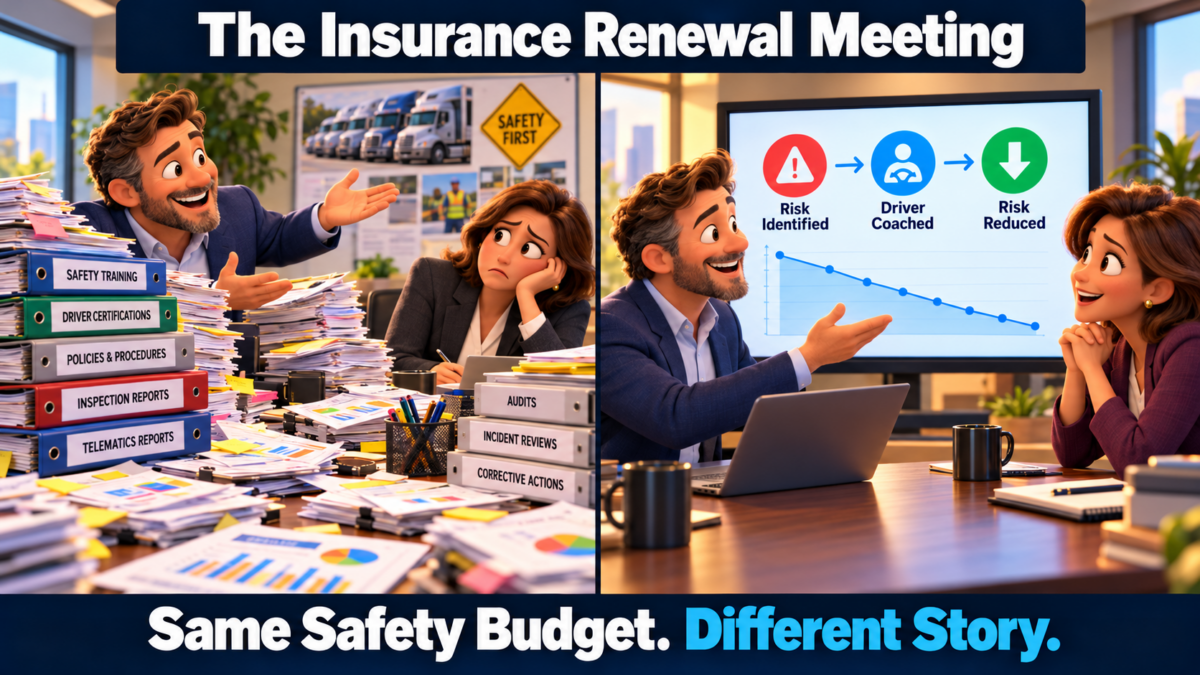
Imagine two fleets with similar vehicles, routes, and accident histories.
Both have invested in safety technology. Both monitor driver behavior. Both require annual safety training.
But when an insurance underwriter asks how each company is reducing risk, their answers look very different.
The first fleet presents its safety policies, training completion rates, and telematics dashboard.
The second shows something more interesting: which risky driving patterns were identified, how supervisors intervened, whether drivers changed their behavior, and how those changes affected the fleet’s overall safety performance.
Both companies have safety programs.
Only one can clearly demonstrate how its program is managing risk.
That distinction could matter considerably when it’s time to renew commercial auto insurance.
Insurers are trying to predict what happens next
A recent article by Together for Safer Roads,
How Insurers Think About Fleet Risk—and Why It Matters, offers a useful perspective on how insurance companies evaluate fleets.
Based on a conversation with John Ehinger of Orion Fleet Intelligence, the article explains two important dimensions of underwriting: exposure, meaning the risks associated with a fleet’s operations, and experience, meaning its actual history of losses and incidents.
Here’s the interesting part: although a company cannot change its accident history, it can demonstrate that the conditions contributing to future accidents are being addressed.
Consider a fleet that experienced several speeding-related incidents last year. Its claims history remains unchanged, even if it has since implemented a successful intervention program.
But suppose the company can now show that it identified repeat speeding patterns, coached the affected drivers, and subsequently measured a sustained reduction in speeding events per 10,000 miles.
That evidence gives an underwriter more information about the company’s current risk than its historical claims alone.
It doesn’t guarantee a lower premium. Insurance pricing depends on numerous factors, including claims costs, operating exposure, coverage requirements, and the insurer’s underwriting criteria.
But it can make a stronger case that the company’s future risk may differ from its past.
A dashboard is not evidence of risk reduction
Fleets have become remarkably good at collecting safety data.
Cameras detect distractions. Telematics flags speeding and harsh braking. Dashboards rank drivers and track incidents.
Yet collecting more information does not necessarily make a fleet safer.
The Federal Motor Carrier Safety Administration’s Safety Management Cycle makes an important distinction between monitoring performance and taking meaningful action. Its guidance emphasizes that companies must not only identify unsafe behaviors but also respond through appropriate interventions, including feedback, training, and improvements to safety management processes.
In other words, detecting a problem is only the beginning.
Consider what happens after a driver is repeatedly flagged for harsh braking.
Was the driver notified? Did a supervisor investigate the circumstances? Was coaching provided? Did the behavior improve? And did anyone check whether that improvement lasted?
Without those answers, a fleet may have an excellent record of identifying risk and very little evidence of reducing it.
The value isn’t in the number of incidents detected. It’s in what happens after detection.
What should fleets be prepared to show?
A useful way to approach insurance renewal is to think beyond demonstrating that safety activities occurred.
Instead, show the relationship between the risks identified, the actions taken, and the results observed.
| What fleets often report |
What makes the evidence stronger |
| 95% training completion |
Changes in driving behavior following training |
| 200 speeding alerts |
Repeat speeding trends and documented interventions |
| 100% telematics coverage |
How consistently alerts are reviewed and addressed |
| Monthly safety meetings |
Specific operational changes resulting from safety reviews |
| Fewer incidents this quarter |
Incident rates adjusted for mileage and sustained over time |
This doesn’t mean traditional safety metrics are unimportant. Policies, training records, maintenance logs, and incident reports remain essential.
But a documented connection between intervention and improvement helps explain whether the safety program is actually working.
Insurance broker HUB International similarly emphasizes the importance of a consistently applied, documented safety program supported by operational data that underwriters can evaluate.
The risk of knowing but not acting
There is another reason this matters beyond insurance premiums.
Technology creates visibility, and visibility creates an expectation of responsible action.
If a fleet repeatedly identifies dangerous driving behavior but takes no meaningful steps to address it, those records could become important in litigation following an accident.
Together for Safer Roads raises this concern in its article, noting that telematics and maintenance records may be examined during legal discovery.
Of course, identifying a risky event does not automatically establish negligence or liability. The circumstances, applicable law, and reasonableness of the company’s response all matter.
But a systematic process for investigating concerns, supporting drivers, documenting appropriate interventions, and evaluating results can help demonstrate responsible safety management.
And importantly, the objective should not be to generate documentation for its own sake.
A completed coaching form doesn’t make a driver safer. An intervention that changes behavior might.
Make safety progress visible
Perhaps the most useful question a fleet leader can ask before the next insurance renewal isn’t simply, “How much have we invested in safety?”
It’s “What can we show has changed because of those investments?”
That question encourages a different approach to safety management.
Instead of treating training as an annual requirement, treat it as an opportunity to influence specific behaviors. Instead of counting telematics alerts, examine recurring patterns and the effectiveness of interventions. Instead of presenting a dashboard full of activity, tell a measurable story of improvement.
This approach benefits more than the insurance conversation. It gives fleet executives a clearer understanding of which safety investments are producing results and where additional attention is needed.
The strongest case a fleet can make to its insurer is not that it has eliminated risk. No fleet can.
It’s that risk is being identified, acted upon, measured, and managed consistently.
And that’s a story worth being able to prove.
References
Together for Safer Roads. (2026, October 14).
How insurers think about fleet risk—and why it matters
.
LinkedIn.
Federal Motor Carrier Safety Administration. (n.d.).
Safety Measurement System: Help Center
.
U.S. Department of Transportation.
Federal Motor Carrier Safety Administration. (2012).
Safety Management Cycle: An overview
.
U.S. Department of Transportation.
HUB International. (n.d.).
Fleet risk management
.
 Learner Login