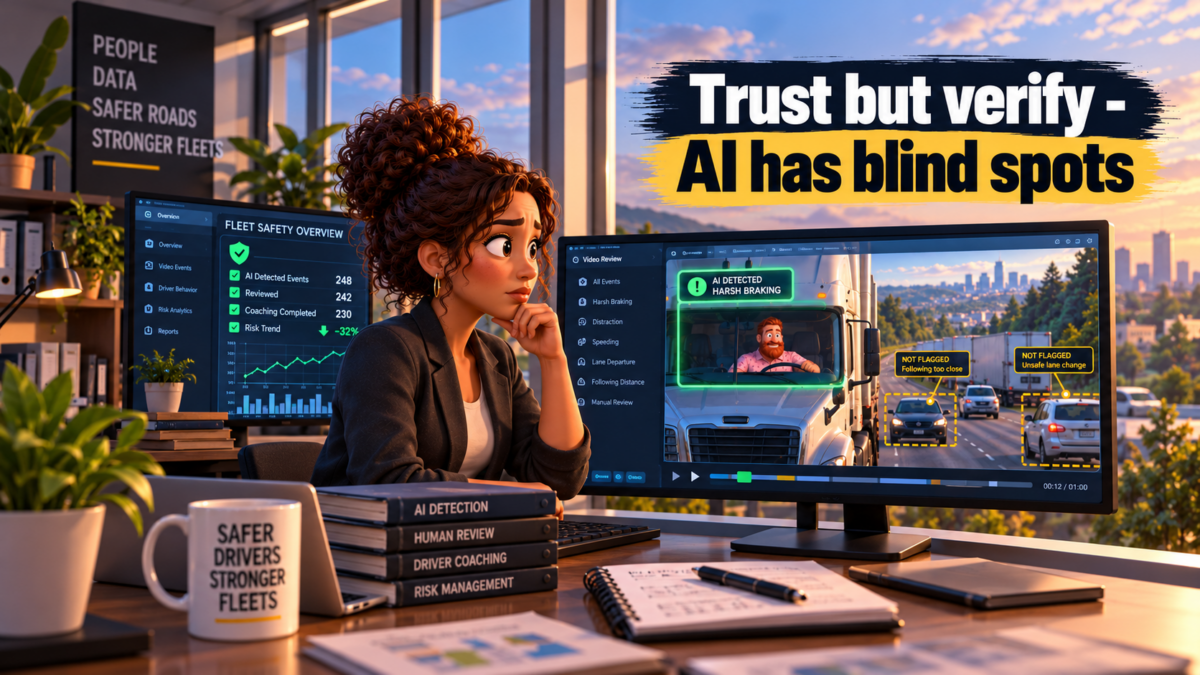
A fleet safety dashboard may display hundreds of detected events, completed reviews, and a decline in risky driving alerts. For safety directors overseeing thousands of hours of footage, these metrics can suggest the technology is effective. However, dashboards cannot reveal risks the system fails to recognize.
For instance, a driver flagged for harsh braking may also exhibit unsafe following distance in the same video. The system detects one event, sends it for review, and records the intervention while another risk goes unnoticed. The technology functions as designed, but its output may be mistaken for a complete account.
This blind spot is the focus of Jason Cannon’s October 18, 2026, article, The Blind Spot in Fleet Safety: When AI Misses the Crash Risk, published by Commercial Carrier Journal (CCJ). Reporting from the American Trucking Associations’ Management Conference & Exhibition, Cannon highlights warnings from trucking defense attorney Doug Marcello and Solera Fleet Solutions Vice President Sean Ritchie about the legal and operational risks of relying on automated video detection without sufficient human verification.
The report cites research indicating that approximately 30% of AI-triggered video clips contain additional safety risks the software missed. This challenges the assumption that dashboard events represent all risks requiring management’s attention.
The risks hidden inside successful detection
Artificial intelligence has made video safety monitoring more practical. Fleets generating thousands of hours of footage daily cannot expect safety managers to watch every minute. Automated computer vision identifies relevant events, filters recordings, and directs attention to behaviors requiring review.
While this filtering is a key strength, it also introduces a limitation. AI systems classify events based on the behaviors and patterns they are trained to recognize. Their results depend on detection capabilities, camera visibility, event thresholds, and footage quality. Events outside these parameters may not be flagged even when a human reviewer would recognize them as concerns. These missed events are called false negatives.
The 30% figure cited by CCJ refers to secondary risks within videos already selected for review, not 30% of all unsafe driving events. Even when automated detection identifies one event, it may overlook other important behaviors occurring simultaneously. A fleet could therefore report fewer incidents without knowing whether this reflects safer driving or limitations in what the technology detects.
If safety is measured primarily through automated alerts, the system effectively determines which risks become visible and which patterns enter management reports. The danger is not simply that technology misses something but that organizations may have no reliable way of knowing what is missing.
When invisible risks become judgment debt
The problem intensifies when footage containing missed events is retained. In CCJ’s report, Ritchie introduces the concept of judgment debt to describe risks that accumulate when organizations depend heavily on automation without questioning its limitations. Consider a carrier operating 500 vehicles equipped with AI-powered cameras.
Each day, the system identifies events for review while large volumes of footage remain unexamined. Some recordings may contain unsafe behaviors that never triggered alerts. Over time, the organization could accumulate an archive showing recurring patterns absent from its safety reports. Management may interpret the lack of alerts as an absence of problems but the recordings could tell a different story. This becomes especially important during litigation. Video footage, telematics records, and related safety documentation may be subject to discovery following a serious crash.
Attorneys can examine historical recordings for evidence of unsafe behaviors, recurring patterns, and the organization’s responses to identifiable risks. This is the contradiction at the heart of judgment debt: organizations can accumulate more evidence about their operations while becoming less aware of what that evidence contains. Not every missed event becomes legally significant, and possessing footage does not automatically establish that a carrier knew about every behavior recorded. Nevertheless, retained footage can raise questions about the adequacy of monitoring and review processes.
The courtroom sees more than the dashboard
A key point in CCJ’s reporting is the difference between how fleets use video internally and how that footage may be examined after a serious crash. Inside safety departments, recordings are often organized around AI-generated event classifications. Managers review footage associated with speeding, distraction, harsh braking, or other predefined categories.
In litigation, however, attorneys may examine the broader footage, identify behaviors the technology overlooked, and investigate whether those events reveal patterns of unsafe driving or inadequate oversight. CCJ describes a Philadelphia case involving a $26 million verdict in which historical speeding events became relevant, even though accident reconstruction experts did not identify speeding as the cause of the crash.
The example illustrates how earlier driving behavior can influence arguments about a company’s safety practices. A dashboard might show that AI identified 200 events and that all 200 received attention. But if the underlying footage contains additional unflagged behaviors, the apparent completeness of that review process may be misleading. Courts do not automatically hold carriers strictly liable for every instance of misconduct captured on video. Legal responsibility depends on the facts and applicable law. However, explaining that an automated system failed to recognize a behavior does not, by itself, establish that the organization’s oversight was reasonable.
The missing layer between automation and visibility
If automated detection cannot provide a complete picture, reviewing every recording might seem like the solution. But that would undermine much of the efficiency AI provides. A more practical approach is the human-in-the-loop model emphasized by Marcello and Ritchie, combining automated detection with human verification. Rather than treating AI classifications as final conclusions, reviewers examine selected footage to identify additional behaviors, assess context, and evaluate the accuracy of automated assessments. This helps identify both false positives, where technology incorrectly flags unsafe behavior, and false negatives, where actual risks go undetected. Human review cannot guarantee complete visibility.
Reviewers can also make mistakes, and no monitoring process eliminates every blind spot. The objective is to reduce uncertainty and understand the limitations of the technology. For fleets, this means evaluating how frequently automated classifications are verified, whether reviewers examine footage beyond the original flagged behavior, and how discrepancies are documented. If reviewers repeatedly identify unsafe following distances in footage flagged for other reasons, that pattern may reveal a weakness in the system’s detection capabilities.
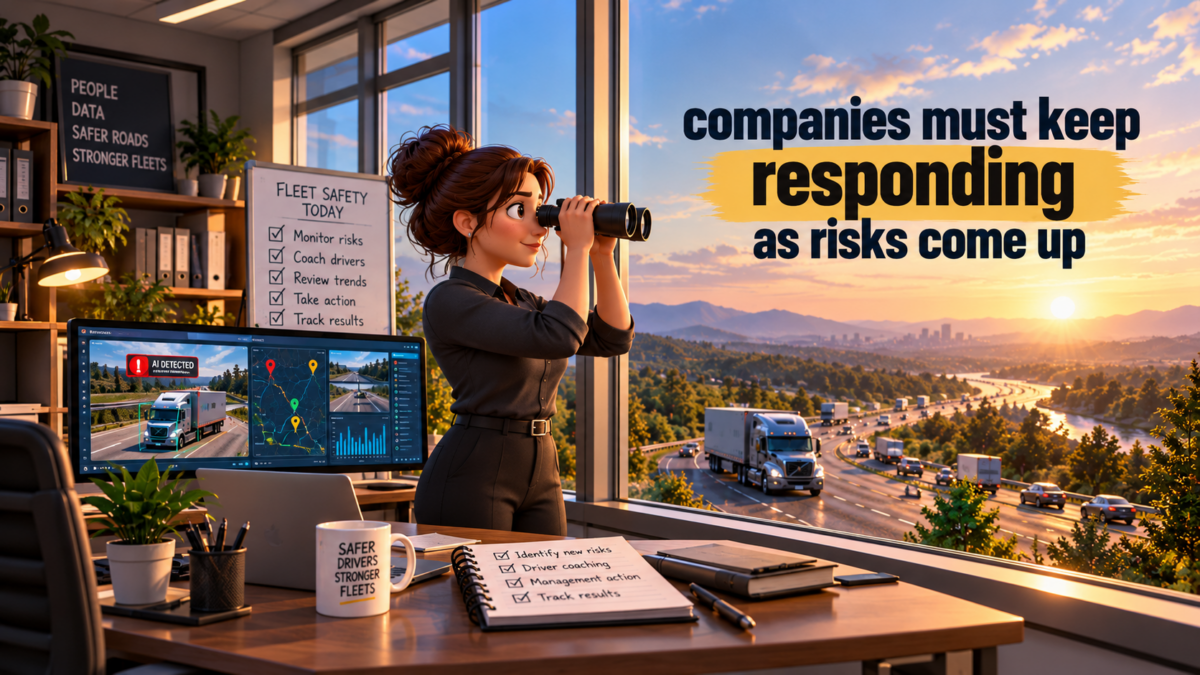
The organization can then reassess alert settings, review procedures, or technology configuration. This changes how fleet leaders should evaluate their safety investments. A decline in alerts does not necessarily indicate improved driving behavior, just as an increase in detected events may reflect better visibility rather than deteriorating safety. Performance reviews should therefore consider detection reliability, secondary risks identified during human verification, and recurring gaps in automated monitoring.
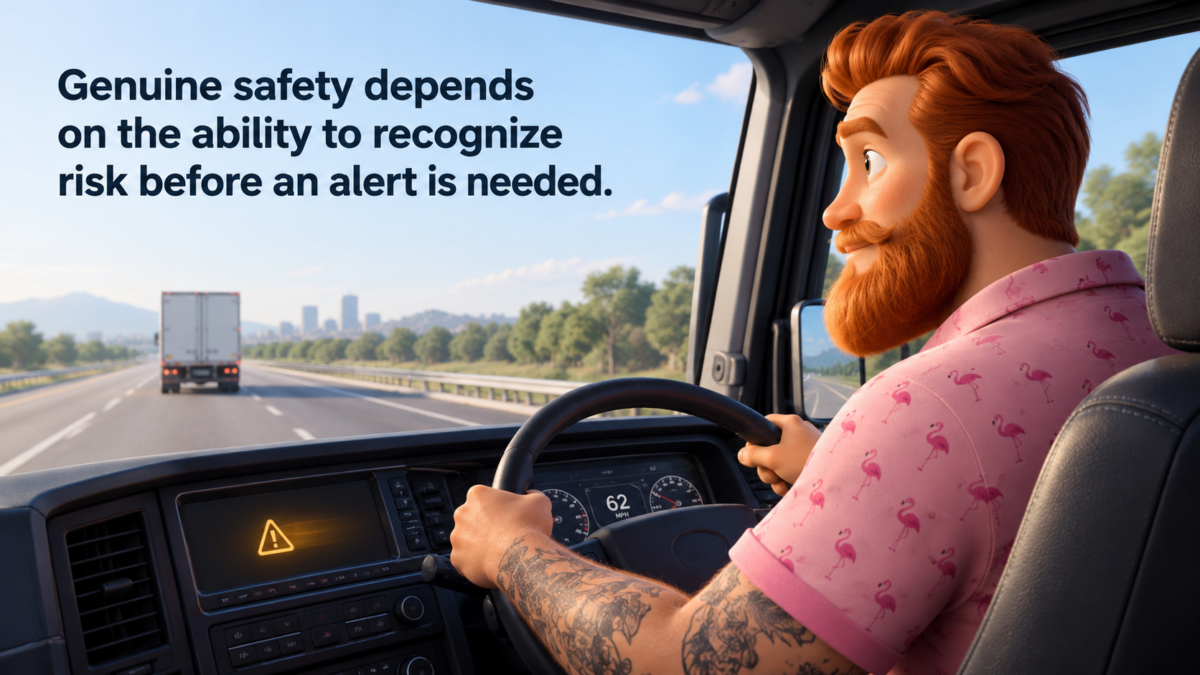
The goal is not to review every second of every trip but to understand what the organization can see, what it may be missing, and how confidently it can interpret the information presented to management. As AI becomes more central to fleet safety, its outputs increasingly shape how organizations define and measure risk. Yet an AI-generated dashboard remains an interpretation of available information, not a complete record. The most significant blind spot may not be the driving behavior AI fails to detect but the confidence organizations place in an unverified picture.
 Learner Login