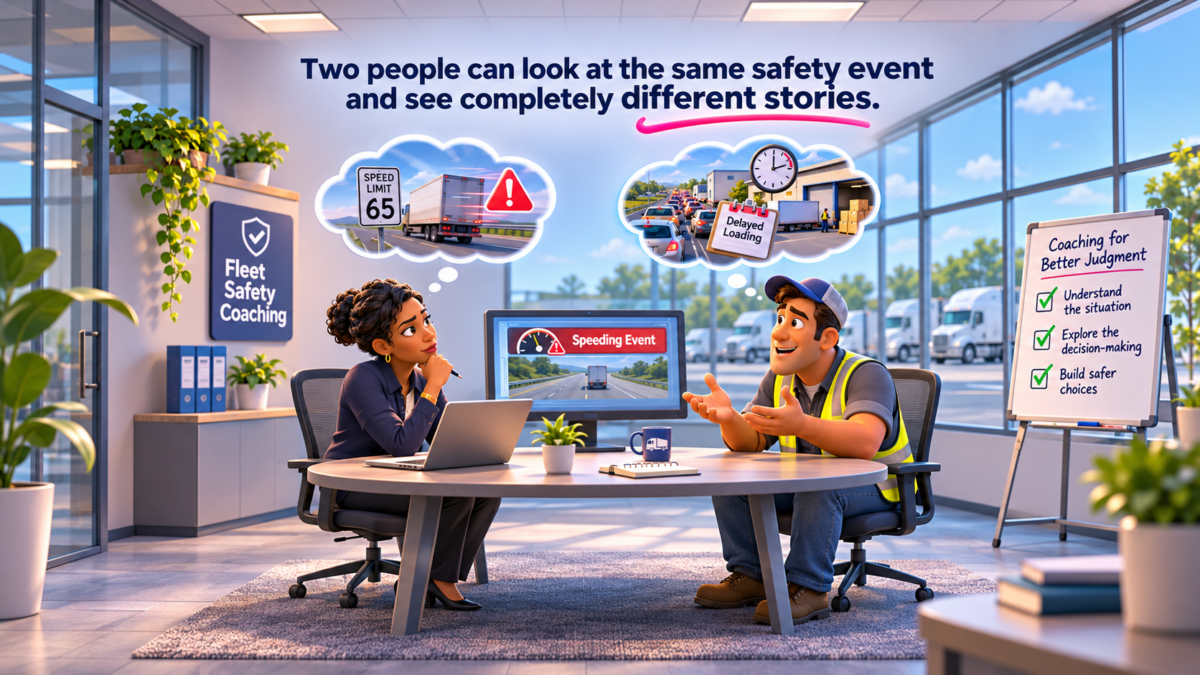
A fleet safety manager reviews a speeding alert from a long-haul driver. The violation is clear, and the driver needs coaching. But when they discuss the incident, two different perspectives emerge.
The manager sees an unsafe decision, while the driver points to a delayed loading appointment, worsening traffic, and pressure to meet a delivery deadline.
Neither perspective changes the violation, but both reveal something important about safety training. What if effective coaching depends not only on identifying unsafe behavior, but also on understanding how drivers and supervisors interpret the same event?
The psychology behind the stories we tell ourselves is important
People rarely see behavior without trying to explain it. Psychologists call this process causal attribution: how people assign causes to actions and events.
Sometimes we explain behavior by pointing to personal traits. A driver speeds because they are careless. Other times, we blame circumstances. We were running late because the schedule changed.
In their research article, Culture, Attribution and Automaticity: A Social Cognitive Neuroscience View, Mason and Morris (2010) examine how people interpret the causes of others’ behavior. Their review shows that first judgments can happen automatically, while rethinking those judgments may take more mental effort.
Consider what happens when a safety manager reviews a speeding event after a long day. In that situation, it may be easier to focus on the driver’s choice than to look into the conditions around it. The driver, on the other hand, may focus so much on the circumstances that they downplay their own responsibility. Both views can miss important details.
When feedback becomes more than just a warning
Pradhan et al. (2024) studied speeding events in a long-haul trucking fleet over 37 weeks.
Drivers labeled as higher risk made up only 7% and 11% of the feedback and no-feedback groups, but they were responsible for 59% and 49% of their groups’ speeding events during the first observation period. Over time, speeding-event rates went down, with bigger drops among higher-risk drivers who got feedback.
Speeding also went down among drivers who did not get feedback. The researchers suggested several possible reasons, such as the effect of monitoring, knowing that coworkers were getting coaching, and changing social norms in the fleet. These reasons were not directly tested, and the study cannot prove that coaching alone caused the improvements. Still, the findings show something important about fleet safety: driver behavior does not happen in isolation.
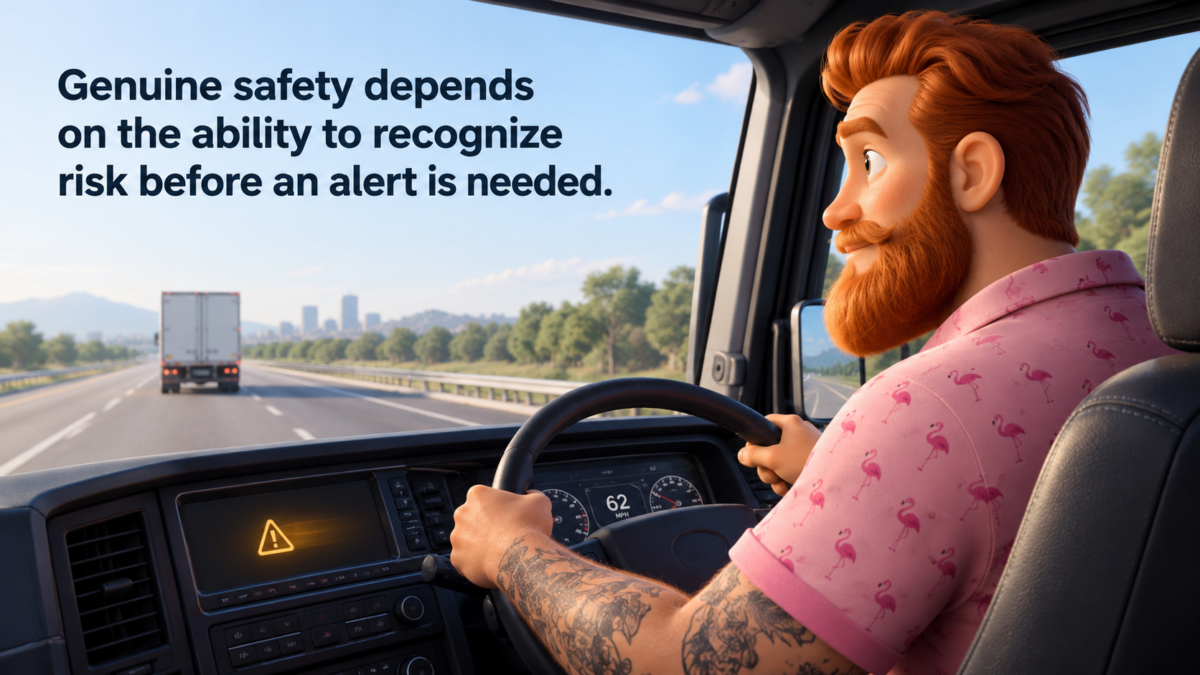
Technology can show that speeding happened, but it cannot by itself tell us whether the driver understands the risk, how the driver receives the feedback, or what will help prevent the behavior from happening again. Those questions need more than detection. They need education.
Teaching drivers to recognize the thinking behind their decisions is key
At IMPROVLearning, our approach to safety education is based on a simple idea: people are more likely to use what they learn when training grabs their attention, connects with their experiences, and helps them see how decisions play out in real situations.
Consider how the original speeding event could become a learning moment. Instead of just giving a warning, the supervisor could ask the driver to walk through the situation. When did the pressure to make up lost time start? What could the driver do differently if the same thing happened tomorrow? These questions do not excuse unsafe behavior. They help uncover the thinking and circumstances that led to it.
Scenario-based learning is one way to explore this. Instead of just being told the right answer, the learner has to decide how to handle the situation. A relatable scenario showing the funny lengths people sometimes go to in order to save a few minutes can make a tough lesson easier to take in.
Improv adds another layer: the ability to respond when things change. Drivers cannot practice for every traffic jam, delivery problem, or surprise on the road. But they can practice noticing changes, questioning their assumptions, and choosing safer actions when the original plan falls apart. The goal is not to teach drivers a perfect script. It is to help them build judgment when the script no longer fits.
Better coaching starts with a better understanding of the problem
A speeding alert may point to a driver who needs coaching. But if similar incidents happen with several drivers facing the same scheduling pressures, the organization may need to look at its own expectations.
A supervisor who blames every unsafe event on individual carelessness may miss bigger organizational issues that add to risk. A driver who blames every violation on outside pressure may ignore the choices they still control. Good coaching needs to allow for both views.
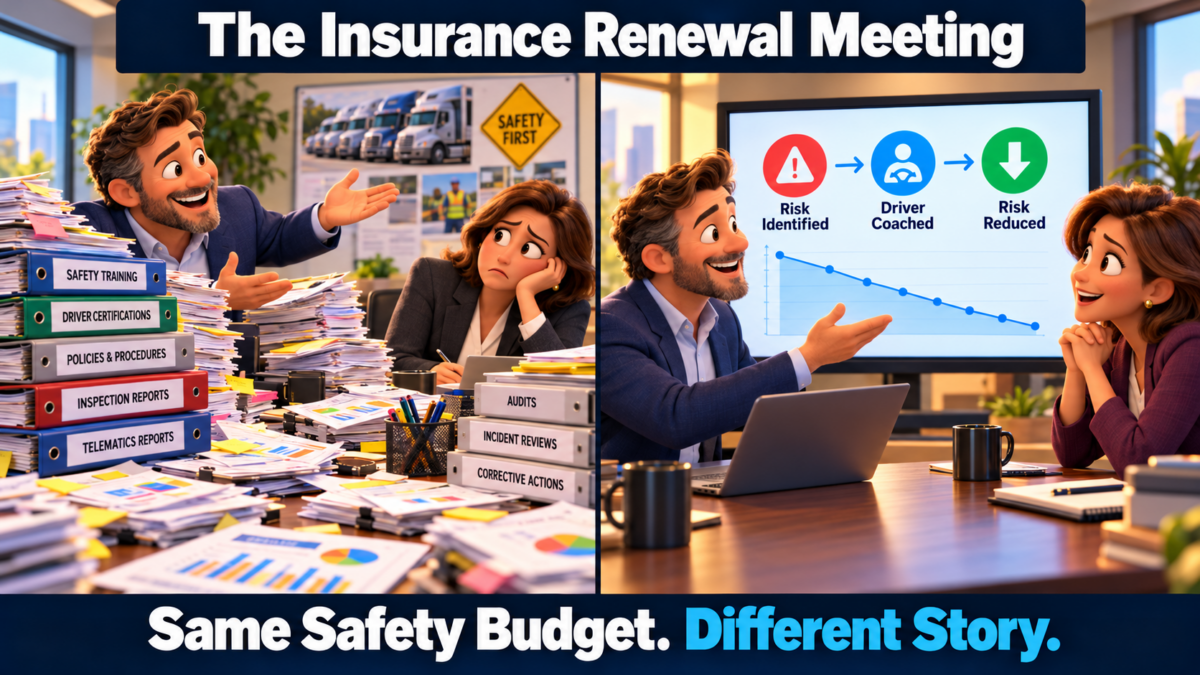
What we do not yet know is whether directly addressing attribution bias in fleet coaching leads to better driving. For organizations investing in telematics, AI-powered cameras, and behavior-based safety programs, the opportunity is to use technology as the start of a learning process, not the end.
The most valuable question in a coaching conversation may not be, Why did you do that? It may be, What made that decision seem reasonable at the time, and what could help you make a safer one next time?
Because two people can look at the same safety event and see completely different stories. The chance for better training starts when they learn to understand both.
References
Mason, M. F., & Morris, M. W. (2010). Culture, attribution and automaticity: A social cognitive neuroscience view. Social Cognitive and Affective Neuroscience, 5(2–3), 292–306. https://doi.org/10.1093/scan/nsq034
Poore, H. E., & Waldman, I. D. (2018). Cognitive attribution bias. Developmental Pathways to Disruptive, Impulse-Control and Conduct Disorders, 161–181. https://doi.org/10.1016/b978-0-12-811323-3.00007-9
Pradhan, A. K., Lin, B. T. W., Wege, C., & Babel, F. (2024). Effects of behavior-based driver feedback systems on the speeding violations of commercial long-haul truck drivers. Safety, 10(1), 24. https://doi.org/10.3390/safety10010024
 Learner Login