There’s a story that many truck drivers know: a driver flips his truck, a fire breaks out, and his seatbelt keeps him trapped inside. The message seems obvious: he might have survived if he hadn’t worn his seatbelt.
The Transport Research Board report, The Role of Safety Culture in Preventing Commercial Motor Vehicle Crashes Commercial truck and bus safety synthesis program (CTBSSP) Synthesis 14, sponsored by the Federal Motor Carrier Safety Administration (FMCSA), notes that this seatbelt myth is real for some drivers and highlights how the story is told and what it suggests. The report suggests gathering these kinds of myths from drivers and working to correct them. Think about what your organization offers in response: maybe a policy, a note in the orientation binder, or a laminated card in the cab. Which of these do you think drivers are most likely to talk about with each other late at night?
What people repeat becomes what people believe
The synthesis from FMCSA defines safety culture as the norms, attitudes, values, and beliefs an organization holds about safety. It references Schein’s caution that there is no universally “right” culture, only one that fits its environment. Cameron and Quinn describe culture as the prevailing ideology people carry internally, noting it is often undetectable. Because internal beliefs cannot be audited, only spoken words and visible behaviors can be observed, and these are shaped by what is most memorable. This is why IMPROV Learning’s training outperforms traditional content delivery: it encourages repetition, the core mechanism of culture.
Language plays a critical role. Van Fleet’s “accident myths” are narratives that shift responsibility. If a driver speeds to meet a delivery window and arrives safely, it is not called an accident. If the same driver crashes, it is, even though the behavior was identical. Only the outcome changed, and that is what is named. Reagle argues that calling these events accidents suggests they are beyond human control, when in fact they result from specific actions.
The message changes once it leaves the safety department
Leadership defines the boundary between unacceptable behavior and honest mistakes but is often absent when that boundary is tested. Morrow and Crum, cited in the Synthesis, found effective management practices reduce close calls, crashes, and fatigue even with limited direct contact. Influence persists despite distance. The same research noted that dispatchers sometimes pressure drivers to operate while fatigued, undermining safety efforts. Carroll’s study of a nuclear plant revealed communication failures throughout the hierarchy, producing inconsistent understanding of safety. Schein observes that conflict between drivers and managers often stems from ineffective or absent communication.
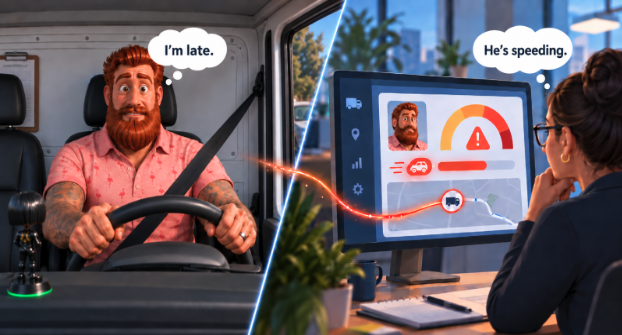
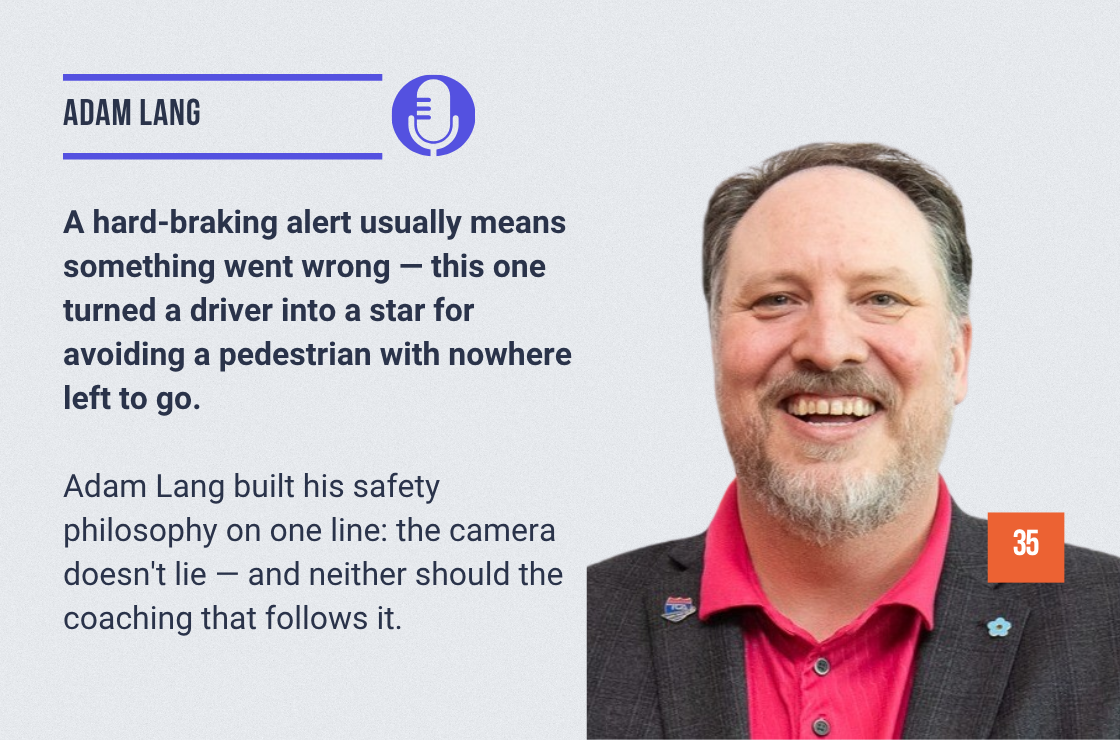
The TRB report anticipated technology would bridge these gaps, which has proven true. Previously, fleets measured safety by the absence of incidents, and when incidents occurred the narrative depended on who told the story. Adam Lang, Director of Customer Advisory Services at Netradyne, described the shift on IMPROVLearning‘s Roadrageous podcast: “The exoneration aspect, the camera doesn’t lie. It shows what it shows. And if it’s good facts or bad facts, you own it. Most of the time it’s good facts, because our drivers are professionals.”
Cameras settled the facts. They settled nothing about trust. The same clip that exonerates a driver on Tuesday can humiliate him on Thursday, and drivers know it. The message reaches the driver but is shaped by the dispatcher’s tone and peer discussions. As Gherardi et al. state, people in organizations do not learn “safety,” they learn safe working practices shared within a community of practice. This is a connection issue, not a content issue, and better documentation cannot solve it. Only relationships that carry safe practice can.
Training for the road you actually drive
Blind-spot drifts and trailers sliding on ice rarely resemble training exercises. Safety training matters, but in stressful moments deeply learned habits outperform memorized rules. Improv, as planned practice for unexpected events, matches the shape of real-world risk.
Lang gave an example. A hard-braking alert went off, usually read as a mistake. The video showed a driver holding safe speed and distance when a pedestrian crossed all lanes without warning. With no way around it, he braked hard and prevented a crash. “You had no other choice but to do that… he pressed hard on the brakes and avoided hitting a pedestrian.” Lang recorded it as excellent driving, the result of trained instinct and a manager who could tell a bad result from a bad choice.
The people who need that practice most may not be the newest drivers. McElroy et al.’s survey of about 3,400 drivers found longer careers linked to more negative feelings about the job, pay, and advancement. Lang points to the measure that tracks it: “Safety metrics which include harsh handling, sharp turns, hard acceleration, aggressive driving. The attitude controls the truck.”
Dobie and Glisson suggest connecting training to career growth, so improvement leads somewhere. Let experienced drivers guide new hires: veterans gain a reason to stay, and learning travels through relationships instead of memos. Humor works the same way. It should never be used near a fatal crash, but the seatbelt myth survives because it is memorable, not convincing. If your message is less interesting, the myth wins. The bias is built in: “Human beings tend to notice negative things much faster than positive ones. That’s not accidental, it’s by design.” Repetition alone won’t fix that.
Different cultures can produce the same safety outcome
The synthesis presents onsite case studies of three carriers.
Carrier A prioritizes drivers, maintains organizational equality, and upholds safety standards exceeding the regulations it deliberately downplays. Carrier B centers on leadership, uses command-and-control, emphasizes compliance, and makes termination a visible consequence. Both maintain strong safety records. Carrier C, a truckload operator with about 1,500 drivers, is recovering from difficult audits. Its CEO is revising the mission statement, and while its drivers are receptive, the real challenge is integrating safety culture across departments beyond safety.
The report names no best approach, suggesting each carrier sits at a different stage or that each culture suits its environment. All three show the same thing: a deliberate, people-driven culture, sustained through communication.
Nine ways to move safety from policy into practice
The synthesis sets out nine actions for building safety culture:
- Define or redefine culture and safety internally: what does being safe actually mean here?
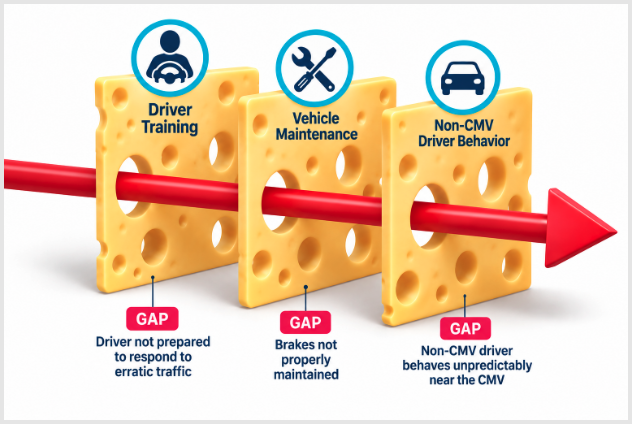
- Conduct a “Swiss cheese” analysis: map your barriers and the holes in each.
- Identify and dispel myths: including language myths like accident.
- Develop institutional safety knowledge: through training that itself learns, documented experience, and mentoring.
- Define safety roles top to bottom with driver involvement.
- Assess and reengineer safety communication in both directions.
- Build safety data collection and analysis; including penalty-free driver reporting.
- Redevelop motivational tools, training, and orientation; simple, fair, and tied to advancement.
- Improve driver retention because culture takes time to transmit.
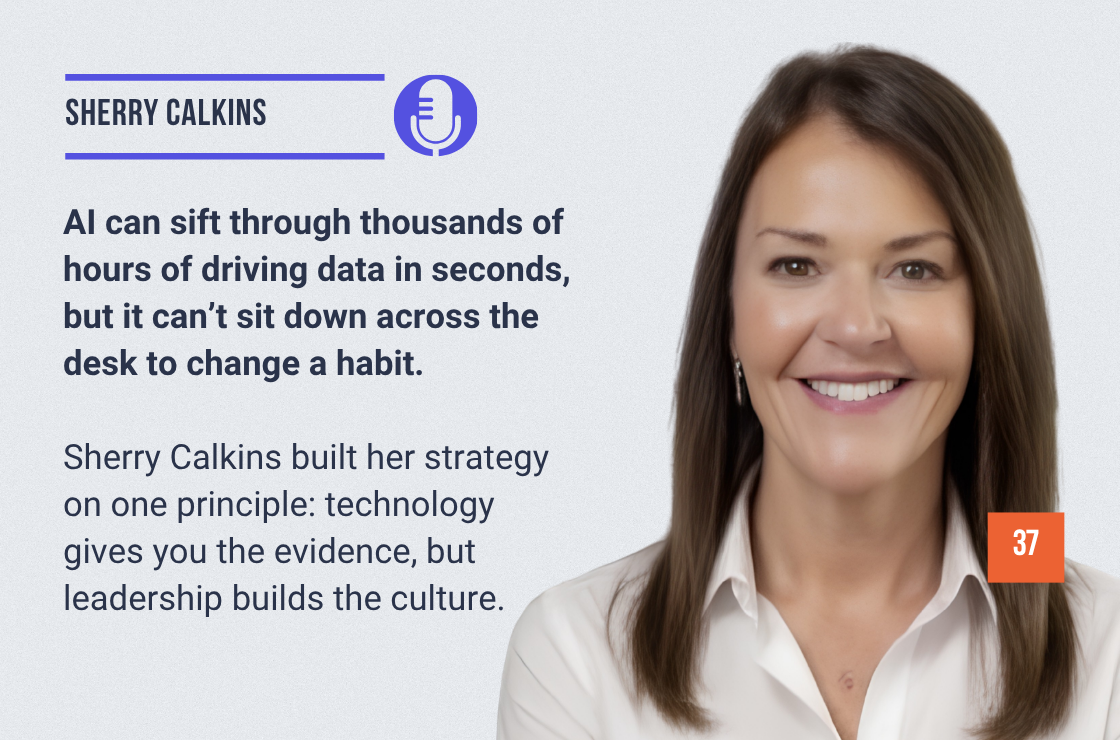
A clear pattern emerges from the list: only two items address systems, while the remaining seven focus on beliefs, communication, and teaching. As Lang notes, “AI can help analyze huge amounts of data and process it faster than a human can, that’s math. It’s up to us to interpret it.” Interpretation and effective coaching are human skills. Lang’s guidance is concise: “Don’t shine them. Don’t say you’re a good driver. Tell them why they’re a good driver.” Your drivers already operate within a safety culture shaped by stories, many of which you may not know. The key question is whose stories are influencing this culture and whether your team has learned to share more effective ones. IMPROVLearning specializes in this work, let’s get you sorted.
 Learner Login