The Moment Nothing Happens. There is a version of this story that happens thousands of times a day.
A driver reaches for their phone at a red light. The light turns green. They are still reading. Nothing happens. They merge onto the highway, settle into their lane, and somewhere in the next mile, the brain quietly closes the file: that was fine.
That moment the one where nothing happened is where the real danger begins.
Distracted driving rarely announces itself. It does not arrive with warning signs or close calls. It runs beneath the surface of ordinary workdays and familiar routes, tucked inside habits that have never produced a consequence worth remembering. And it is precisely that absence of consequence that keeps the behavior alive. Each uneventful glance at a screen becomes its own quiet permission slip for the next one.
In 2022, distracted driving claimed 3,308 livesin the United States.¹ The number has stayed roughly in that range for years persistent, unresponsive to awareness campaigns, resistant to simple fixes. This is not because people lack information. Most drivers know distracted driving is dangerous. They have seen the statistics, sat through the training, nodded at the right moments. And then, a week later, they check a message at 68 miles per hour because it feels like a quick look.
This is not a knowledge problem. It is a behavior problem. The two require entirely different solutions.
What Is Actually Happening in the Brain
What makes distracted driving so difficult to address is rooted in the mechanics of human attention. The NHTSA estimates that reading or sending a text takes a driver’s eyes off the road for an average of five seconds.² At highway speed, that is the length of a football field traveled without looking up. The comparison is striking in theory. It feels nothing like that in practice and that gap between how risk feels and how risk actually behavesis where accidents live.
Cognitive scientists describe what happens inside the brain during these moments as inattention blindness.The driver is not asleep. They are looking forward. But the brain, preoccupied with another task, stops processing the visual field in any meaningful way.³ Hazards can appear directly in a driver’s line of sight and go completely unregistered. The eyes are open. The mind has left the vehicle.
What makes this harder to address is that the impairment is largely invisible to the person experiencing it. Consider what research consistently shows:
- Drivers significantly overestimate their abilityto manage divided attention
- The subjective sense of control does not erode at the same rate as actual capability
- A driver can feel sharp and responsive while operating well below their normal capacity to detect sudden changes in the road ahead
Research from the AAA Foundation for Traffic Safety added a finding that surprised even experienced safety professionals: voice-to-text features often promoted as a safer alternative to manual phone use produced some of the highest levels of mental workload observed in their studies, in several cases comparable to holding the phone directly.⁴ The hands were on the wheel. The mind was composing a sentence. Safety is not a matter of where the hands are. It is a matter of where the attention is.
The Familiarity Trap
Fleet managers hear this frustration constantly that some of the most difficult drivers to reach with safety training are the ones who have been driving the longest, logging the most miles, carrying the cleanest records. It feels counterintuitive. It is entirely predictable.
When a behavior is repeated hundreds of times without incident, the brain quietly reclassifies it. What was once treated as a mild risk becomes routine. Psychologists call this risk normalization, and it is especially powerful in:
- Familiar routes driven week after week
- Light or predictable traffic conditions
- The repetitive middle miles of a long shift
- Situations where the driver has “always been fine before”
The problem is that familiarity does not reduce risk. It reduces the perceptionof risk. A driver who has glanced at their phone on the same stretch of highway three hundred times without incident is not safer than someone doing it for the first time. They simply feel that way and that feeling is more persuasive than any statistic.
This also explains why training that relies on dramatic footage or sobering data tends to fade quickly. The impression is real. The behavior change is fragile. Hermann Ebbinghaus mapped this more than a century ago: without reinforcement, the brain releases most of what it learns within days.⁶ A single training event is working against the brain’s own architecture. It lands, it moves the needle briefly, and then the familiar route home reasserts everything the training tried to interrupt.
The Organizational Layer Most Programs Miss
Even the best individual coaching operates inside an organizational environment and that environment either reinforces or quietly undermines what the training is trying to build.
When productivity pressure signals whether explicitly or through unspoken norms that being reachable matters more than being attentive, drivers absorb that message. The safety policy is on the wall. The actual norm lives in the culture. Research on behavioral patterns in organizations consistently shows that people take their cues from what is modeled and reinforced around them, far more than from what is formally required.⁷
A manager who calls a driver mid-route and expects an immediate answer is participating in the distracted driving problem, whatever the handbook says.
Safety culture is not a document. It is the accumulation of small, repeated choices what gets rewarded, what gets ignored, what leaders do when no one is officially watching.
What Actually Changes Behavior
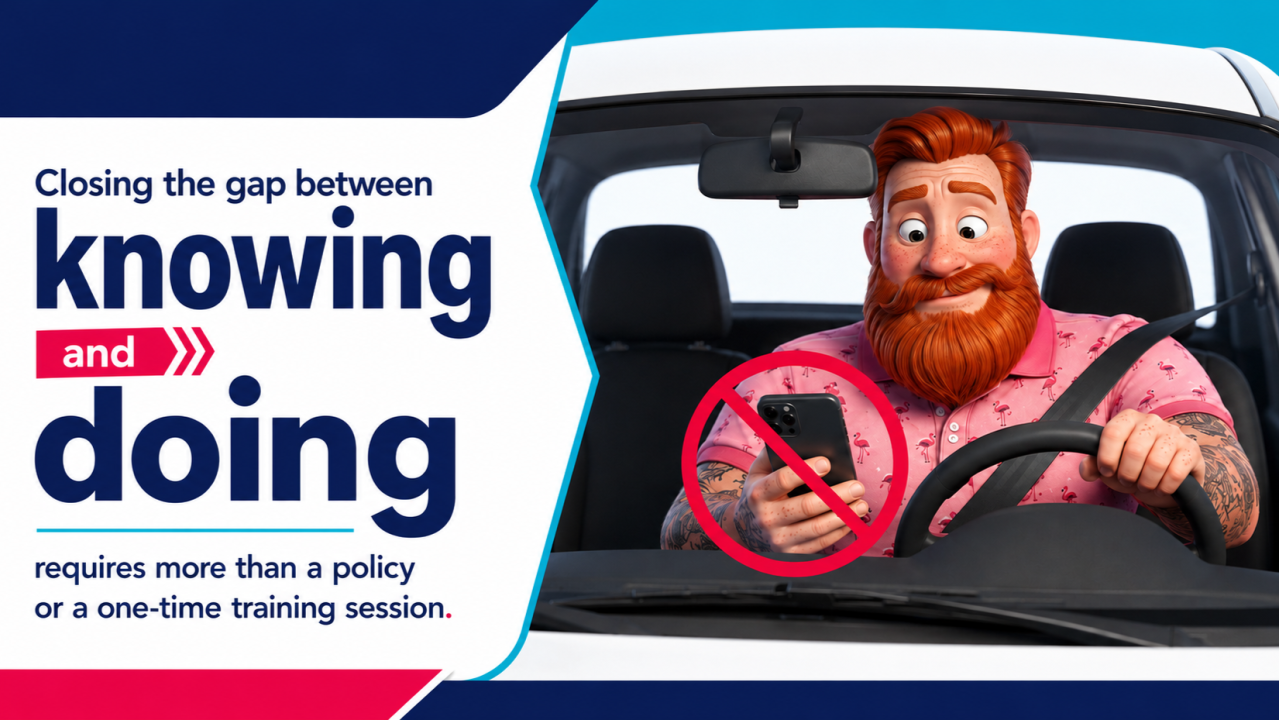
Closing the gap between knowing and doing requires more than a policy or a one-time training session. The evidence points clearly toward a layered approach:
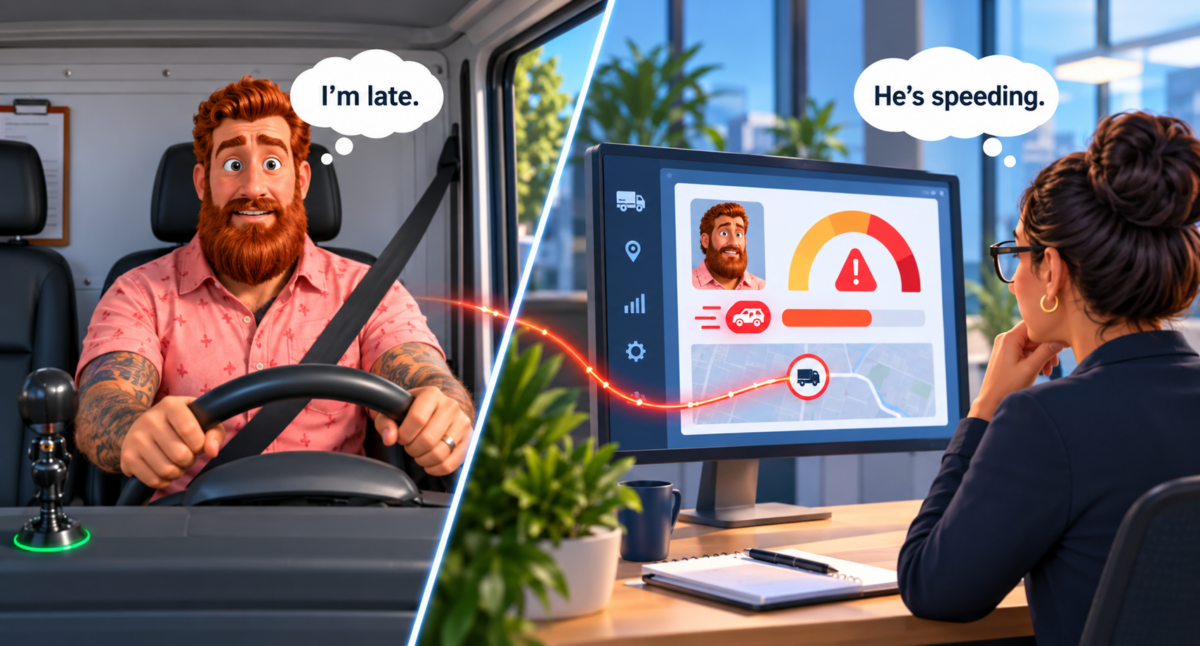
- Timing and specificity of feedback. When a driver receives coaching tied to a specific event on a specific road at a specific time rather than a general reminder weeks later the brain has a context to attach it to. Telematics makes this possible in ways classroom training cannot replicate. That kind of feedback is harder to dismiss and harder to forget.
- Spaced reinforcement over time.Short, recurring coaching touchpoints accumulate into genuine habit change. One training event is an impression. Twelve well-timed coaching moments over six months are a standard.
- Self-efficacy as a foundation.Research on behavior change is consistent: people act on safety knowledge more reliably when they believe their own habits are changeable.⁸ Training that gives drivers a sense of agency not just information is more likely to transfer into real behavior behind the wheel.
- Engagement over compliance.Humor, used with purpose, lowers the defensive resistance that direct correction often triggers. A driver who is told their behavior is dangerous may shut down. A driver who arrives at the same insight through a format that engages rather than lectures is more likely to carry it forward.
The Danger Hidden in Plain Sight
The hidden danger in distracted driving is not recklessness. It is ordinariness.
It happens in the unremarkable middle of a workday, on roads the driver knows well, in the brief space between one task and the next. The risk does not feel like risk. It feels like efficiency a quick check, a fast reply, a small use of time that the brain has already decided is acceptable.
Changing that is not simply a matter of reminding people that driving is dangerous. It is about helping them see the specific moments where their attention quietly slips and building the conditions, the culture, and the coaching that make the safer choice feel like the natural one, not the inconvenient one.
That is a harder problem than awareness. It is also the one that actually matters.
References
¹ National Highway Traffic Safety Administration. Distracted Driving 2022.Traffic Safety Facts Research Note. DOT HS 813 561. April 2024.
² National Highway Traffic Safety Administration. Faces of Distracted Driving. NHTSA.gov.
³ Strayer, D.L., Drews, F.A., & Johnston, W.A. (2003). Cell phone–induced failures of visual attention during simulated driving. Journal of Experimental Psychology: Applied, 9(1), 23–32.
⁴ AAA Foundation for Traffic Safety. Measuring Cognitive Distraction in the Automobile.June 2013.
⁵ Slovic, P. (1987). Perception of risk. Science, 236(4799), 280–285.
⁶ Ebbinghaus, H. (1885). Über das Gedächtnis[On Memory]. Leipzig: Duncker & Humblot. Translated and republished 1913.
⁷ Edmondson, A.C. (1999). Psychological safety and learning behavior in work teams. Administrative Science Quarterly, 44(2), 350–383.
⁸ Bandura, A. (1977). Self-efficacy: Toward a unifying theory of behavioral change. Psychological Review, 84(2), 191–215.
 Learner Login