There is a conversation happening in courtrooms across America that every fleet executive needs to hear.
For two decades, the message to fleets was simple: instrument everything. Install the telematics. Add the dash cameras. Capture the alerts. Build the dashboard. Visibility was the goal.
And the technology delivered.
Today, a fleet manager can see every hard brake, every speeding event, every drowsy drift across the fog line, and every risky pattern that once disappeared into the noise of daily operations.
But there is a harder truth buried inside that visibility: once the data reaches your dashboard, your organization may no longer be able to say, “We didn’t know.”
In tort law, what a company knew or reasonably should have known can become the center of the case. Negligent entrustment, negligent retention, negligent supervision, and negligent training all circle the same basic question: did the employer become aware of a safety risk and fail to take reasonable action?¹
Before telematics, “knew or should have known” was often a fight over paper files, manager recollections, and incomplete records. Now, the evidence may be timestamped, geo-located, machine-logged, and sitting on the company’s own server.
That is the liability paradox of modern fleet safety. The tools purchased to protect the company can become the very evidence used to prove the company saw the risk and failed to intervene.
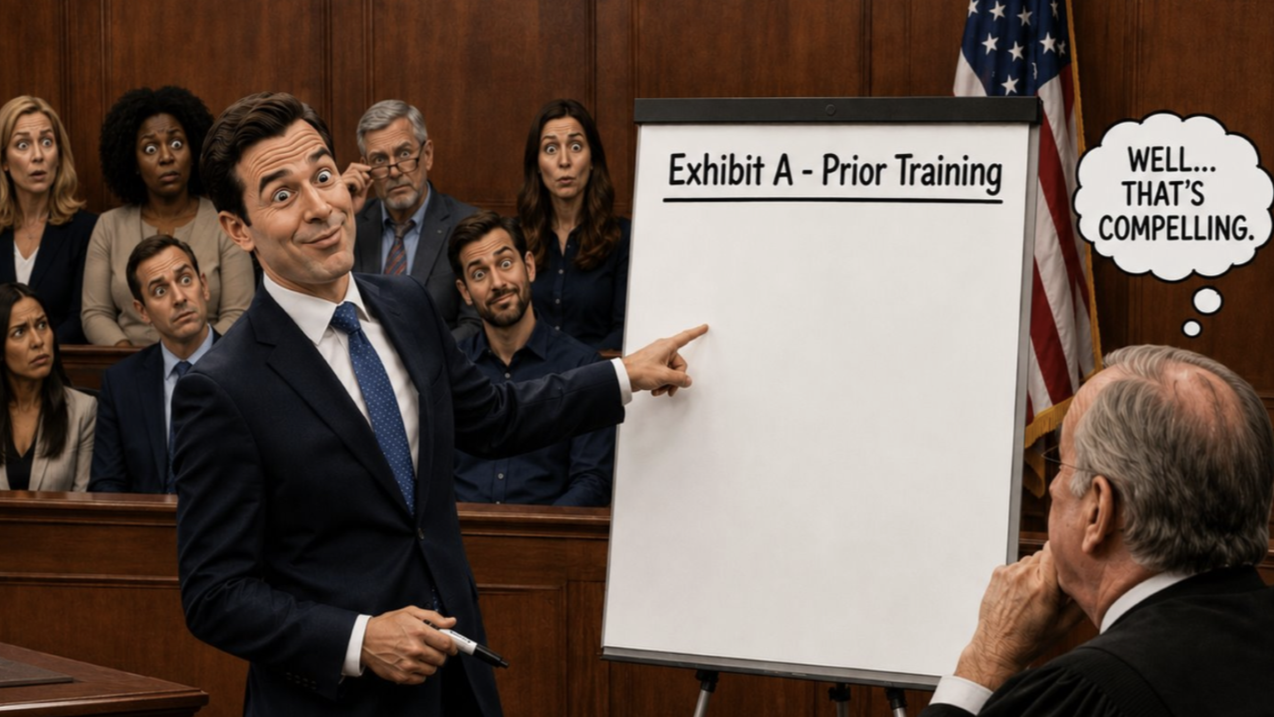
The New Exhibit A
This is not an argument against telematics or cameras. Fleets need visibility. They need event data. They need a way to understand what is happening on the road before something catastrophic happens.
The problem begins when detection is mistaken for prevention.
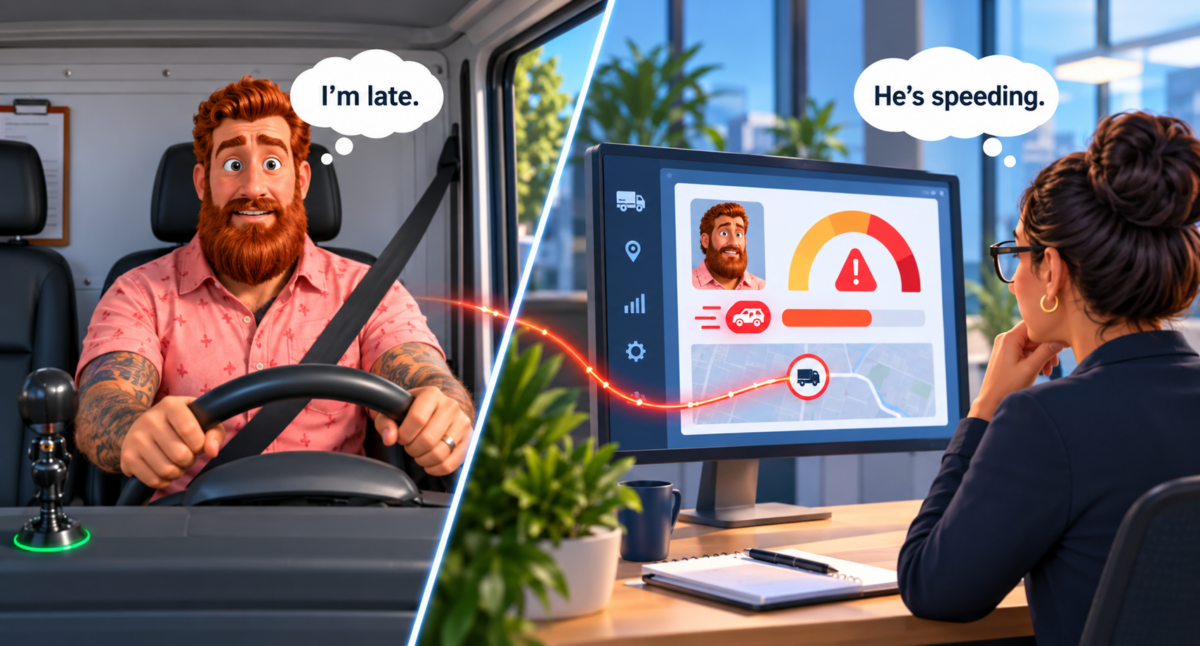
A dashcam can record a distracted glance. A telematics platform can flag repeated speeding. An AI model can identify a driver whose risk score is trending in the wrong direction. But none of those tools, by themselves, changes behavior.
And in litigation, the question quickly shifts from “Did the driver do something unsafe?” to “What did the company do after it knew?”
Transportation defense attorney Doug Marcello has called this “ghost coaching” the pattern where fleets collect driver safety data but fail to coach, fail to document the coaching, or fail to prove the coaching changed the behavior.² His warning is blunt: policies and manuals are not much of a defense if they are not enforced.²
That distinction matters. A policy sitting in a binder is not the same as a safety system. A dashboard full of alerts is not the same as an intervention. A hallway conversation after a speeding event is not the same as documented behavior change.
The $26 Million Lesson
Marcello shared one particularly sobering example: a four-truck fleet at a flooring company that was hit with a $26 million verdict after one of its drivers drifted off the road at 2 a.m. and struck a man who had pulled onto the shoulder. According to the account, the company had speed-monitoring devices on its trucks but did not follow or enforce the data.²
Four trucks. A small fleet. A preventable pattern. A massive verdict.
The technology did what it was supposed to do. It captured the risk.
The company simply did not close the loop.
That is the uncomfortable lesson for every fleet leader investing in visibility tools. The more precisely you can identify risk, the more clearly you must be able to show what happened next.
This Is Now a Repeatable Litigation Playbook
The flooring company example is not an outlier. It reflects a broader pattern in transportation litigation: plaintiffs’ attorneys increasingly look for evidence that the company had warning signs before the crash.
Consider the $1 billion Florida trucking verdict in 2021. A jury awarded damages after the wrongful death of an 18-year-old, following a crash involving trucking companies and allegations that included distracted driving, excessive hours, and failure to brake until one second before impact.³ Those facts are exactly the kinds of behaviors modern fleet systems are designed to capture: hours, speed, attention, braking, fatigue risk.
In California, Rodriguez and Gomez v. The Original Mowbray’s Tree Service resulted in an $83.8 million verdict after plaintiffs alleged negligent hiring, supervision, retention, and entrustment. The company allegedly knew the employee lacked a valid driver’s license and had a drinking problem, yet he was still permitted to operate a company vehicle.⁴ Again, the core issue was not just the driver’s conduct. It was the organization’s prior knowledge and failure to act.
The American Transportation Research Institute’s research on nuclear verdicts underscores the same point. ATRI reported that average trucking verdicts over $1 million increased from approximately $2.3 million in 2010 to $22.3 million in 2018 a 967% increase.⁵ Other summaries of ATRI’s findings have noted that cases involving hours-of-service violations or a history of driver violations were especially damaging for defendants.⁶
The broader civil litigation environment is also escalating. In 2024, corporate defendants faced 135 nuclear verdicts awards over $10 million totaling $31.3 billion, a 52% increase in count and 116% increase in total value over 2023.⁷
For fleet executives, the message is clear: when a plaintiff can show a documented pattern that the company ignored, the case is no longer only about the crash. It becomes a story about corporate tolerance.
How the Dashboard Gets Weaponized
After a serious crash, plaintiffs’ attorneys do not stop at the police report. They request operational records, driver qualification files, hours-of-service logs, maintenance records, telematics alerts, camera footage, safety policies, coaching records, and prior violations.
Electronic logging device data, black box records, dashcam footage, and telematics reports can all become central evidence because they provide an objective timeline of what happened before the crash.⁸ Some plaintiff-side trucking litigation resources explicitly describe these records as critical to proving fatigue, hours-of-service violations, speed, braking behavior, and company negligence.⁹
The data cannot simply disappear, either. Once litigation is reasonably anticipated, companies have a duty to preserve relevant electronically stored information. Federal Rule of Civil Procedure 37(e) allows courts to impose sanctions when electronically stored information that should have been preserved is lost because a party failed to take reasonable steps.¹⁰ In practice, spoliation letters often arrive quickly after a crash, demanding preservation of electronic records, vehicle data, driver files, and related evidence.¹¹
And AI makes the discovery risk more complicated, not less.
Predictive analytics can now identify high-risk drivers by combining telematics, route history, weather, behavioral alerts, and other operational data.¹² That creates a new line of questioning: if the system flagged a driver in March and the crash happened in June, what did the company do in April and May?
That question may become the whole case.
“But We Coached Him” Is Not Enough
This is where many fleets feel protected, but are not.
A supervisor saying, “I talked to him,” is not the same as a defensible intervention. A note in a file is better than nothing, but even that may not be enough if the behavior continues.
Imagine the pattern in front of a jury:
A driver generates 40 speeding alerts.
The company “coaches” him 40 times.
The alerts continue.
Then the driver causes a fatal crash.
Forty coaching records may not prove a strong safety program. They may prove the company knew the intervention was not working and kept handing over the keys.
That is why the standard fleets should be moving toward is not simply documented coaching. It is documented behavior change.
A defensible safety system needs to show four things:
- The risky behavior was identified.
- A targeted intervention followed.
- The company measured whether the behavior improved.
- If the behavior did not improve, the company escalated.
That escalation may mean retraining, closer supervision, temporary restriction, removal from certain routes, or termination when risk persists. Employment negligence guidance consistently points to the importance of training, supervision, corrective action, and documentation when known deficiencies create foreseeable risk.¹³
Telematics handles step one extremely well.
It is not designed to handle steps two, three, and four on its own.
A camera can show that a driver tailgates. It cannot teach the driver why the brain underestimates following distance at highway speed. A dashboard can rank a driver as high risk. It cannot build a new habit. A scorecard can show repeated harsh braking. It cannot determine whether the driver’s attention, route pressure, fatigue, or decision-making pattern is driving the behavior.
That requires intervention by design.
The Missing Link: From Detection to Behavior Change
Fleet safety technology gave leaders eyes. It did not automatically give them hands.
The next generation of fleet safety will not be defined by who has the most alerts. It will be defined by who can turn alerts into action, action into learning, and learning into measurable risk reduction.
That matters for safety. It also matters for liability.
A closed-loop system changes the legal posture. Instead of showing a neglected pattern, the company can show a disciplined process:
An alert was generated.
The driver received targeted training.
The behavior was monitored afterward.
The risk decreased.
If it did not decrease, the company escalated.
That is a different story in front of a jury. It moves the company from passive observer to active safety manager.
And that is the story every fleet should want its data to tell.
What Fleet Leaders Should Do Now
Start with the last 90 days of alerts.
For every driver flagged for repeated speeding, following too closely, harsh braking, distraction, fatigue risk, or hours-of-service concerns, ask three questions:
Can we show what intervention followed?
Can we show the driver completed it?
Can we show whether the behavior changed afterward?
If the answer is no, the organization has not closed the loop. It has only collected the evidence.
Next, review the gap between policy and practice. If the policy says repeated speeding triggers coaching, retraining, or escalation, make sure that is what actually happens. Unenforced policies are dangerous because they create a written standard the company can be measured against later.
Finally, make behavior change the goal not event closure. Closing an alert is administrative. Changing the pattern is preventive.
The fleets that will be best protected are not the ones with the most sophisticated dashboards. They are the ones that can prove they used the data to reduce risk before the crash happened.
Because once the alert exists, the question is no longer whether the company had visibility.
The question is what the company did with it.
References
- Great American Insurance Group. (n.d.). Negligent entrustment: What it is and why you should be concerned. (web)
- Truck News. (2026, June 5). Ignoring telematics data could expose fleets to nuclear verdicts. (Truck News)
- Truckinginfo. (2021, September 7). 5 takeaways from a billion-dollar verdict. (Heavy Duty Trucking)
- Exlitem. (2024, September 3). California personal injury lawsuit results in $83.8M verdict against Original Mowbray’s Tree Service for negligence. (Exlitem)
- American Transportation Research Institute, as summarized by Frantz & Phelan. (2021, March 18). Understanding the impact of nuclear verdicts on the trucking industry. (Franklin & Prokopik, P.C.)
- Baker Sterchi Cowden & Rice. (2022, January 11). In 2021, a record setting $1 billion dollar verdict was rendered against a trucking company. (Baker Sterchi)
- Insurance Journal. (2025, May 22). Corporate nuclear verdicts surged to new record high in 2024. (Insurance Journal)
- MartinWren, P.C. (2026, May 11). How does telematics data prove driver fatigue in a truck accident? (MartinWren, P.C.)
- Miller & Zois. (n.d.). Truck accident sample request for production of documents. (Maryland Personal Injury Lawyers)
- Legal Information Institute. (n.d.). Rule 37. Failure to make disclosures or to cooperate in discovery. Cornell Law School. (Legal Information Institute)
- Versus Injury Lawyers. (2026, January 4). How we investigate truck crashes. (Varghese Summersett)
- Fulginiti Law. (2025). When the truck knows more than the driver: How AI and data are rewriting truck accident law. (Fulginiti Law)
- The CLM. (n.d.). Investigating negligent hiring claims. (theclm.org)
 Learner Login