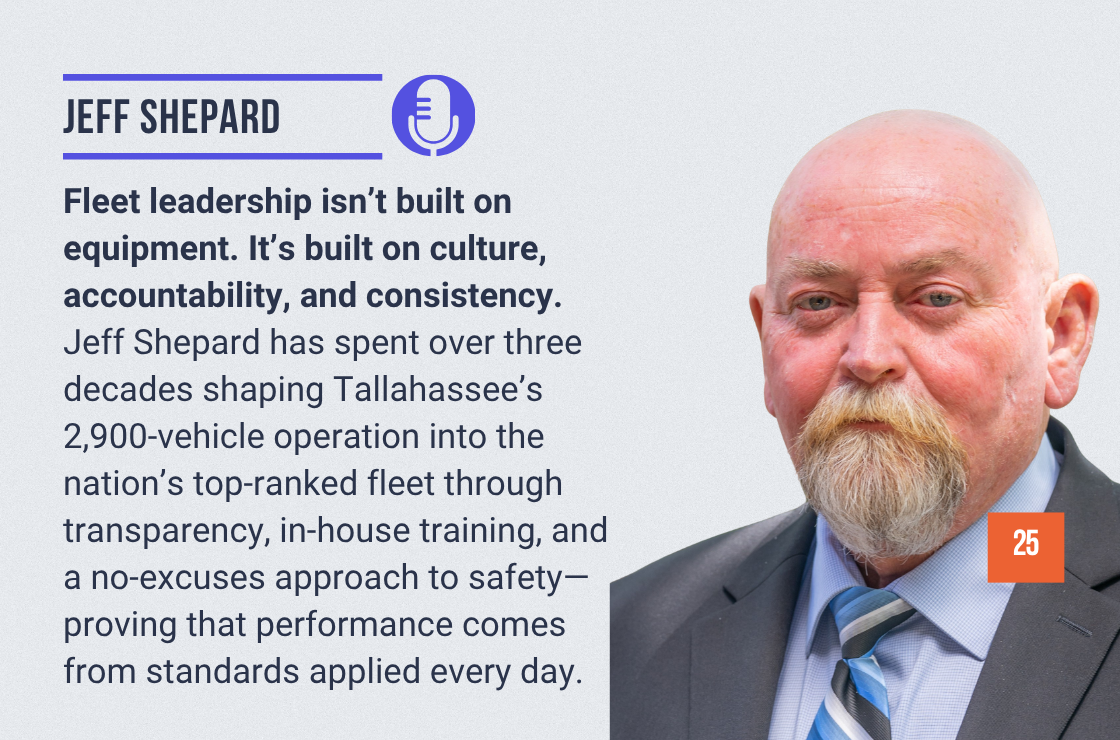
Jeff Shepard is the Fleet Manager for the City of Tallahassee, recognized as the number one leading fleet in the nation for 2025. With over 32 years of experience starting as a dealership technician, Jeff oversees nearly 2,900 vehicles spanning transit, solid waste, police, fire, utilities, airport, and public works. His leadership is built on transparency, technician investment, and treating internal departments as customers.
Here’s a glimpse of what you’ll learn:
- [1:12] How selling equipment to the city led Jeff to join it full-time
- [2:39] The cultural shift toward data-driven customer service
- [3:22] What no excuses on driver safety looks like in practice
- [5:58] How telematics went from pushback to department-wide adoption
- [7:05] Managing 1,000,000+ miles of vehicle travel per month
- [9:55] Running CNG, EV, diesel, and hybrid vehicles across one operation
- [13:11] A mobile level 3 charger on a diesel generator for storm response
- [17:00] Transparency dashboards and earning buy-in from the manager’s office
- [21:15] Building an in-house CDL training program from scratch
- [29:50] Jeff’s advice for any fleet trying to climb the national rankings
In this episode…
Most people picture a city fleet as a garage full of police cars and garbage trucks. Tallahassee runs close to 2,900 vehicles across airport, transit, solid waste, police, fire, gas utilities, power generation, and public works. The fleet includes CNG vehicles, 150 fully electric light-duty vehicles, around 30 electric transit buses, Toyota hybrids, electric Silverados, excavators, and robotic mowers. They maintain solar farms, power plants, and 130-plus backup generators for water and sewer systems. When a hurricane hits, Tallahassee Fleet fuels mutual aid trucks at hotel parking lots at night so crews can go straight to work in the morning.
Running that operation at the national top spot did not happen by accident. In this Roadrageous episode, Jeff Shepard breaks down the cultural transformation, the transparency infrastructure, and the people-first investments behind the ranking.
The Cultural Shift That Changed Everything
Jeff came up as a technician. His instincts were built around fixing things and keeping equipment running. But the bigger shift at Tallahassee Fleet was not technical. It was cultural.
“We’ve changed our whole culture throughout fleet through customer service,” Jeff explains. “We run a data-driven customer service operation. They’re our customers. We don’t dictate to them their equipment. We just manage it for them, purchase it for them, and keep it on the road safely.”
Municipal fleet departments can fall into the trap of functioning like internal monopolies. Departments that rely on fleet have no other option, so the pressure to perform like a service business is easy to ignore. Jeff chose the opposite path. Every internal department now has access to a SharePoint dashboard showing their vehicles’ mileage, downtime, repair history, and billing costs.
“Transparency is my biggest thing,” Jeff says. “You’ve got to get buy-in from the top, the manager’s office. They know what we do and they know exactly how important it is.”
No Excuses on Driver Safety
When asked about the Tallahassee approach to driver safety, Jeff’s answer is direct: no excuses. When a vehicle is repaired, it goes back out safely. No shortcuts on brakes. No compromises on technician safety.
A monthly safety committee surfaces concerns and brings recommendations to leadership. A safety officer inspects every garage on a regular schedule. For drivers, accountability runs through both training and technology.
Tallahassee built its own in-house CDL training program about four years ago after struggling with external programs. A master technician, a supervisor, and a senior manager designed the curriculum together. The program has now run 180 to 200 people through CDL certification. The city operates a state-certified CDL testing track and a dedicated training room with live air brake board systems.
Even police officers come in for annual driver training because their work involves larger emergency service vehicles. The partnership runs both ways. Vendors must also provide defined training hours as part of every purchasing contract.
Telematics: From Pushback to Department-Wide Adoption
Introducing cameras and telematics into a public sector fleet rarely goes smoothly. Employees pushed back. Privacy concerns were real. Jeff’s team held meetings and showed employees documented examples of cameras protecting drivers rather than penalizing them.
“We always get driver complaints from the citizens and they pulled the camera up and said, no, he did not do that,” Jeff recalls. “We can either prove that he was or prove that he wasn’t speeding with the GPS. Other departments are following suit now and asking for cameras.”
Exoneration became the entry point. Coaching followed from there. Driver confidence in the system replaced the initial resistance.
The operational utility has grown well beyond safety. With the fleet traveling more than one million miles a month, telematics is the only reliable way to capture mileage and fault codes across CNG and electric vehicles. During emergencies, the manager’s office sees dispatch times and vehicle locations in real time. Fuel supervisors use tank monitors tied to the system to direct mobile fuel trucks to generators citywide without leaving their desks.
Running a Multi-Fuel Fleet at Scale
Few fleets manage Tallahassee’s fuel complexity. Gas, diesel, CNG, electric, and hybrid vehicles all operate under the same umbrella, each with different infrastructure requirements and different failure modes during a crisis.
A CNG station going down during a storm puts a significant portion of the fleet in a bind immediately. Tallahassee maintains a strong vendor partnership to minimize that risk. For EVs, the team developed a practical solution for storm response: a mobile level 3 charger mounted on a diesel generator, carrying two level 2 ports and two level 3 ports, capable of simultaneously charging two transit buses and two Lightning F-150s anywhere in the city.
Managing state of charge across 30 electric transit buses requires its own layer of oversight. A night crew fuels, washes, and inspects buses after late routes. Superintendents monitor charge states via telematics from their phones. Buses are ready by 5 AM.
What It Takes to Be Number One
When asked what advice he would give a fleet currently ranked 20th or 50th nationally, Jeff returns to consistent themes.
Start with transparency. Give your customers visibility into what you are doing and what it costs. Build a leadership relationship where people at the top understand the stakes every day, not just during emergencies.
Invest in your team before anything else. Training is not a budget line to cut. Own your mistakes quickly and fix them with your team. And stay focused on who you are actually serving.
“Just look at who you’re supporting,” Jeff says. “You’re supporting your customers to support the citizens.”
For Jeff, the ranking confirms a philosophy. Tallahassee Fleet has also navigated COVID, tornado damage, and recurring hurricane seasons by building institutional resilience: the training programs, vendor relationships, and data systems that absorb pressure before it becomes a crisis.
Quotable Moments:
- “No excuses on driver safety. When we repair something, it’s got to be back out on the road safely.”
- “Transparency is my biggest thing. You’ve got to get buy-in from the top.”
- “We run a data-driven customer service operation. They’re our customers.”
- “If you make a mistake, just own it and go back and fix it.”
- “Fleet don’t stop. These vehicles are not going to stop.”
- “Technology’s good, just keep it working and then you still got your responsibility.”
- “Support your team and train and educate your team. That’s the biggest thing.”
Action Steps:
- Build a transparency dashboard. Build a transparency dashboard for internal customers.
- Give departments direct visibility into vehicle mileage, downtime, repair history, and costs.
- Develop in-house training. Develop in-house CDL and driver training programs.
- Build your curriculum with your best people and certify your own trainers rather than waiting on external programs.
- Require training in contracts. Require training provisions in every vendor contract.
- Negotiate factory training hours into every purchasing agreement.
- Lead with exoneration. Deploy telematics as an exoneration tool first.
- Share early stories of drivers cleared by the data to build trust in the system.
- Plan fuel infrastructure early. Plan multi-fuel infrastructure before you need it.
- Have backup plans for CNG station failures and grid outages before the first storm arrives.
- Own mistakes fast. Own mistakes quickly and fix them with your team.
Key Takeaways
- Ranked #1 nationally for 2025, Tallahassee Fleet runs nearly 2,900 vehicles across 7+ departments
- Safety is non-negotiable, with monthly safety committees and no shortcuts on brake maintenance or technician protection
- An in-house CDL program has certified 180 to 200 people using a state-approved track and dedicated training facilities
- Telematics adoption was driven by driver exoneration stories, not mandates
- A mobile level 3 charger on a diesel generator keeps the EV fleet operational during grid outages
- Transparency dashboards give every department visibility into their own fleet data
- Vendor contracts now require factory training as a deliverable
- Leadership support from the city manager’s office is credited as a critical factor in sustained investment
Conclusion
Jeff Shepard has spent 32 years building something that does not appear on any dashboard: a culture of accountability, service, and continuous improvement inside a government fleet operation. The number one national ranking for 2025 reflects investments that started years ago. A training room with air brake boards. Contracts written to include knowledge transfer. A portal where any department head can check their vehicles. A mobile EV charger ready when the grid fails.
For fleet leaders looking to close the gap between where they are and where they want to be, Jeff’s path offers clear principles: serve your customers, invest in your people, own your mistakes, and make sure leadership understands exactly what you do and why it matters.
Resources mentioned in this episode:
About Jeff Shepard
Jeff Shepard is the Fleet Manager for the City of Tallahassee, where he leads one of the most operationally complex municipal fleets in the United States. With over 32 years of experience, Jeff oversees approximately 2,900 vehicles across transit, solid waste, police, fire, utilities, airport, and public works. His background as a technician and dealership professional gave him an equipment-first perspective he has combined with a customer service philosophy that treats every internal department as a client. Tallahassee Fleet was recognized as the number one leading fleet in the nation for 2025.
Sponsor
IMPROVLearning — At IMPROVLearning, we are dedicated to transforming driver education through innovative, research-backed training methods. Our SPIDER Driver Training platform combines humor with proven brain-training techniques to help drivers anticipate and avoid dangers on the road. Technology creates visibility. Trained drivers make good decisions when no one is watching. SPIDER training develops hazard recognition, space management, and split-second decision-making under pressure. Visit improvlearning.com.
 Learner Login