Fuel costs are one of the few expenses a fleet feels immediately. It hits every day. Every route. Every vehicle. Every driver.
As of May 5, 2026, the U.S. Energy Information Administration reported regular gasoline at $4.251 per gallon on the East Coast and $5.583 per gallon on the West Coast. On-highway diesel was $5.504 per gallon on the East Coast and $6.631 per gallon on the West Coast.¹ For fleet leaders, those numbers are not just market data. They are operating pressure.
And one of the clearest places to find relief is already visible in the telematics dashboard.
Not in a new vehicle purchase.
Not in a major route redesign.
In the habits.
The two behaviors that burn fuel
When we talk about driver training, safety is usually the headline: fewer incidents, fewer violations, fewer claims, better awareness behind the wheel.
But the same habits that create safety risk often create fuel waste.
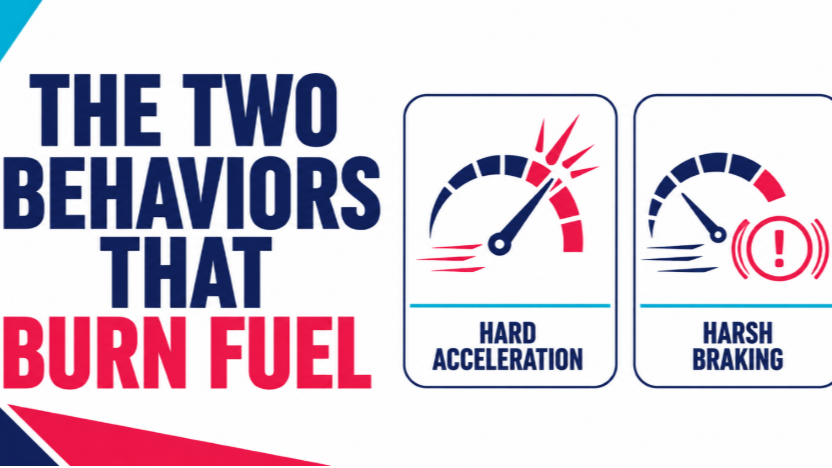
Two telematics events matter most here: hard acceleration and harsh braking.
Hard acceleration is the obvious fuel burner. A driver presses the pedal aggressively to get moving quickly, close a gap, beat a light, recover lost time, or push through traffic. The vehicle demands more power. More power means more fuel.
Harsh braking tells the other half of the story. Braking itself is not what burns the fuel. The waste usually happened seconds earlier. The driver already paid for that momentum through acceleration, then threw it away because of close following, late recognition, distraction, or overconfidence.
That is the simplest way to explain it:
Hard acceleration burns extra fuel. Harsh braking wastes the fuel the vehicle already used.
The U.S. Department of Energy states that aggressive driving, including rapid acceleration and braking, can lower gas mileage by roughly 15% to 30% at highway speeds and 10% to 40% in stop-and-go traffic. It also notes that driver feedback devices can improve fuel economy by about 3% on average, and by about 10% among drivers using them specifically to save fuel.²
That matters because most fleet training conversations focus on what drivers know. Fuel savings come from what drivers repeatedly do.
What the numbers show
The infographic estimates potential monthly savings for a 100-vehicle fleet using a 10% fuel-use reduction scenario. That is not a guarantee. It is a credible improvement scenario when telematics feedback and driver coaching are used to reduce aggressive driving patterns.
The model breaks savings into two coaching targets:
6% attributed to reducing hard acceleration
4% attributed to reducing harsh braking
That split is practical. Hard acceleration is the more direct fuel burner. Harsh braking is the signal that fuel-paid momentum was just lost.
The numbers also show why fuel type and geography matter. A primarily diesel fleet on the West Coast has more fuel-cost exposure than a primarily gasoline fleet on the East Coast. The driving behavior may be similar, but the financial impact changes with fuel price, vehicle efficiency, route type, load, and mileage.
The U.S. Department of Energy’s Alternative Fuels Data Center makes the same fleet-level connection: driver training can help fleets save fuel and money, and telematics can identify behaviors such as accelerating too quickly, aggressive starts and stops, and braking aggressively or frequently.³
The coaching message is simple
A useful coaching conversation does not have to sound punitive.
A fleet manager might say:
“Every hard launch costs fuel. Every hard brake usually means we already spent fuel we did not need to spend. The goal is not to crawl through the route. The goal is to drive smoother: ease into acceleration, look farther ahead, leave more space, and let the vehicle carry momentum instead of constantly rebuilding it.”
That message works because it connects behavior to something concrete.
The pedal matters.
The space cushion matters.
The timing matters.
The rhythm of the route matters.
Better habits compound
Fuel savings do not come from one perfect drive. They come from small choices repeated across the fleet.
A smoother start from the curb.
A little more space before the next vehicle.
An earlier lift off the accelerator.
One less hard brake at the intersection.
One less aggressive launch after the light changes.
None of those moments looks dramatic by itself.
But fleet costs rarely come from one dramatic moment. They come from patterns.
That is the real opportunity inside driver training. It helps drivers notice the habits they have stopped noticing. It turns telematics events into coaching moments. It connects safer driving to measurable operating value.
Because at today’s fuel prices, better habits behind the wheel are not just a safety advantage.
They are a fuel strategy.
References
- U.S. Energy Information Administration. (2026, May 5). Gasoline and diesel fuel update. https://www.eia.gov/petroleum/gasdiesel/
- U.S. Department of Energy. (n.d.). Driving more efficiently. Energy Saver. https://www.energy.gov/energysaver/driving-more-efficiently
- U.S. Department of Energy, Alternative Fuels Data Center. (n.d.). Efficient driving behavior for fleets. https://afdc.energy.gov/conserve/driving-behavior
 Learner Login