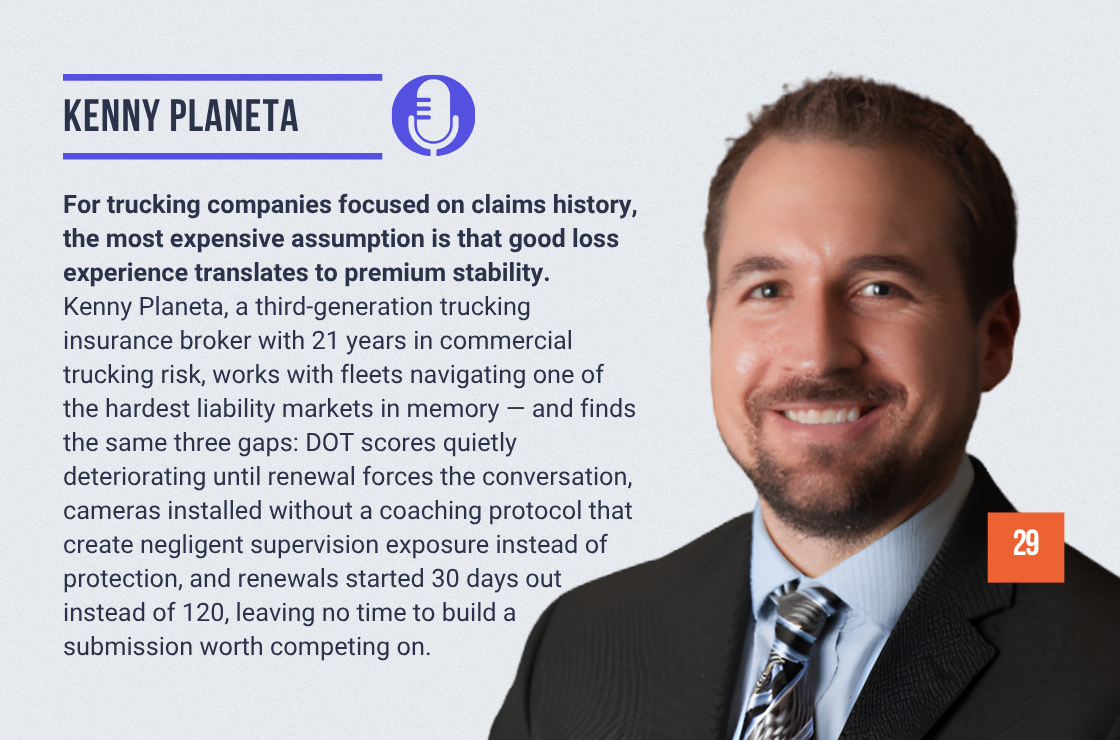
Kenny Planeta is a third-generation trucking insurance broker with 21 years of experience working exclusively in commercial trucking risk. He grew up inside the industry. His grandfather started the business over 40 years ago, his father followed, and by the time Kenny finished college and decided accounting wasn’t for him, he already had five years managing a book of truck insurance under his belt. He works closely with fleets of all sizes to reduce premiums, improve insurability, and build the kind of safety culture that keeps insurance costs from quietly becoming a business-ending expense.
Kenny Planeta is a third-generation trucking insurance broker who has spent 21 years at the intersection of claims, underwriting, and fleet risk management. He is known for pulling back the veil on how the insurance market actually works and for giving fleet owners the unfiltered truth about what is driving their premiums up and what it actually takes to bring them down.
Here’s a glimpse of what you’ll learn:
- [1:12] How a third-generation family business led to 21 years in trucking insurance
- [2:17] Why litigation, not accidents, is the single biggest driver of rising trucking premiums
- [4:34] Why trucking companies are specifically targeted by injury attorneys
- [6:26] How distracted driving has changed the claim landscape over the last decade
- [7:59] A real mediation case: how a minor fender bender became a $275,000 settlement
- [13:54] Why trucking accidents almost never go to trial and what that costs the industry
- [18:56] The camera conversation: why not having one is no longer defensible
- [25:54] How DOT scores now matter more to underwriters than claims history
- [31:26] The profile of a fleet that hasn’t felt this hard market and what they’re doing right
- [40:41] The one piece of advice every fleet should act on to control renewal costs
In this episode…
Every fleet operator knows insurance is expensive. What most don’t know is why and what it actually reveals about their operation. In trucking, your premium is not just a cost of doing business. It is a signal. It tells underwriters, insurers, and the litigation ecosystem exactly what kind of company you run and how much risk you represent.
Kenny Planeta has spent 21 years on the inside of that signal. As a third-generation trucking insurance broker, he has sat through mediations, reviewed thousands of claims, watched insurance companies exit the trucking market entirely, and worked with fleets that have somehow kept their premiums nearly flat through one of the hardest insurance markets in recent memory.
In this Roadrageous episode, Kenny breaks down the real mechanics of trucking insurance: why litigation is the root cause of premium inflation, how a minor accident in a plaintiff-friendly county can turn into a six-figure settlement with no documented injuries, why DOT scores now matter more to underwriters than loss history, and what the safest fleets are doing differently, not just operationally, but culturally.
The Litigation Trap: Why Every Truck Accident Is a Target
The single biggest driver of rising trucking insurance premiums has nothing to do with how often trucks get into accidents. It has to do with what happens after. According to Kenny, virtually every accident today involves attorney representation, and trucking companies are specifically targeted because the math is obvious to anyone who knows how to read a policy.
“The minimum insurance requirements are $750,000 for auto liability. But the reality is that every trucking company is carrying at least a million for their contracts. When the four-wheelers are out there, the state minimum insurance for personal autos is like $25,000 per person commonly. Attorneys look at it and say, why would I want to take a case where the insurance involved has 25K when I could take a trucking case that’s got $1,000,000?”
The result is what the industry calls social inflation: a normalized environment of litigation and large verdicts where the mere involvement of a truck is enough to trigger attorney engagement, regardless of fault. The billboards on every interstate are not coincidence. They are a calculated response to the insurance exposure that commercial vehicles carry.
The downstream effect ripples all the way to the consumer. When litigation drives premiums up, trucking companies have to raise freight rates or exit the business. Either way, the cost lands somewhere. As Kenny puts it, everything that arrives in a truck has insurance cost embedded in it, and most people never think about that until they see the bill.
A $275,000 Settlement With No Documented Injuries
Kenny recounts a mediation he sat through roughly a year ago, a case that crystallized everything he knows about how the current claims environment actually works. A low-impact accident, disputed fault, a claimant with significant shared responsibility, and a beat-up truck that had pre-existing damage. No cameras on the fleet vehicle at the time of the incident. Classic word-against-word.
The accident happened in San Bernardino County, California. The claimant, a 72-year-old laborer with years of physical wear, immediately retained an attorney. The insurance company reserved the claim at $500,000, not because the injuries justified it, but because they knew the county.
“These things all end up in mediation. The majority go into mediation. The demands and the things they’re saying, those attorneys know exactly what they’re doing. They have a book. They know exactly what they’re hitting on. The threats are not empty. They know you don’t want this going to court. So they’re going to try to squeeze as much as they can out of this claim.”
The claim settled for $275,000. The claimant had no documented injuries. He was materially at fault. It did not matter.
Kenny’s takeaway is not that the system is broken beyond repair. It is that fleets who enter this environment without cameras, documentation, and a clear safety record are making themselves easy targets. The only independent eyewitness in a disputed accident is a dash camera. Without one, the truck is presumed at fault. That is how the math works.
The Camera Isn’t Big Brother. It’s Your Defense Attorney
The resistance to dash cameras and telematics has largely dissolved in the fleets Kenny works with. A few years ago, the objection was about driver privacy and union pushback. Today, the objection is almost exclusively about cost, and even that conversation has shifted.
“In this litigation-heavy environment, that is the only independent eyewitness. I don’t know if you’ve ever witnessed a vehicle accident. It’s really hard to recall exactly what happened. There’s a lot that happens really fast. Without that dash camera, a car that darts in front and brakes could be viewed as a rear-end accident. Oh, you were tailgating, road rage, truck driver out of control. That is the story that is told without a camera.”
But Kenny draws a critical distinction that most fleet operators miss: having cameras is not enough if you are not prepared to act on what they show. Getting alerts and ignoring them is, in some ways, worse than having no system at all. If litigation arises and it comes out that the fleet had behavioral data and took no action, the exposure for negligent supervision becomes its own liability.
“If you’re going to have cameras and get the alerts, you need to be prepared to coach on them. You can’t just take in all those alerts and not do anything with them because in some ways it looks worse. You’re complicit. You knew this guy was driving like this and you did nothing about it.”
The best fleets, Kenny says, use cameras for more than exoneration. They use near-miss footage to recognize drivers who avoided accidents. Those calls reinforce the culture and remind every driver that someone is paying attention to the good work too, not just the violations.
DOT Scores: The Metric That Now Matters More Than Claims
There has been a significant shift in how underwriters weight the inputs that determine a trucking company’s premium. Kenny has watched it happen over the last decade, and the conclusion is clear: DOT scores now matter more to most preferred markets than claims history.
“Step one of all the preferred trucking markets is: what do their scores look like? It’s an exception to take somebody with one or multiple alerts. That’s an exception. So even with a stellar loss history, the insurance company actuaries have said, no, we really want clean accounts as far as DOT history. Even with a rough year of claims, a company with phenomenal scores is probably going to be more marketable than that company with the poor scores and the better claim history.”
The reason is structural: litigation exposure means a single bad accident in a plaintiff-friendly venue can produce a verdict that far exceeds any reasonable actuarial model. DOT scores are a leading indicator of whether a fleet is operating safely enough to avoid those scenarios. Clean scores signal discipline, process, and a culture that reduces the frequency of the events that lead to catastrophic claims.
One of Kenny’s most instructive client examples is a 60-truck fleet whose scores were genuinely bad fifteen years ago. Over time, through engaged ownership, empowered managers, driver buy-in, new equipment, and cameras used correctly, that same fleet now scores near the top of the state almost every year. Their insurance costs over the last seven years have risen by less than 10% total. In a market where 25-30% annual increases are common for average operators, that is a different business entirely.
The Renewal Strategy Most Fleets Get Wrong
Kenny’s single most actionable piece of advice has nothing to do with technology or compliance programs. It is about timing and organization, two things that are completely within a fleet’s control and that most operators consistently underweight.
“Be very intentional about your insurance renewal starting very early. Do not wait until you’re 30, 60 days out to start thinking about this. As soon as you’ve just signed that one contract, you really already need to be starting to think about what your plan is for next year. This is a huge line item on your profit and loss sheet that could actually put you out of business because it gets so expensive.”
Underwriters are overwhelmed. Submissions are coming in constantly, and the ones that are complete, clean, and organized, with clear driver lists, dates of hire, years of experience, and a documented safety approach, rise to the top. The ones that are haphazardly assembled, incomplete, or arrive 30 days before the renewal date do not get worked with the same care.
Kenny also pushes back on the common wisdom that fleets should shop their insurance every year. Strategic market testing is valuable. Chasing the lowest quote annually is not. It strips the relationship equity that protects a fleet when they have a bad year, and it signals to the market that loyalty is not part of the equation.
Quotable Moments
- “You’re guilty until proven innocent every time in a truck accident as a trucking company. That’s been my experience for the last 21 years.”
- “The only independent eyewitness out there is that camera. I’m sorry. That dash camera is like, that’s what happened.”
- “If you’re going to have cameras and get the alerts, you need to be prepared to coach on them. You can’t just take in all those alerts and not do anything with them because in some ways it looks worse.”
- “The riskiest drivers are the new hires. Not inexperienced drivers, just new hires to you.”
- “The biggest myth in trucking insurance? That if I have good claims, my premiums will go down.”
- “Insurance is just a line item. It’s a reflection of how your operation runs.”
- “It is a culture. And I know that’s a really hard thing to do, but it takes time and it takes an engaged ownership team.”
Action Steps
- Implement cameras with a coaching protocol. Install forward-facing and driver-facing cameras on every unit. Budget for a monitored system, not a cheap alternative. Build a documented process for reviewing alerts and coaching drivers within a defined timeframe.
- Know your DOT scores before your underwriter does. Log into the FMCSA portal and review your CSA scores across all seven BASIC categories. If you have alerts, understand which drivers and inspections triggered them and document your corrective actions immediately.
- Monitor driver turnover as an insurance metric. Track driver tenure alongside claims frequency. Establish a structured onboarding process for new hires with supervised miles, documented training, and a clear performance review in the first 90 days.
- Begin insurance renewal planning at 120 days out. Start the renewal process 120 days out, not 60 or 30. Assemble a clean submission with driver lists, hire dates, years of experience, safety program documentation, and a narrative that explains any anomalies in your history.
- Choose your broker like a strategic partner. Build a relationship with one broker who specializes in trucking and has access to the preferred markets. Treat them as a strategic advisor, not a quote-shopping service. Go to market strategically, not every year by default.
- Use camera footage for recognition, not just discipline. Create a culture where near-miss recognition is as routine as violation coaching. Drivers who avoid accidents should hear about it. Positive reinforcement from camera footage reduces resistance and reinforces the behaviors that protect your scores.
Key Takeaways
- Trucking companies are specifically targeted in litigation because they carry $1 million or more in coverage, making them the highest-value target in any accident involving a commercial vehicle.
- A minor accident in a plaintiff-friendly county can produce a six-figure settlement regardless of fault, shared liability, or lack of documented injury, as Kenny’s $275,000 mediation case demonstrates.
- Dash cameras are the only independent eyewitness in a disputed claim. Without one, the truck is presumed at fault. With one used correctly, frivolous claims are frequently dropped before they go anywhere.
- DOT scores now matter more to preferred insurance markets than claims history. A single bad inspection from a fired driver can make a fleet uninsurable at competitive rates even with years of clean claims.
- Driver turnover is one of the most undertracked insurance metrics. New hires, regardless of experience, are statistically the highest-risk drivers in any fleet.
- The fleets that consistently beat the market on premiums are not just operationally clean. They are culturally aligned, engaged owners, empowered managers, drivers who buy in, and insurance renewal treated as a year-round priority.
- Shopping insurance every year is counterproductive. Building a long-term relationship with a specialized broker and banking profitable years creates the buffer that protects a fleet when things go wrong.
Conclusion
Kenny Planeta did not choose trucking insurance. He grew up inside it, learned it from two generations before him, and kept going because by the time he graduated, it was the thing he knew better than anything else. Twenty-one years later, that depth of knowledge is what fleet owners call him for, not just to place a policy, but to understand a market that can quietly destroy a business if no one is paying attention.
The picture he paints of the current environment is not comfortable. Litigation has fundamentally changed the risk profile of trucking. Premiums reflect that reality regardless of how safely an individual fleet operates. And the gap between fleets that are absorbing 25-30% annual increases and those holding near flat is not luck. It is culture, data, cameras, scores, and a broker relationship that starts before the crisis arrives.
For fleet operators looking to take control of their risk profile, Kenny’s message is direct: know your scores, install cameras and actually use them, treat your insurance renewal like the business-critical process it is, and build the kind of operation that an underwriter looks at and sees a company worth protecting.
Resources Mentioned in This Episode
- Kenny Planeta on LinkedIn
- FMCSA CSA Safety Scores — ai.fmcsa.dot.gov
- SPIDER Driver Training by IMPROV Learning — improvlearning.com
- Chad Lindholm on LinkedIn
About Kenny Planeta
Kenny Planeta is a third-generation trucking insurance broker with 21 years of experience working exclusively in commercial trucking risk. He began managing a book of truck insurance while still in college, following in the footsteps of his father and grandfather, and has spent his career helping fleets navigate one of the most complex and litigious insurance markets in the transportation industry. He is known for his transparent, advisory approach to broker relationships and his ability to connect operational safety culture directly to long-term premium performance.
Sponsor
IMPROVLearning — At IMPROVLearning, we are dedicated to transforming driver education through innovative, research-backed training methods. Our SPIDER Driver Training platform combines humor with proven brain-training techniques to help drivers anticipate and avoid dangers on the road. Kenny Planeta’s point is clear: cameras can document what a driver did, but only trained drivers consistently make the right decision before the accident happens. SPIDER training develops hazard recognition, space management, and split-second decision-making under pressure. Visit improvlearning.com.
 Learner Login