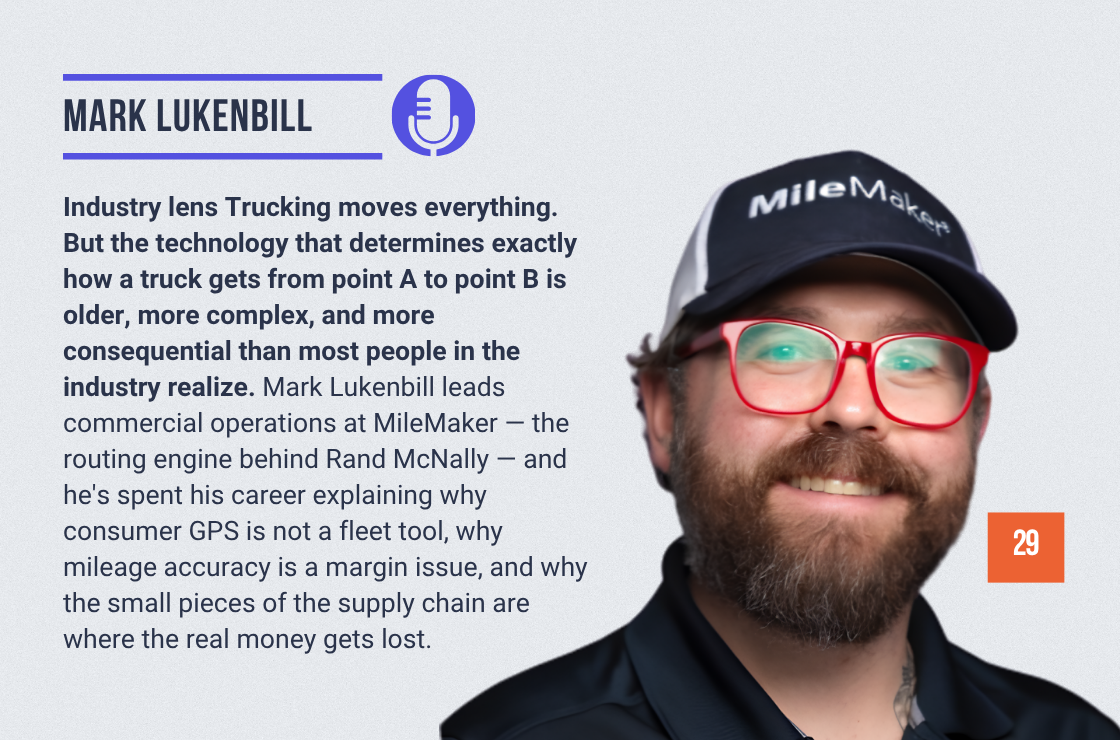
Mark Lukenbill is the Head of Commercial Operations for MileMaker, the commercial mileage and routing technology that powers Rand McNally. He grew up riding along with truck driver uncles across the lower 48, graduated into freight brokerage during the 2008 financial crisis, and has spent the last six-plus years working in transportation technology from TMS and procurement software to railroad operations before landing at one of the most storied names in North American mapping.
Mark Lukenbill leads commercial operations at MileMaker (Rand McNally), bringing a freight-first perspective to the technology that determines how commercial trucks move across North America. With roots in brokerage and a career built on consultative sales and customer-driven product development, he bridges the gap between operational reality and the routing decisions that quietly make or break fleet profitability.
Here’s a glimpse of what you’ll learn:
- [1:51] How summers in an over-the-road cab led to a career in freight technology
- [3:00] Why freight brokerage in 2008 was the gateway to modern transportation tech
- [4:15] What MileMaker is and how it powers commercial routing for Rand McNally
- [6:45] Why Google Maps and Apple Maps are dangerous tools for commercial fleets
- [9:17] The real cost of letting drivers override commercial routing decisions
- [14:34] How MileMaker is building a Bosch integration to add lane maintenance cost data
- [16:26] Why tech stack hygiene reviewing what you actually use could save you thousands
- [18:49] The right way to think about AI in fleet operations: enhancing people, not replacing them
- [28:05] Career advice for anyone entering the freight and transportation industry
In this episode…
Every fleet manager knows the basics of routing: get the truck from A to B as efficiently as possible. What most don’t realize is how much is hiding inside that sentence. Weight restrictions. Bridge heights. Axle limitations. Hazmat exclusions that reroute an entire lane around a major city. The gap between what Google Maps thinks a truck should do and what it actually has to do is where money gets lost, vehicles get damaged, and drivers get frustrated.
Mark Lukenbill has spent his career at that intersection between the data that drives routing decisions and the operators who live with the consequences. As Head of Commercial Operations at MileMaker, the commercial mileage engine behind Rand McNally, he works with shippers, trucking companies, and logistics providers who depend on accurate commercial routing to protect their margins and keep their fleets moving.
In this Roadrageous episode, Mark breaks down why routing is a bigger deal than most people think, what happens when fleets cut corners with consumer-grade GPS tools, how AI should actually be applied in transportation technology, and what it takes to build a tech stack that operators will actually use.
The Routing Gap Nobody Talks About
Ask most people outside the industry how a truck gets from point A to point B and they’ll say: GPS. The same way a car does. It is a reasonable assumption, and it is wrong in ways that cost real money.
Commercial trucks operate under a completely different set of rules than passenger vehicles. Weight restrictions, bridge height clearances, axle load limits, hazardous materials exclusions — all of these variables determine what roads a truck can legally and safely travel. Consumer routing tools like Google Maps and Apple Maps were not built with any of that in mind.
“Google Maps and AI don’t have weight restrictions and axle limitations and bridge heights built in to the entire North American road network. And it’s fine if you want to trust it, but then if a truck hits a bridge where you get a $4,000 fine for going down a road with axle limitations, then was that really worth the less cost?”
The consequences compound quickly. A driver who takes a shortcut through a restricted zone faces fines, potential vehicle damage, and liability exposure. A fleet that tolerates those shortcuts even unknowingly builds the cost into its operating model without ever seeing it as a line item. The problem is invisible until it isn’t.
Mark uses a concrete example that catches people off guard: if you’re hauling paint or chemicals, you cannot route through Indianapolis. There are similar restrictions scattered across the country. No algorithm that doesn’t know that will get you where you need to go safely, legally, or cheaply.
When Drivers Think They Know Better
One of the more persistent challenges in commercial routing is the experienced driver who has run the same lane for twenty years and does not see why anyone needs to tell them how to do their job. It is a reasonable position. It is also one that creates measurable financial problems downstream.
“If their driver is taking a different way and adding miles to the truck, because that’s their preferred route, then their maintenance costs are going to be off, their driver pay is going to be off, it’s going to create all these discrepancies inside the fleet.”
The reason this matters more than most people realize is that shippers, the manufacturers and distributors who control the source of truth for mileage, typically base rates on commercial routing benchmarks. If a trucking company’s driver adds 70 miles to a lane because that is the route they prefer, the company gets paid only for the commercial route. The driver’s preference costs the business real money that shows up nowhere obvious.
MileMaker addresses this not by fighting the drivers, but by building features that make the commercially routed path the easiest path, tools like custom avoidances, toll integrations, and route what-if scenarios that help operators plan lanes before committing rather than discovering discrepancies after the fact.
The Tech Stack Problem: Too Much, Too Little, All Wrong
Across the transportation industry, companies tend to fall into one of two traps when it comes to technology. They either buy everything reactively layering solutions on top of each other until operators are logging into seventeen different tabs every morning with no integration between them or they are still running on legacy systems while their board demands an AI strategy by next quarter.
“Don’t make technology decisions top down, make them bottom up. Talk to the people who are using it and understand what they do on a day-to-day basis and make sure that the tech’s going to fit into that. You can spend hundreds of thousands of dollars on technology, and if your operators don’t use it, then it’s just a cost.”
Mark pushes a discipline he calls tech stack hygiene: a regular, honest review of every tool in a company’s current portfolio. What is it actually doing? Is the business still the same as it was when the contract was signed? Has the vendor added new capabilities that solve a problem the company has been living with?
He points to his own experience: a review of a major CRM contract surfaced thousands in annual savings simply by identifying features the company was paying for but not using. A separate vendor turned out to have already built a solution for a pain point the team had assumed they would need to go out and buy. The technology was already there nobody had looked.
AI That Actually Works: Enhancing the Operator, Not Replacing Them
The pressure to have an AI story is real across every industry, and transportation is no exception. Mark’s view is that most companies are getting the framing wrong asking how to automate their entire operation when they should be asking how to make their people better at their jobs.
“AI is not going to replace humans, but humans using AI will replace those jobs. It comes down to how do you make your people more efficient? So one, you can do a little bit more with less or two, maybe they can bring on additional responsibilities and your business can grow.”
MileMaker built its AI implementation around that principle. The AI agent inside the platform handles quick reference lookups a dispatcher who needs to know the shortest commercial route between two cities does not have to rebuild a full route query; they get an instant answer. The goal is to automate the forty percent of tasks that are purely mechanical, freeing operators to take on more complex work and allowing the business to grow without proportional headcount increases.
The alternative full automation as a goal in itself fails because the complexity of real-world freight operations is irreducible. Weather changes, construction updates, regulatory changes, shipper requirements: all of it requires judgment that a machine cannot fully replicate. The companies that will win with AI are the ones that use it to extend their people’s capacity, not replace their thinking.
Customer Service as the Forgotten Differentiator
Mark makes a point that does not always get enough attention in conversations about technology: the quality of support after the sale matters as much as the product itself. When a routing system goes down mid-dispatch, the ability to reach a knowledgeable human being quickly is not a nice-to-have it is a business continuity issue.
“We don’t have the time to wait on hold for two hours to find a quick answer to a quick problem. Support shouldn’t be that way. We spend a lot of money and a lot of time in support. Our support’s US-based. These guys are industry guys. You don’t call us and get AI prompts that you have to go through for an hour and a half before you talk to a human.”
It is a point that resonates beyond fleet technology. In any vendor relationship, the visibility of that relationship tends to drop to zero until something goes wrong. At that moment, the quality of support response time, depth of knowledge, ability to resolve without escalation becomes the entire value proposition. Mark argues that this is one of the most underweighted criteria in technology purchasing decisions, and one of the ones with the clearest ROI.
Quotable Moments:
- “Google Maps and AI don’t have weight restrictions and axle limitations and bridge heights built in to the entire North American road network.”
- “Don’t make technology decisions top down, make them bottom up. Talk to the people who are using it.”
- “You can spend hundreds of thousands of dollars on technology, and if your operators don’t use it, then it’s just a cost.”
- “AI is not going to replace humans, but humans using AI will replace those jobs.”
- “If you find what you love in this industry, you’re never going to leave. Once freight gets into your blood, it’s hard to get out.”
- “The lucky ones have already had it happen to them back when the mistake was cheaper.”
Action Steps:
- Audit your routing source of truth. Schedule a review of your routing process and verify whether it is based on commercial routing data or consumer GPS defaults. The cost difference often shows up as unexplained fines, maintenance overruns, or driver pay discrepancies.
- Run a tech stack hygiene review. Set up a regular tech stack review at minimum annually. Contact every active vendor and ask what has changed in their product in the last 12 months. You may already own the solution to a problem you have been living with.
- Involve operators in technology decisions. Before purchasing new technology, talk to the operators who will use it daily. Define success in terms of their workflow. If they cannot adopt it, the ROI projection is meaningless.
- Target AI at task automation, not workforce replacement. Apply AI to the 40% of tasks that are purely mechanical lookups, repetitive data entry, standard queries. Measure the capacity this frees up and apply it to higher-value work rather than headcount reduction.
- Assess customer service quality as a procurement criterion. Evaluate vendor support quality before you need it. Find out if support is US-based, industry-knowledgeable, and reachable without a multi-hour queue. This is a business continuity decision, not just a preference.
- Treat vendor relationships as advisory partnerships. Ask every vendor you work with for one piece of advice about how companies in your position get the most out of their product. Consistent curiosity compounds into real competitive advantage over time.
Key Takeaways
- Commercial routing and consumer GPS are fundamentally different tools using the wrong one creates hidden costs in fines, maintenance, and driver pay that rarely surface as obvious line items.
- When shippers set commercial route benchmarks as the basis for payment, drivers who deviate from those routes are costing their own companies money without either party necessarily realizing it.
- Technology adoption fails when decisions are made top-down. Operators who do not understand or believe in a tool simply will not use it, and unused technology is just an expense.
- AI should be measured by how much more effective it makes operators not by how many workflows it eliminates. The goal is capacity growth, not headcount reduction.
- Tech stack hygiene regularly reviewing what you use, what you pay for, and what your vendors have built recently consistently finds savings and surfaces solutions companies already own.
- Customer service quality is an underweighted factor in technology purchasing. The value of fast, knowledgeable support becomes clear at exactly the worst moments.
- The freight and transportation industry rewards people who find their specific niche and go deep whether that is driving, brokerage, technology, or operations.
Conclusion
Mark Lukenbill did not choose freight freight found him at age seven in the back of an over-the-road cab, and it has never really let go. From brokerage to TMS to railroad operations to commercial routing, his career has followed the natural path of someone who genuinely wants to understand how things move, why they move the way they do, and how to make them move better.
At MileMaker, that translates into a product philosophy built around one idea: the small pieces of the supply chain that look unimportant are often the ones where the most money gets quietly lost. Commercial routing is one of those pieces. It sits far down on most fleet managers’ priority lists until a truck hits a bridge, a driver gets a $4,000 fine, or a shipper refuses to pay for miles that were not on the approved route.
For fleet and transportation professionals looking to tighten operations, Mark’s advice is straightforward: audit what you are actually using, talk to the people doing the work, and never assume that a consumer tool is a substitute for industry-grade data. The road between point A and point B is a lot more complicated than it looks.
Resources mentioned in this episode:
About Mark Lukenbill
Mark Lukenbill is the Head of Commercial Operations for MileMaker, the commercial mileage and routing technology platform that powers Rand McNally. He began his career in freight brokerage following the 2008 financial crisis, moved into transportation technology sales across TMS, procurement software, and railroad operations, and has spent the last several years building commercial operations for one of the most established names in North American mapping. He is based in Kansas City and brings a consultative, customer-driven approach to every conversation about how freight moves.
Sponsor
IMPROVLearning — At IMPROVLearning, we are dedicated to transforming driver education through innovative, research-backed training methods. Our SPIDER Driver Training platform combines humor with proven brain-training techniques to help drivers anticipate and avoid dangers on the road. Mark Lukenbill’s point is clear: routing technology can put a truck on the right road, but it’s a trained driver who makes the right decisions when conditions change. SPIDER training develops hazard recognition, space management, and split-second decision-making under pressure. Visit improvlearning.com.
 Learner Login